

Presidential Office spokesperson Charles Chen (陳以信) yesterday blasted president-elect Tsai Ing-wen (蔡英文) for calling President Ma Ying-jeou’s (馬英九) barbs against those criticizing his trip to Itu Aba Island (Taiping Island, 太平島) “inappropriate.”
Ma on Thursday was upset after Democratic Progressive Party (DPP) Legislator Chao Tien-lin (趙天麟) and others condemned his one-day trip to Itu Aba as an unnecessary provocation, saying they should not “hold him back by dragging his feet” when he tried to defend Taiwan’s sovereignty over the island.
Before Ma made the retort, the DPP said that Chao’s remarks were his personal views and the DPP’s official stance originates with Tsai, who maintains Taiwan’s sovereignty over the region and supports freedom of navigation by either airplanes or naval vessels.
Nevertheless, in response to Ma’s comments, Tsai on Friday said that Ma should “face serious issues with a serious attitude; the way he commented on the issue is very inappropriate.”
“If Tsai thought that a DPP lawmaker’s criticism of Ma was right, why did the DPP have to claim that it was Chao’s personal view to distance itself from the remarks? And if Tsai believes [Ma’s trip to the island] should not be condemned, why did she say that Ma’s call for the nation’s support was ‘inappropriate’?” Chen said, adding that Tsai’s self-contradictory logic is hard to understand or support.
Chen said Itu Aba is the territory of the Republic of China and is the largest island with drinkable fresh water among the Spratly Islands (Nansha Islands, 南沙群島), but the island’s legal status is now being seriously challenged by the Philippines, which has attempted to relegate the island’s status to that of a “rock” before the Permanent Court of Arbitration (PCA) in The Hague, the Netherlands, and thereby strip its 200 nautical mile (370km) exclusive economic zone.
The “ridiculous claims” made by the Philippines would deal significant damage to the nation’s rights and interests if acceded, Chen said.
“So was it not the perfect time for President Ma to make a trip in order to voice our deep concerns to the international community and the PCA?” he asked.
“Should President Ma just sit and watch the PCA make a ruling that is against our interests and later be slammed as the president who ‘neglected his duty and humiliated his nation?’” Chen asked.
The challenge by another nation to Itu Aba’s legal status is an extremely serious issue, Chen said, adding that the ruling and opposition parties should present a united front to face the challenge.
“Why does Tsai not condemn inappropriate criticism made from within the DPP? Why does she not, along with Ma, publicly assert to the international community that Itu Aba is an island rather than a rock in her capacity as president-elect?” Chen asked.

Taiwan, which accounts for more than half of the global outsourced semiconductor assembly and testing market, is well-positioned to develop copackaged optics (CPO) and manufacture precision silicon photonics chips, the Ministry of Economic Affairs said yesterday. Silicon photonics are emerging as a mainstream optical communications technology and is seen as key to overcoming bottlenecks in AI computing power. The technology is a key project under the government’s New 10 Major AI Infrastructure Projects, with industry, government, academia and research institutions working to overcome critical technological hurdles and build a self-reliant silicon photonics supply chain, the ministry said. Nvidia Corp in March invested US$4
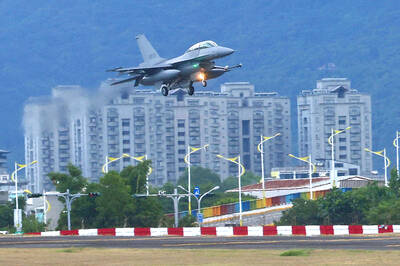
The air force plans to build 26 more hardened aircraft shelters as the number of F-16Vs stationed along Taiwan’s east coast is expected to reach 120 when the final shipment of 66 jets procured from the US arrives. The incoming jets would be stationed at Chihhang Air Base in Taitung County, augmenting the F-16V Block 20s operated by the 5th Tactical Fighter Wing in Hualien County, officials said yesterday. The air force plans to allocate more than NT$6.88 billion (US$218.1 million) from next year to 2031 to build the shelters in Hualien and Taitung as part of the implementation of a “one
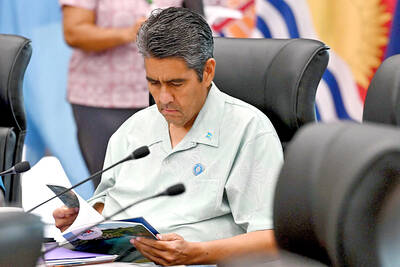
Palau’s president yesterday called for a “unified” Pacific response to a missile test by China in July, while Taiwan and its Pacific allies a day earlier at the Pacific Islands Forum (PIF) reaffirmed their commitment to peace, stability and prosperity. China gave only a handful of nations short notice before test-firing an intercontinental ballistic missile in July, sparking condemnation from several Pacific leaders. The 18-member PIF being held in Palau was expected to release a communique after press time last night, with a formal response to the test possibly included. Palau, which invited Taiwan to attend sideline events as an aid partner, urged
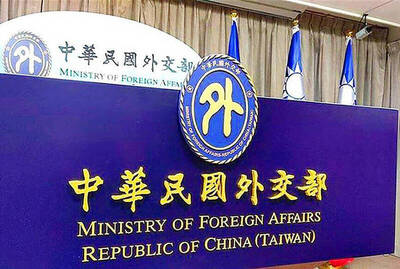
China’s continued efforts to inject geopolitical rivalry into the region and disrupt Pacific nations’ discussions of regional issues warrant greater international attention, a foreign affairs official said yesterday. Minister of Foreign Affairs Lin Chia-lung (林佳龍) last week led a delegation to diplomatic ally Palau to attend events related to the 55th Pacific Islands Forum (PIF) summit. However, the absence of some member-state leaders has been interpreted by some people as a sign of fracturing in Pacific unity. Thirteen PIF members were represented by their heads of state or government, while Fiji, New Caledonia, Vanuatu and Samoa sent ministerial-level representatives, a diplomatic official


 RSS
RSS