


The two people responsible for defacing the artworks donated by Hong Kong actor Jackie Chan (成龍) to the National Palace Museum Southern Branch yesterday defended their actions as a protest against China’s cultural “united front” strategy.
“As far as China is concerned, the 12 zodiac animal heads are antiquities looted from them by foreigners and they must be returned to their rightful owner. Putting copies of the sculptures in Taiwan insinuates that ‘Taiwan is China’s lost property,’” 19-year-old Chen Miao-ting (陳妙婷) and 33-year-old Chen Yi-ting (陳儀庭) said in a statement issued yesterday.
The pair said the statues serve as an expression of China’s political message that “both sides of the Taiwan Strait belong to one family” and that “there is bound to be unification after prolonged division.”
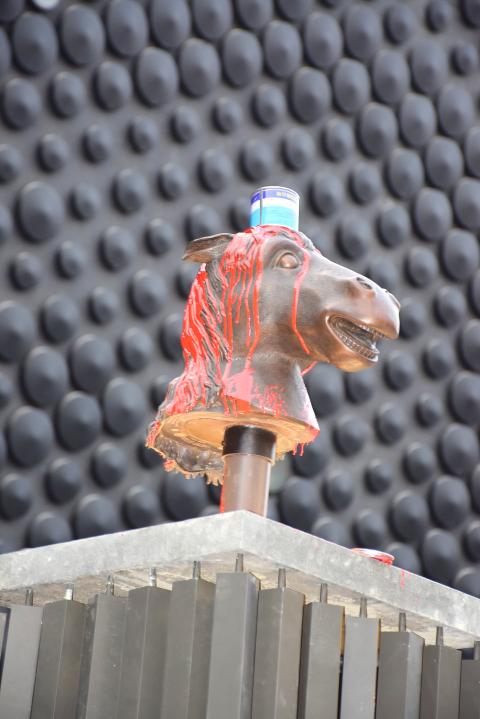
Photo: Wu Shih-tsung, Taipei Times
In addition, the existence of the museum is not only meant to demonstrate the superiority of Zhonghua culture (中華文化) and paint Taiwanese as barbarians, it also signifies foreign colonization, the pair said.
“We refuse to let any objects indicating [China’s] cultural united front strategy or replicas from other cultures be displayed in our arts and cultural palace,” they said.
They demanded that the replicas of the 12 zodiac animal heads be immediately removed from the National Palace Museum Southern Branch, while urging Democratic Progressive Party (DPP) presidential candidate Tsai Ing-wen (蔡英文) to dismiss National Palace Museum Director Feng Ming-chu (馮明珠) should she take office.
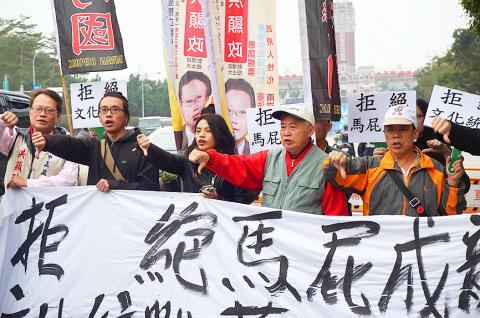
Photo: Tu Chu-min, Taipei Times
Chen Miao-ting and Chen Yi-ting were taken in for questioning by the police on Wednesday evening, hours after they allegedly vandalized the bronze dragon and horse heads with red paint, and sprayed the Chinese characters for “cultural united front” (文化統戰) onto their pedestals.
They were then charged with vandalism and obstructing public officials and referred to the Chiayi District Prosecutors’ Office, which later released them.
The statues are two of the replicas of 12 zodiac sculptures donated by Chan, a member of the Chinese People’s Political Consultative Conference (CPPCC). The originals were looted from China’s Old Summer Palace by British and French forces in 1860.
The animal heads have been on display in the courtyard of the museum in Chiayi County since the venue’s soft opening on Monday.
After the incident, the museum issued a statement on Wednesday saying most of the antiquities it has amassed originated from the Qing Dynasty, which would naturally make them Zhonghua culture artworks.
“If displaying antiquities of Zhonghua culture is tantamount to launching an united front, how are we ever going to run a national museum?” the museum asked, vowing to hold the responsible parties accountable.
Museum official Wang Shih-sheng (王士聖) yesterday said that staff had removed the paint from the statues.
“As the statues are displayed in an open area, it is almost impossible to prevent this sort of vandalism. We urge everyone to adopt a rational attitude toward the museum,” Wang said.
Meanwhile, Hakka hip-hop group Kou Chou Ching (拷秋勤) yesterday defended Chen Miao-ting and Chen Yi-ting on Facebook, saying they should be applauded.
“It was the opening of Taiwan’s new cultural site and you asked Chan, a CPPCC member, to join the opening ceremony? May I ask: What do Chan’s replica animal heads have to do with Taiwanese culture?” Kou Chou Ching wrote.
Additional reporting by CNA

‘NO SECURITY RISK’: The Railway Bureau reassured the public that the technicians’ activities were limited to technical guidance and did not involve sensitive systems The Railway Bureau yesterday said it had invited eight Chinese technicians to assist with an airport MRT construction project. The bureau issued the confirmation after an Internet user said Chinese nationals had entered the construction zone of Taiwan Taoyuan International Airport’s Terminal 3 project. They asked why “individuals from an enemy state” were allowed access to such a major national infrastructure project, which raised serious concerns over Taiwan’s industrial safety, sensitive systems and information security. The bureau’s Northern Region Engineering Branch Office said subcontractor Taiwan Handle Industrial Co (台灣手把工業) of the Taoyuan airport MRT’s “Contract No. CU05 Project A14 Station Civil, MEP &

A US uncrewed surface vessel (USV) encountered multiple Chinese warships during an autonomous transit of the Taiwan Strait, US defense company Seasats said in a statement on Wednesday. Seasats announced that a Lightfish USV had completed the first autonomous transit of the Taiwan Strait. Over five days, the USV traversed the entire length of the Strait while constantly monitoring surface vessel traffic, the company said. The Lightfish encountered multiple Chinese warships, one of which was a Chinese People’s Liberation Army Navy (PLAN) Type 056 corvette, it said. The Chinese vessels were operating “well within Taiwan’s exclusive economic zone without transmitting their identity via the
GREATER REACH? Auto parts and wood products would face tariffs of up to 15%, matching those targeting the EU, Japan and South Korea, Vice Premier said The US has announced that preferential tariff treatment for Taiwan’s non-semiconductor Section 232 goods would take effect retroactively from May 1, the Executive Yuan said yesterday. The US government yesterday posted a notice on the Federal Register’s public inspection Web site previewing tariff concessions for Taiwan under a memorandum of understanding (MOU) on Taiwan-US investment after two months of negotiations. The MOU signed on Jan. 15 stipulated three major preferential tariff arrangements: a 15 percent “reciprocal” tariff rate for Taiwan without stacking most-favored nation (MFN) rates; preferential Section 232 treatment for semiconductors and related products; and preferential Section 232 treatment for non-semiconductor

TIT-FOR-TAT: The US allegedly revoked the visa of a Chinese national working at Xinhua News Agency in the US in response to Beijing’s expulsion of Vivian Wang The Presidential Office yesterday condemned China for expelling a New York Times correspondent from Beijing following the newspaper’s interview with President William Lai (賴清德), saying the move highlighted Beijing’s suppression of press freedom and its threat to international news media. Taiwan has noted a series of recent incidents in which Beijing used similar tactics to “threaten and pressure international media outlets and journalists,” Presidential Office spokeswoman Karen Kuo (郭雅慧) said in a statement. “This concerns not only press freedom and freedom of expression, but also the safety of journalists, and Taiwan and relevant partners are paying close attention to the situation,” she


 RSS
RSS