


Chinese hackers have allegedly attacked Taiwanese targets, including local news organizations and the Democratic Progressive Party (DPP), in a bid to get information about policies and speeches ahead of next month’s presidential and legislative elections.
An attack on the unnamed media outlets came in the form of phishing e-mails with the subject line “DPP’s Contact Information Update,” according to research by security company FireEye, which identified a Chinese state-backed group called APT16 as carrying out the attacks.
Hackers also infiltrated e-mails of party staff, changing security protocols and writing messages spoofing the account holders in what might have been an attempt to deliver malicious code, according to one of the victims.
Opinion polls show the DPP is likely to win a legislative majority in the Jan. 16 elections, with DPP Chairperson Tsai Ing-wen (蔡英文) expected to secure the presidency after eight years of Chinese Nationalist Party (KMT) rule.
China is wary of the DPP’s views on Taiwanese independence and advocacy of more caution in its relationship with China.
As well as not wanting the DPP in power, China might want to understand the party better to be able to undermine it with access to non-public information, FireEye principal threat intelligence analyst Jordan Berry said by telephone.
“There’s a lot of people in China who want and need information for their own intelligence purposes,” Berry said.
The Chinese Ministry of Foreign Affairs did not reply to a faxed request for comment.
Another target appears to be former American Institute in Taiwan director William Stanton, who said he has received multiple warnings from Google that his Gmail account might be targeted by government hackers.
“If you were directed to this page from a warning displayed above your Gmail inbox, we believe that state-sponsored attackers may be attempting to compromise your account or computer,” the warning read, without identifying the nation. “It’s likely that you received e-mails containing malicious attachments, links to malicious software downloads, or links to fake Web sites that are designed to steal your passwords or other personal information.”
Stanton, who was the agency’s director from 2009 to 2012 in a position akin to ambassador, told Bloomberg News he believes he is being targeted because of his former role, as well as his current position as director of National Tsing Hua University’s Center for Asia Policy.
While the DPP has been under attack for months, the frequency of attacks has increased in the past few weeks, said DPP deputy director of international affairs Ketty Chen (陳婉宜), who was among as many as 50 DPP staff targeted by hackers. She said she was alerted when she noticed inconsistencies in the writing style of a colleague in internal correspondence.
“There were fake e-mails that looked like they came from her,” Chen said. “When I read it, the style was not how she would write, so I called to ask if she really sent them, and she said that she had not.”
Chen received e-mails purporting to come from Tsai’s speechwriter and another from a member of the DPP’s cross-strait policy team. In each case, the e-mail asked the recipient to open an attachment purporting to be a draft document.
Hackers typically send e-mails to targets hoping they open attachments loaded with malware that infiltrate their computers, providing links to colleagues’ computers and contacts.
Due to concerns over the security of their work accounts, some DPP staff switched to Gmail, Chen said. Chen’s Gmail account was compromised when hackers turned off the two-step identification verification process by deleting her mobile number and adding a forwarding address so that all incoming e-mails went to an external Gmail account.
The allegations come weeks after China’s state-run Xinhua news agency reported that an investigation into an alleged theft of data from the US Office of Personnel Management had shown the attack was carried out by criminals, rather than being state-sponsored as previously suspected by the US government.
DPP spokesman Wang Min-sheng (王閔生) said that, to prevent leaks of confidential information, the party must take data security measures, such as never transmitting classified information via the internet.
Additional reporting by Su Feng-ho

‘NO SECURITY RISK’: The Railway Bureau reassured the public that the technicians’ activities were limited to technical guidance and did not involve sensitive systems The Railway Bureau yesterday said it had invited eight Chinese technicians to assist with an airport MRT construction project. The bureau issued the confirmation after an Internet user said Chinese nationals had entered the construction zone of Taiwan Taoyuan International Airport’s Terminal 3 project. They asked why “individuals from an enemy state” were allowed access to such a major national infrastructure project, which raised serious concerns over Taiwan’s industrial safety, sensitive systems and information security. The bureau’s Northern Region Engineering Branch Office said subcontractor Taiwan Handle Industrial Co (台灣手把工業) of the Taoyuan airport MRT’s “Contract No. CU05 Project A14 Station Civil, MEP &

A US uncrewed surface vessel (USV) encountered multiple Chinese warships during an autonomous transit of the Taiwan Strait, US defense company Seasats said in a statement on Wednesday. Seasats announced that a Lightfish USV had completed the first autonomous transit of the Taiwan Strait. Over five days, the USV traversed the entire length of the Strait while constantly monitoring surface vessel traffic, the company said. The Lightfish encountered multiple Chinese warships, one of which was a Chinese People’s Liberation Army Navy (PLAN) Type 056 corvette, it said. The Chinese vessels were operating “well within Taiwan’s exclusive economic zone without transmitting their identity via the
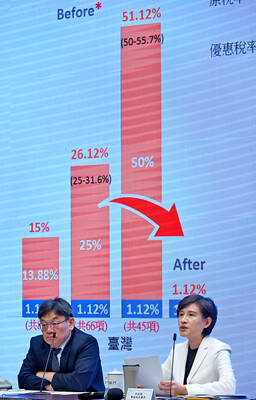
GREATER REACH? Auto parts and wood products would face tariffs of up to 15%, matching those targeting the EU, Japan and South Korea, Vice Premier said The US has announced that preferential tariff treatment for Taiwan’s non-semiconductor Section 232 goods would take effect retroactively from May 1, the Executive Yuan said yesterday. The US government yesterday posted a notice on the Federal Register’s public inspection Web site previewing tariff concessions for Taiwan under a memorandum of understanding (MOU) on Taiwan-US investment after two months of negotiations. The MOU signed on Jan. 15 stipulated three major preferential tariff arrangements: a 15 percent “reciprocal” tariff rate for Taiwan without stacking most-favored nation (MFN) rates; preferential Section 232 treatment for semiconductors and related products; and preferential Section 232 treatment for non-semiconductor

The National Chungshan Institute of Science and Technology yesterday showcased its locally developed variants of the Vision 60 robotic patrol dog, which it plans to deploy on the nation’s outlying territories in the South China Sea. The variants were produced under the Joint Lab project — created by the institute and domestic companies — and assembled with domestically produced motors, lenses and artificial intelligence (AI) systems alongside licensed tech from the US, Missile and Rocket Systems Research Division deputy director Jen Kuo-kang (任國光) told the media event at a military base in Taipei’s Dazhi (大直) area. Taiwan has built up its strengths


 RSS
RSS