


Democratic Progressive Party (DPP) presidential candidate Tsai Ing-wen’s (蔡英文) support rating has exceeded 50 percent for the first time, buoyed by her choice of former Academia Sinica vice president Chen Chien-jen (陳建仁) as her running mate, while scandal-dogged Chinese Nationalist Party (KMT) vice presidential candidate Jennifer Wang (王如玄) is widely unpopular among voters, according to a survey released by the Cross-Strait Policy Association (CSPA) yesterday.
The poll, conducted on Sunday and Monday among Taiwanese aged 20 and older, showed that the Tsai-Chen ticket garnered a support rating of 52.6 percent, up from the 48.6 percent the DPP chairperson received in the previous poll released on Nov. 8 — eight days before she confirmed Chen as her running mate.
By comparison, only 20.1 percent of respondents backed KMT presidential candidate Eric Chu (朱立倫) and Wang, down from the 21.4 percent Chu received in last month’s poll.
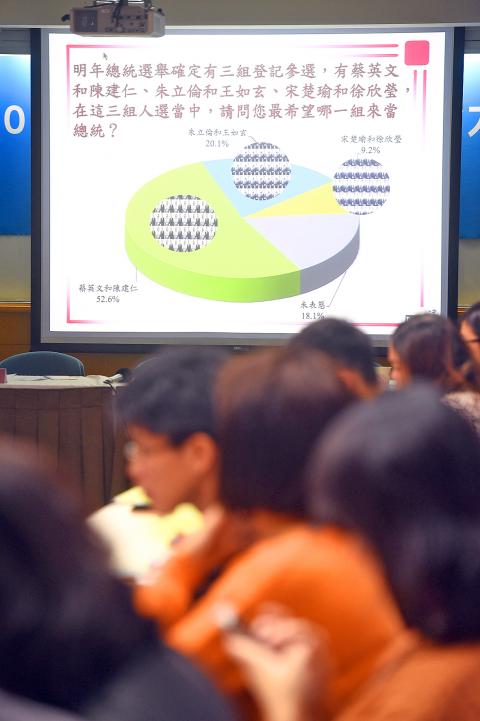
Photo: George Tsorng, Taipei Times
People First Party (PFP) presidential candidate James Soong’s (宋楚瑜) support rating edged up to 9.2 percent from last month’s 8.3 percent, after teaming up with the Republican Party and selecting its chairperson, Hsu Hsin-ying (徐欣瑩), as his running mate late last month.
The majority of respondents, regardless of political affiliation, believed that Tsai would win the Jan. 16 election, with 96.5 percent of pan-green respondents, 70.2 percent of pan-blue supporters and 67.7 percent of swing voters throwing their support behind her.
Asked how they felt about the three vice presidential candidates, 53.7 percent of respondents said they view Chen favorably, followed by Hsu at 27.2 percent and Wang at 12.3 percent.
Due presumably to the snowballing controversy surrounding Wang’s speculative sales of military housing units, 63.4 percent of those polled said they disapproved of Wang, compared with 22 percent for Hsu and 11.5 percent for Chen.
Even pan-blue voters perceived Wang as an undesirable candidate, with 48.5 percent indicating they disliked her, while 26.2 percent thought otherwise.
Asked about Wang’s involvement in the housing controversy, 68.1 percent said that her speculative activities were inappropriate, while 63 percent disagreed with her explanation that her transactions of government-subsidized military housing units were neither illegal nor reflected any moral defect.
The poll also showed that 66.1 percent of respondents were unsatisfied with the way she has handled the controversy.
The survey collected 1,076 valid samples. It has a confidence level of 95 percent and a margin of error of 2.99 percentage points.
Cross-Strait Policy Association deputy director-general Tan Yao-nan (譚耀南) said the polling results suggested that Chen was conducive to Tsai’s campaign, while Wang could drag down Chu’s already dismal election prospects.
“The KMT leadership cannot remain inactive or mum about Wang’s speculative sales of military housing, which has evolved into an issue of social and distributive justice. They must take the matter seriously to prevent the KMT from collapsing in the post-election era,” Tan told a press conference in Taipei.
Chiu Chui-cheng (邱垂正), an assistant professor at National Quemoy University’s Department of International and Mainland China Affairs, said the KMT should be alarmed by the fact that 81.3 percent of respondents who are public servants, teachers, military personnel or police — groups traditionally viewed as pro-blue camp — were dissatisfied with Wang’s handling of the housing scandal.
“In addition, nearly 92 percent of students and 83 percent of professionals polled also described Wang’s management of the controversy as unsatisfactory,” Chiu said.
Former DPP legislator Lin Cho-shui (林濁水) said Chu’s selection of Wang as his running mate could undermine the KMT’s voter base, which generally includes residents of Taipei, New Taipei City and Keelung, as well as public servants.
“A cross-analysis of the results showed that just 9.8 percent of respondents living in the three administrative regions and 7.3 percent of public servants support Wang,” Lin said.
Despite Wang’s long-term experience as a lawyer and former minister of the Council of Labor Affairs, Lin said only 3.5 percent of industry specialists and 11 percent of workers favored her.

‘NO SECURITY RISK’: The Railway Bureau reassured the public that the technicians’ activities were limited to technical guidance and did not involve sensitive systems The Railway Bureau yesterday said it had invited eight Chinese technicians to assist with an airport MRT construction project. The bureau issued the confirmation after an Internet user said Chinese nationals had entered the construction zone of Taiwan Taoyuan International Airport’s Terminal 3 project. They asked why “individuals from an enemy state” were allowed access to such a major national infrastructure project, which raised serious concerns over Taiwan’s industrial safety, sensitive systems and information security. The bureau’s Northern Region Engineering Branch Office said subcontractor Taiwan Handle Industrial Co (台灣手把工業) of the Taoyuan airport MRT’s “Contract No. CU05 Project A14 Station Civil, MEP &

The National Chungshan Institute of Science and Technology yesterday showcased its locally developed variants of the Vision 60 robotic patrol dog, which it plans to deploy on the nation’s outlying territories in the South China Sea. The variants were produced under the Joint Lab project — created by the institute and domestic companies — and assembled with domestically produced motors, lenses and artificial intelligence (AI) systems alongside licensed tech from the US, Missile and Rocket Systems Research Division deputy director Jen Kuo-kang (任國光) told the media event at a military base in Taipei’s Dazhi (大直) area. Taiwan has built up its strengths

NOT IMMEDIATE: Taiwan has a chance to appeal the proposed 10 percent tariff before it starts, while other countries face a 12.5 percent tariff from the trade office Taiwan is among 60 economies determined by the US to have failed to impose or enforce a ban on the importation of goods produced with forced labor, according to a notice released on Tuesday by the Office of the US Trade Representative (USTR), which proposed imposing an additional 10 percent or more tariff on them. The USTR in a statement said that following an investigation, it had determined under Section 301 of the Trade Act of 1974 that the failure of the 60 economies to impose and effectively enforce a prohibition on the importation of goods produced with forced labor is

TIT-FOR-TAT: The US allegedly revoked the visa of a Chinese national working at Xinhua News Agency in the US in response to Beijing’s expulsion of Vivian Wang The Presidential Office yesterday condemned China for expelling a New York Times correspondent from Beijing following the newspaper’s interview with President William Lai (賴清德), saying the move highlighted Beijing’s suppression of press freedom and its threat to international news media. Taiwan has noted a series of recent incidents in which Beijing used similar tactics to “threaten and pressure international media outlets and journalists,” Presidential Office spokeswoman Karen Kuo (郭雅慧) said in a statement. “This concerns not only press freedom and freedom of expression, but also the safety of journalists, and Taiwan and relevant partners are paying close attention to the situation,” she


 RSS
RSS