


President Ma Ying-jeou (馬英九) yesterday urged the public to remain calm after Taiwan’s national flag appeared in a new video purportedly released by the Islamic State (IS) group on Tuesday.
“I exchanged opinions with Premier Mao Chi-kuo (毛治國) in the morning and instructed the national security agencies and the Executive Yuan to implement preventive measures to protect Taiwanese from terror attacks, whether they occur at home or abroad,” Ma said.
Ma said people should refrain from panicking and those planning to travel abroad should remain vigilant.
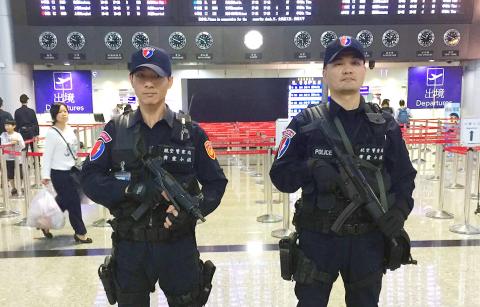
Photo: CNA
The Ministry of Foreign Affairs will also release relevant security information to better prepare people for their overseas journeys, Ma said.
Ma made the remarks yesterday morning during a visit to a Taiwan Semiconductor Manufacturing Co facility in Taichung, one day after the publication of a video titled “No Respite,” allegedly produced by the IS.
The video features the national flags of 60 of the 65 members of the US-led coalition against the IS, including that of Taiwan, the US, the UK and Japan. Its background narrator calls on the coalition members to “bring it on,” threatening to let the “flame of war” burn them in the “hills of death.”
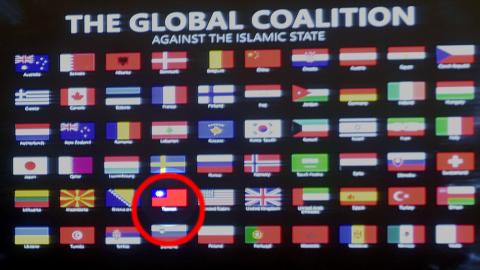
Photo: Wang Min-wei, Taipei Times
It came after US President Barack Obama mentioned Taiwan as a member of the anti-IS international coalition during a speech on Sunday at the East Asia summit in Kuala Lumpur.
Ma said anti-terrorism efforts not only include armed confrontation, but also humanitarian aid, as demonstrated by Taiwan’s donation of 350 prefabricated houses to Syrian refugees last year.
“The efforts cover a wide range of aspects and do not target the IS solely,” Ma said.
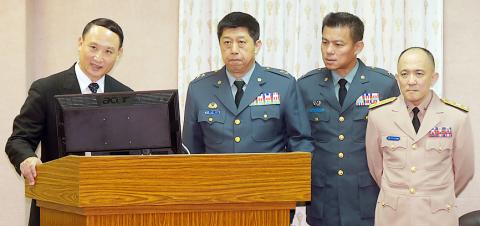
Photo: Wang Min-wei, Taipei Times
Ministry spokesperson Eleanor Wang (王珮玲) said that it has notified all of Taiwan’s overseas representative offices to launch an emergency response system, step up their anti-terror and security efforts and adopt extra vigilance when issuing visas to foreigners.
“In terms of its role in the global anti-terror effort, Taiwan has merely provided humanitarian aid and emergency rescue assistance,” Wang said.
However, Wang declined to confirm rumors that Representative to the US Shen Lyu-shun (沈呂巡) attended an anti-terrorism meeting held by the US Department of State on Tuesday to discuss expanding the global coalition against the IS.
In the legislature, Minister of the Interior Chen Wei-zen (陳威仁) echoed the president by calling on the public “not to panic, as we have always called for peace.”
Chen said that Taiwan’s effort in the so-called “anti-terror coalition” has been providing humanitarian aid for refugees, and emergency assistance and information exchange in terms of international cooperation.
“Muslims in Taiwan are in a good and friendly relationship with [other religious groups] and receive equal treatment,” Chen said.
The conflict surrounding “IS is mainly a religious one,” Chen said.
The minister of the interior said that while there has been no report about suspicious individuals’ entering the nation, security and cargo checks at airports and ports and border management will be stepped up, with the help of information exchange with other countries.
National Policy Agency Director-General Chen Kuo-en (陳國恩) said the nation’s counterterror mechanism is comprised of two levels: The National Security Council and the National Security Bureau are in charge of the national security level, and the Executive Yuan’s Office of Homeland Security is in charge of the administrative level, and if incidents involving violent assaults take place, the police would counteract with emergency squads.
In the event of a domestic terror attack, the Wei-An Special Services Commando Unit would be prepared, as it has done anti-terror exercises with forces from Singapore, France and the US, Chen Kuo-en said.
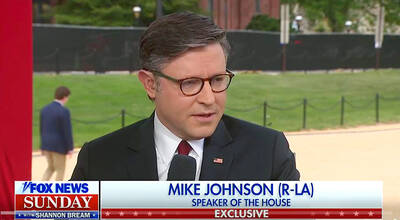
RESOLUTE BACKING: Two Republican senators are planning to introduce legislation that would impose immediate sanctions on China if it attempts to invade Taiwan US House of Representatives Speaker Mike Johnson on Sunday reaffirmed US congressional support for Taiwan, saying the US and “all freedom-loving people” have a stake in preventing China from seizing Taiwan by force. Johnson made the remarks in an interview with Fox News Sunday on US President Donald Trump’s summit with Chinese President Xi Jinping (習近平) last week. In an interview that aired on Friday on Fox News, just as Trump wrapped up a high-stakes visit to China, he said he has yet to green-light a new US$14 billion arms package to Taiwan and that it “depends on China.” “It’s a very good
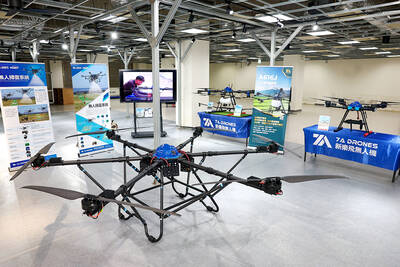
DRONE CENTRAL: Taiwan aims to become Asia’s democratic hub for drones, with most exports focused on high-quality military-grade models, an official said Taiwan’s drone industry is expected to expand significantly by 2030, producing 100,000 units per month and exporting half of them, the Ministry of Economic Affairs said yesterday. Current drone production capacity is about 15,000 units per month, but the industry can quickly scale up as demand increases, Industrial Development Administration Director-General Chiou Chyou-huey (邱求慧) told a news conference in Taipei. Taiwan’s drone output grew 2.5-fold last year to NT$12.9 billion (US$408.3 million) under a government program to develop the uncrewed vehicle sector, he said. The Executive Yuan in October last year approved plans to invest NT$44.2 billion into domestic production of uncrewed aerial
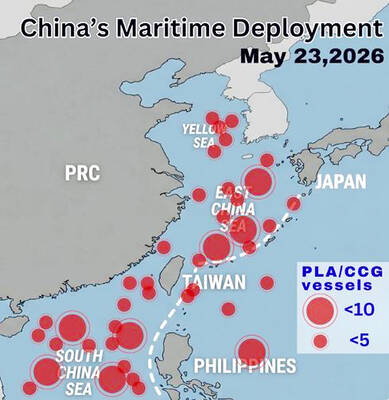
WARNING: China should stop engaging in actions that undermine regional peace and stability, as it would only build resentment among people across the Strait, the CGA said China has deployed more than 100 navy, coast guard and other vessels in waters from the Yellow Sea to the South China Sea and the western Pacific since US President Donald Trump and Chinese President Xi Jinping (習近平) met in Beijing, National Security Council Secretary-General Joseph Wu (吳釗燮) said yesterday. “In this part of the world, #China is the one & only PROBLEM wrecking the #StatusQuo & threatening regional peace & stability,” Wu wrote on X. In a separate post, he said Beijing was coercing Taiwan’s maritime domain, calling it illegal and provocative, after the Coast Guard Administration (CGA) expelled a
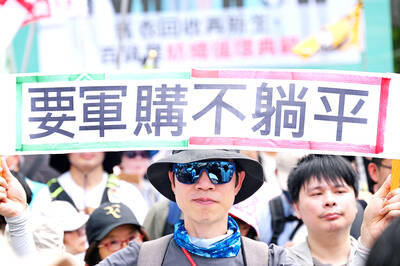
More than 8,000 people took part in a rally in Taipei yesterday to express support for more defense spending, after the opposition slashed the Cabinet’s proposed NT$1.25 trillion (US$39.6 billion) special defense budget and capped it at NT$780 billion. The demonstrators urged the Cabinet to propose another bill. Taiwan Economic Democracy Union convener Lai Chung-chiang (賴中強) said the main problem of the passed budget plan is the removal of funding for critical items, not just that the total amount is smaller. Critical budget items included purchasing or developing uncrewed vehicles, Strong Bow (強弓) missile systems, additional ammunition, artificial intelligence-powered combat systems and Taiwan-US


 RSS
RSS