


Taiwan’s representative to this year’s Miss Earth contest yesterday expressed gratitude to her fans after she was ejected from the pageant for refusing to wear a sash that read “Chinese Taipei” and instead wearing one marked “Taiwan ROC.”
“I feel very appreciative to all the people who have encouraged me. Now that I have been suspended from the contest and have returned to my hotel, I have had more time to think it over,” the 22-year-old Ting Wen-yin (丁文茵) said on Facebook.
“Despite all these difficulties, I still feel grateful that this contest made me more mature and gave me a broader view of the world,” she wrote.
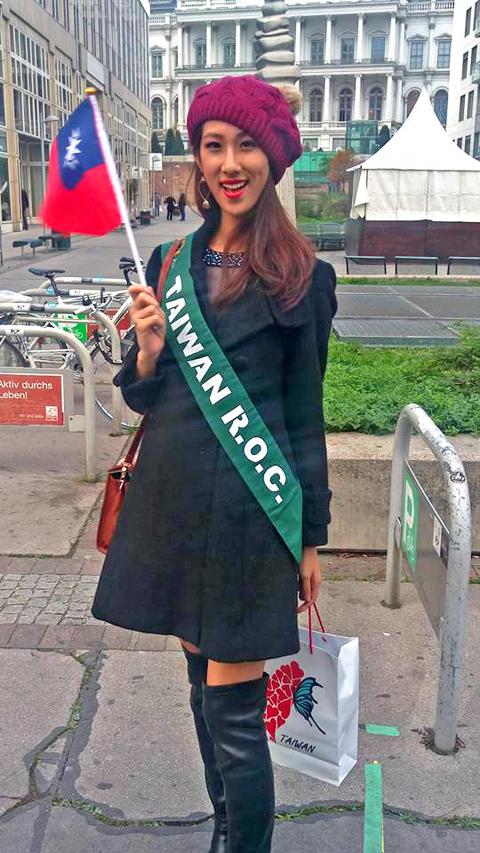
Photo: Screenshot from Facebook
Ting, who was representing Taiwan at the Miss Earth pageant in Vienna, two days earlier revealed that she originally wore a sash given to her by the organizers upon her arrival in Vienna that read “Taiwan ROC” — referring to Taiwan’s formal name, the Republic of China.
However, the organizers later asked Ting to replace her sash with another that read “Chinese Taipei” — the name used in most international events because of pressure from China — claiming that the original sash was misprinted by the event staff, Ting said.
Insisting that she was born in Taiwan and was representing Taiwan, Ting refused to change her sash and was banned from attending the pageant on Monday, while photographers were told not to take her picture, she added.
Ministry of Foreign Affairs spokeswoman Eleanor Wang (王珮玲) said that Ting was forced to replace her sash due to pressure from China.
Wang said that Taiwan’s Chinese International Beauty Pageants Association (中華國際選美發展交流協會), which sent Ting to Vienna, told the ministry that Ting would continue to compete in the pageant using the name “Chinese Taipei.”
Founded in 2001, the Miss Earth pageant is held to promote environmental awareness, empower women worldwide and support international environmental organizations.
This year’s competition, which had 87 contestants, runs from Wednesday last week to Dec. 5, according to the event’s Web site.
The winner of the pageant is to serve as an ambassador in environmental protection campaigns worldwide.
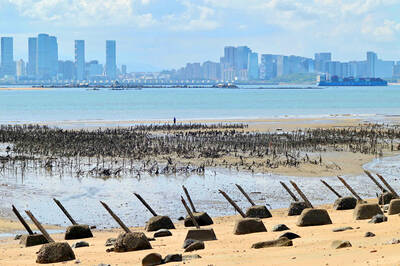
THREATS: Naval facilities have been built in Shanghai and Zhejiang, while airbases have been expanded in Xiamen, Fuzhou and Zhangpu, across the Strait from Taiwan The Chinese Communist Party (CCP) is building large-scale military infrastructure at five sites along the eastern coast of China, the Mainland Affairs Council (MAC) said in a recent report. The latest issue of the council’s Mainland China Situation Quarterly said satellite photos showed military infrastructure such as air force and naval bases being constructed along the eastern coast of China. That means the CCP might be preparing for potential conflict in Taiwan, it said, adding that there are five such construction sites from north to south. A naval base has been built in Shanghai’s Pudong New Area, with underground oil storage tanks, railway
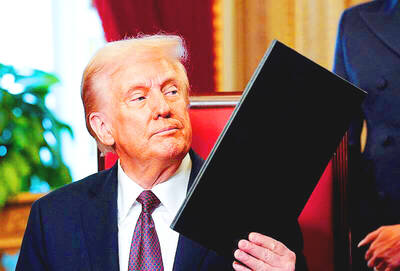
MILESTONE: The foreign minister called the signing ‘a major step forward in US-Taiwan relations,’ while the Presidential Office said it was a symbol of the nations’ shared values US President Donald Trump on Tuesday signed into law the Taiwan Assurance Implementation Act, which requires the US Department of State to regularly review and update guidelines governing official US interactions with Taiwan. The new law is an amendment to the Taiwan Assurance Act of 2020 focused on reviewing guidelines on US interactions with Taiwan. Previously, the state department was required to conduct a one-time review of its guidance governing relations with Taiwan, but under the new bill, the agency must conduct a review “not less than every five years.” It must then submit an updated report based on its findings “not later
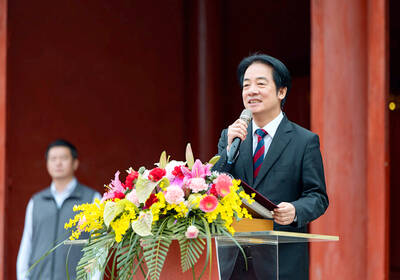
GIVE BACK: The president thanked immigrants, recounting heartwarming stories, from a gymnast helping athletes shine internationally to a spouse helping the disadvantaged There is no need to amend the law to exempt Chinese spouses from single allegiance to the Republic of China (ROC), President William Lai (賴清德) said yesterday, adding that such changes would only increase the public’s doubts toward new residents from China and would not improve social harmony. Taiwan is a democratic, diverse and free country, he said. “No matter which ethnic group you belong to, where you come from or when you arrive, as long as you identify with Taiwan, you are masters of this country,” he said. Taiwan is a democratic nation that follows the rule of law, where immigrants are
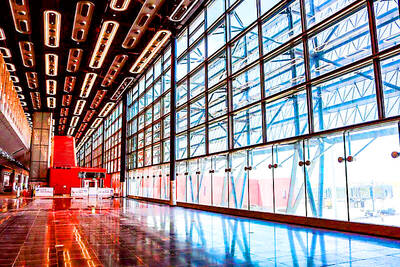
A trial run of the north concourse of Taiwan Taoyuan International Airport’s new Terminal 3 is to commence today, the Ministry of Transportation and Communications said yesterday. The eight additional boarding gates would allow for more aircraft parking spaces that are expected to boost the airport’s capacity by 5.8 million passengers annually, Deputy Minister of Transportation and Communications Lin Kuo-shian (林國顯) said. The concourse, designed by a team led by British architect Richard Rogers, provides a refreshing space, Lin said, adding that travelers would enjoy the tall and transparent design that allows sunshine to stream into the concourse through glass curtain walls. The


 RSS
RSS