


Controversy erupted yesterday over Taipei, New Taipei City and Keelung’s declaration late on Monday night that yesterday would be a full typhoon day, with Taipei Mayor Ko Wen-je (柯文哲) saying that he was “ashamed” an extra typhoon day had been called.
The three municipalities announced at 8pm on Monday that work and schools would be canceled for half a day yesterday morning. However, two hours later, they announced the entire day would be a typhoon day.
The absence of rain and wind yesterday morning led reporters to question Ko about the appropriateness of a second typhoon day due to Typhoon Dujuan.
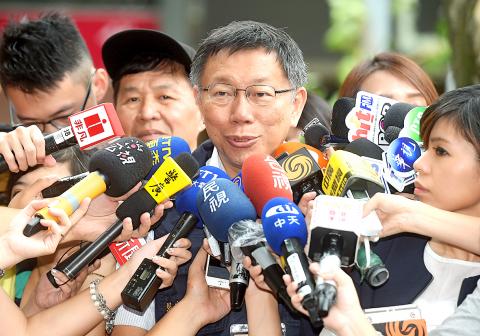
Photo: Chien Jung-fong, Taipei Times
“I feel ashamed — an apology is owed to the public for a typhoon holiday being declared for this kind of weather,” he said.
He said the 8pm decision had been made by the departments of the three municipalities based on data provided by the Central Weather Bureau.
“I just took a look and said okay, but the result is that city residents are pretty dissatisfied,” he said.
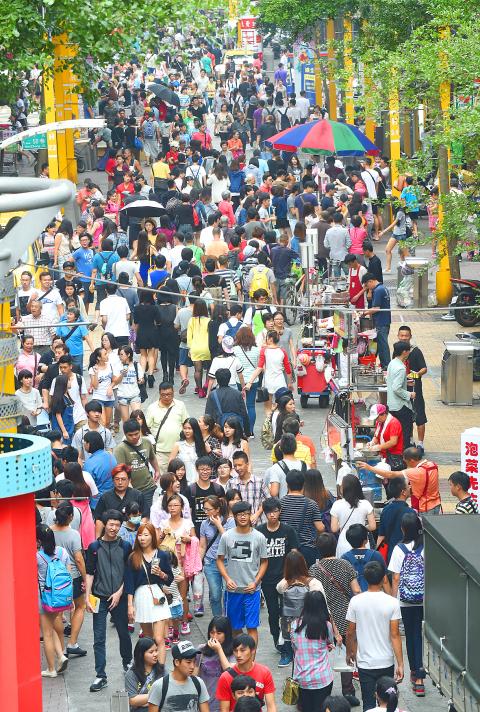
Photo: Liu Hsin-de, Taipei Times
The three cities should collectively bear responsibility for the decision, he said.
Sources said the 8pm decision was based on data that showed that New Taipei City would “brush” the edge of the wind speed standard for canceling classes and work, while Taipei did not meet the standard.
Ko said there was no precedent for starting work and classes in the afternoon after a typhoon holiday, adding that the situation yesterday was also unusual because it would have been the first working day following a long weekend.
Ko confirmed that New Taipei City Mayor Eric Chu (朱立倫) of the Chinese Nationalist Party (KMT) had called him on Monday night, but said that more than half of the telephone call had simply been “chatting.”
He denied that the call to alter the decision had been made by one person or because of public pressure.
The decision was made because the high-speed rail and Taiwan Railways Administration trains were only scheduled to resume service yesterday afternoon, which meant that people who had traveled south or to the east coast to visit relatives for the Mid-Autumn Festival would not be able to get to work in the morning, Ko said.
The three municipalities would continue to make decisions about typhoon holidays together, he said.
In New Taipei City, Chu said the decision to declare a full day off was based on post-Mid-Autumn Festival traffic conditions and the need to clean roads and sidewalks of debris left by the storm.
As for rumors that his government only wanted half a typhoon day, Chu said the decision to declare a full day had been made by all three municipalities.
However, Keelung Mayor Lin Yu-chang (林右昌) of the Democratic Progressive Party expressed a different view on the decisionmaking process.
He said New Taipei City was to blame for the 8pm announcement, and that he had only been told about the half-day plan at 7:45pm.
Lin said that he and Ko both had reservations about the plan, but had been unable to contact Chu before New Taipei City announced it.
From now on, Keelung would make its own decision about typhoon days, rather than just going along with Taipei and New Taipei City’s decisions, he said.
The other two cities should listen to Keelung’s view before making their own decision and expecting Keelung to fall in line, he said.
Taipei city councilors and parent groups blasted the decisionmaking process, saying that the “flip-flops” had created uncertainty.
Taipei City Councilor Kuo Chao-yan (郭昭巖) of the KMT said that Ko should learn from this experience to get a better grip on public opinion and disaster situations to ensure a more “thorough” decisionmaking process in the future.
Additional reporting by Liang Pei-chi
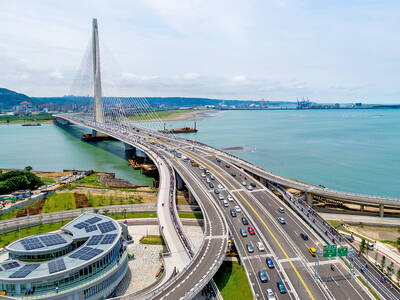
The Ministry of Transportation and Communications yesterday inaugurated the Danjiang Bridge across the Tamsui River in New Taipei City, saying that the structure would be an architectural icon and traffic artery for Taiwan. Feted as a major engineering achievement, the Danjiang Bridge is 920m long, 211m tall at the top of its pylon, and is the longest single-pylon asymmetric cable-stayed bridge in the world, the government’s Web site for the structure said. It was designed by late Iraqi-British architect Zaha Hadid. The structure, with a maximum deck of 70m, accommodates road and light rail traffic, and affords a 200m navigation channel for boats,
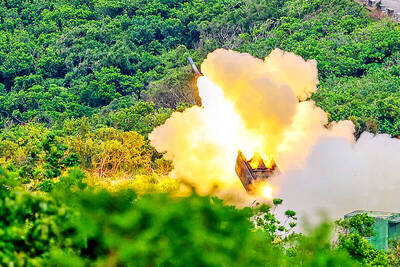
PRECISION STRIKES: The most significant reason to deploy HIMARS to outlying islands is to establish a ‘dead zone’ that the PLA would not dare enter, a source said A High Mobility Artillery Rocket System (HIMARS) would be deployed to Penghu County and Dongyin Island (東引) in Lienchiang County (Matsu) to force the Chinese military to retreat at least 100km from the coastline, a military source said yesterday. Taiwan has been procuring HIMARS and Army Tactical Missile Systems (ATACMS) from the US in batches. Once all batches have been delivered, Taiwan would possess 111 HIMARS units and 504 ATACMS, which have a range of 300km. Considering that “offense is the best defense,” the military plans to forward-deploy the systems to outlying islands such as Penghu and Dongyin so that

Taiwan Semiconductor Manufacturing Co (TSMC, 台積電), the world’s largest foundry service provider, yesterday said that global semiconductor revenue is projected to hit US$1.5 trillion in 2030, after the figure exceeds US$1 trillion this year, as artificial intelligence (AI) demand boosts consumption of token and compute power. “We are still at the beginning of the AI revolution, but we already see a significant impact across the whole semiconductor ecosystem,” TSMC deputy cochief operating officer Kevin Zhang (張曉強) said at the company’s annual technology symposium in Hsinchu City. “It is fair to say that in the past decade, smartphones and other mobile devices were
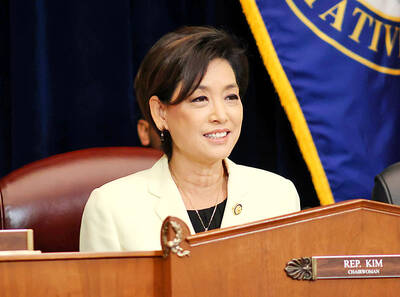
‘CLEAR MESSAGE’: The bill would set up an interagency ‘tiger team’ to review sanctions tools and other economic options to help deter any Chinese aggression toward Taiwan US Representative Young Kim has introduced a bill to deter Chinese aggression against Taiwan, calling for an interagency “tiger team” to preplan coordinated sanctions and economic measures in response to possible Chinese military or political action against Taiwan. “[Chinese President] Xi Jinping [習近平] has directed the People’s Liberation Army to be ready to invade Taiwan by 2027. China has a plan. America should have one too,” Kim said in a news release on Thursday last week. She introduced the “Deter PRC [People’s Republic of China] aggression against Taiwan act” to “ensure the US has a coordinated sanctions strategy ready should


 RSS
RSS