


A property tax cut proposed by the Taipei City Government yesterday came under fire from the Chinese Nationalist Party (KMT) Taipei City Council caucus, with city councilors saying that the policy is aimed at benefiting construction companies.
The city government earlier this month proposed a tax cut that would reduce property taxes paid by construction companies from 3.6 percent of the estimated value of a property to 2 percent for each house they are selling.
Under a draft bylaw, the tax rate would apply for one year after a property is put on the market, after which it would be raised back up to 3.6 percent.
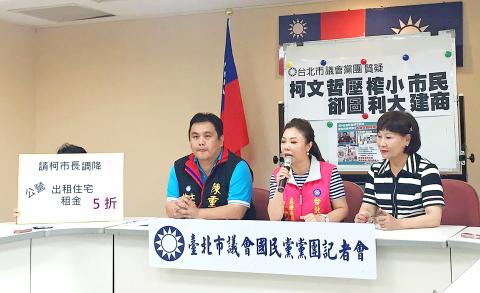
Photo: CNA
The 2 percent rate is lower than that for residents holding two properties — 2.4 percent — and much lower than the rate stipulated for people with three or more properties — 3.6 percent.
At a news conference, KMT Taipei City Councilor Chen Chung-wen (陳重文) criticized the policy, saying that it created double standards for construction companies and Taipei residents.
He said that Taipei Mayor Ko Wen-je (柯文哲) during his election campaign last year repeatedly told Taipei residents that he would endeavor to uphold “residential justice” for young people who cannot afford to purchase a house and the policy belies that pledge.
“The policy panders to building companies, but exploits ordinary residents. Ko should apologize to the young people who voted for him,” Chen said.
KMT Taipei City Councilor Lee Yan-hsiu (李彥秀) said the policy came as a shock to most people given Ko’s campaign promises.
She also said that the tax cut would result in a reduction of about NT$100 million (US$3.04 million) in the city government’s revenue.
“Ko is always trying cut expenses to free up more capital for the city government — for example, canceling the discounts people get when transferring between buses and the MRT, collecting parking fees and canceling subsidies for senior citizens on Double Ninth Day (重陽節) — but by proposing a tax cut for construction companies, I think that he has failed to see the wood for the trees,” Lee said.
The KMT caucus said that it would attempt block the bylaw when it is delivered to the city council for review.
Ko earlier yesterday said the policy was “pragmatic.”
He said that construction companies would be subject to the 2 percent tax rate for one year so that their financial burden could be reduced as they try to sell their stock of houses.
“Under the draft bylaw, the rate would be applied for one year. Some think that is too long. This can be discussed at the council,” Ko said.
He said that the property rates were originally introduced to deter people from stockpiling houses, but that he has discovered that state-run enterprises that want to purchase properties and rent them out to their employees are also required to pay the 3.6 percent tax rate, which he said is unfair.

A signaling system malfunction disrupted high-speed rail (HSR) services beginning at 8am today, with trains temporarily reduced to three northbound and three southbound trains per hour as authorities conduct inspections. The malfunction occurred on a section of track in Miaoli County during pre-operation checks early this morning, forcing northbound and southbound trains to use a single track, the HSR operator said. The regular schedule has been replaced with three hourly trains offering only nonreserved seating in each direction, stopping at every station, it said, adding that business class cars would still have reserved seating. Departures from terminal stations are scheduled at the top

Taiwan is still in the process of assessing the possibility of recruiting workers from Eswatini, the Ministry of Foreign Affairs said yesterday, adding that its goal is to help Eswatini upgrade its vocational training centers. If there are plans to recruit workers from Eswatini, safeguarding national security, protecting public health and ensuring the employment rights of Taiwanese would be prerequisites, Department of West Asian and African Affairs Director-General Yen Chia-liang (顏嘉良) told a news conference. Key considerations would also include filling labor shortages in specific industries, and fostering bilateral professional and technical exchanges, he said. Yen was asked about the progress of labor

A US uncrewed surface vessel (USV) encountered multiple Chinese warships during an autonomous transit of the Taiwan Strait, US defense company Seasats said in a statement on Wednesday. Seasats announced that a Lightfish USV had completed the first autonomous transit of the Taiwan Strait. Over five days, the USV traversed the entire length of the Strait while constantly monitoring surface vessel traffic, the company said. The Lightfish encountered multiple Chinese warships, one of which was a Chinese People’s Liberation Army Navy (PLAN) Type 056 corvette, it said. The Chinese vessels were operating “well within Taiwan’s exclusive economic zone without transmitting their identity via the

VERBOSE VESSELS: A CGA cutter and a China Coast Guard exchanged verbal barbs for more than a day in Taiwanese-controlled waters before the Chinese vessel left The Taiwanese and Chinese coast guards had a standoff near the strategically located Pratas Islands (Dongsha Islands, 東沙群島) in the north of the South China Sea, the Coast Guard Administration (CGA) said yesterday. The two sides engaged in intense radio exchanges over sovereignty claims during the 33-hour standoff. China Coast Guard vessel 3501 eventually left the restricted waters, 26.6 nautical miles (49.2km) west of the Pratas Islands, at 5pm yesterday, the CGA said. Lying approximately between southern Taiwan and Hong Kong, the Taiwan-controlled Pratas are seen by some security experts as vulnerable to Chinese attack due to their distance — more than


 RSS
RSS