


Students occupying the Ministry of Education forecourt to protest the ministry’s controversial curriculum adjustments might withdraw as Typhoon Soudelor approaches, National Taichung First Senior High School Apple Tree Commune Club spokesperson Chen Chien-hsun (陳建勳) said yesterday.
“We will put safety before realizing our demands,” Chen said. “We do not want more people to be hurt as a result of participating in the movement.”
“We will have many more opportunities to continue to push our demands, whether by returning to the Ministry of Education or going elsewhere, so there is no need to gamble everything on this moment,” he said.
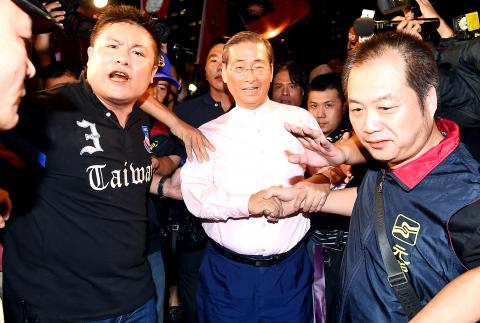
Photo: Chu Pei-hsiung, Taipei Times
Students have occupied the site since Friday last week, demanding the withdrawal or suspension of controversial changes to high-school social studies curriculum guidelines that critics said have a “China-centric” focus.
Chen emerged as one of the most prominent student leaders following the withdrawal yesterday of Northern Taiwan Anti-Curriculum Changes Alliance convener Chu Chen (朱震) from the students’ “policymaking” group.
His comments marked a retreat from earlier remarks by student spokesman Yi Juo-yu (伊若宇), who had stated that students were leaning toward continuing the occupation of the forecourt, although they were to take down tents and remove supplies.
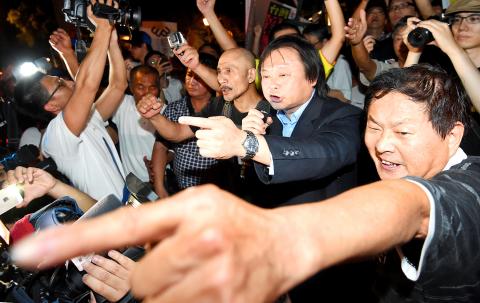
Photo: Chu Pei-hsiung, Taipei Times
He had stated that 10 of a core group of between 20 and 30 student volunteers had expressed willingness to remain in shifts.
Student spokespeople also expressed dissatisfaction with a Legislative Yuan resolution calling for the ministry to establish a “curriculum review committee” to look over controversial guideline adjustments.
Students had originally called for the Legislative Yuan to hold an extraordinary session to directly overturn the guidelines.
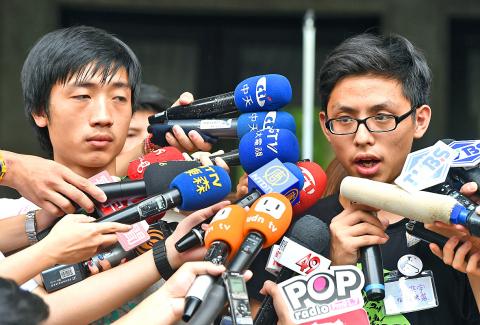
Photo: Liao Chen-huei, Taipei Times
“The progress we have gained is not proportional to the sacrifices we have made, so we do not see any reason to withdraw,” Yi said.
Taichung First Senior High School student Liao Chung-lun (廖崇倫) said it was difficult to agree to the resolution because it was not a “substantial promise,” with no clear plan for implementation.
He emphasized that “suspension” of the guidelines remained the students’ demand, with the curriculum review committee only a “necessary means.”
Liao added that students were open to talks with ministry officials on participation in the “curriculum review committee,” urging the ministry to allow students to participate as full voting members.
Separately yesterday, Minister of Education Wu Se-hwa (吳思華) said that the ministry had formally dropped charges against all of the students who were arrested last week for trespassing on ministry property.
Deputy Minister of Education Lin Teng-chiao (林騰蛟) said that charges would also be dropped against the adults who accompanied students, including three reporters who were arrested.
Lin added that the ministry was open to student representatives participating in the curriculum review committee, saying that besides reviewing the approval process for the guideline adjustments, the committee would also have the power to make amendments.
At about 8:15pm last night, a competing rally was held outside the ministry by the China Unification Promotion Party (CUPP), with powerful loudspeakers broadcasting slogans that accused students of promoting Japanese “imperial citizen education” and “forgetting their ancestors.”
Former Bamboo Union leader and party head Chang An-le (張安樂), also known as the “White Wolf,” said the rally was meant to support the ministry in “setting things straight,” using the curriculum guideline adjustments to reverse a long series of previous changes aimed at promoting Taiwanese independence.
Twin police cordons and barbed wire barriers along Zhongshan S Road’s middle lane separated the rally from the students gathered in the ministry’s forecourt.
Zhongzheng First Precinct Police Chief Chang Chi-wen (張奇文) repeatedly shouted through a loudspeaker that the gathering was illegal because the CUPP had not applied for a permit.

A signaling system malfunction disrupted high-speed rail (HSR) services beginning at 8am today, with trains temporarily reduced to three northbound and three southbound trains per hour as authorities conduct inspections. The malfunction occurred on a section of track in Miaoli County during pre-operation checks early this morning, forcing northbound and southbound trains to use a single track, the HSR operator said. The regular schedule has been replaced with three hourly trains offering only nonreserved seating in each direction, stopping at every station, it said, adding that business class cars would still have reserved seating. Departures from terminal stations are scheduled at the top

DRONE CENTRAL: Taiwan aims to become Asia’s democratic hub for drones, with most exports focused on high-quality military-grade models, an official said Taiwan’s drone industry is expected to expand significantly by 2030, producing 100,000 units per month and exporting half of them, the Ministry of Economic Affairs said yesterday. Current drone production capacity is about 15,000 units per month, but the industry can quickly scale up as demand increases, Industrial Development Administration Director-General Chiou Chyou-huey (邱求慧) told a news conference in Taipei. Taiwan’s drone output grew 2.5-fold last year to NT$12.9 billion (US$408.3 million) under a government program to develop the uncrewed vehicle sector, he said. The Executive Yuan in October last year approved plans to invest NT$44.2 billion into domestic production of uncrewed aerial

VERBOSE VESSELS: A CGA cutter and a China Coast Guard exchanged verbal barbs for more than a day in Taiwanese-controlled waters before the Chinese vessel left The Taiwanese and Chinese coast guards had a standoff near the strategically located Pratas Islands (Dongsha Islands, 東沙群島) in the north of the South China Sea, the Coast Guard Administration (CGA) said yesterday. The two sides engaged in intense radio exchanges over sovereignty claims during the 33-hour standoff. China Coast Guard vessel 3501 eventually left the restricted waters, 26.6 nautical miles (49.2km) west of the Pratas Islands, at 5pm yesterday, the CGA said. Lying approximately between southern Taiwan and Hong Kong, the Taiwan-controlled Pratas are seen by some security experts as vulnerable to Chinese attack due to their distance — more than
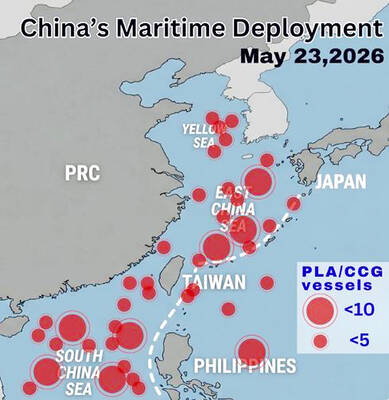
WARNING: China should stop engaging in actions that undermine regional peace and stability, as it would only build resentment among people across the Strait, the CGA said China has deployed more than 100 navy, coast guard and other vessels in waters from the Yellow Sea to the South China Sea and the western Pacific since US President Donald Trump and Chinese President Xi Jinping (習近平) met in Beijing, National Security Council Secretary-General Joseph Wu (吳釗燮) said yesterday. “In this part of the world, #China is the one & only PROBLEM wrecking the #StatusQuo & threatening regional peace & stability,” Wu wrote on X. In a separate post, he said Beijing was coercing Taiwan’s maritime domain, calling it illegal and provocative, after the Coast Guard Administration (CGA) expelled a


 RSS
RSS