


Delegates negotiating a vast Pacific free-trade agreement failed to reach a final deal on Friday after several days of intense talks in Hawaii in a setback for US President Barack Obama.
However, US Trade Representative Michael Froman, in a statement on behalf of the 12 countries involved, said that “significant progress” had been made on the Trans-Pacific Partnership (TPP) agreement, the most ambitious trade deal in decades.
The negotiators were “more confident than ever that the TPP is within reach,” he said, adding that the Pacific Rim countries involved would continue to have bilateral discussions to try and iron out their remaining differences.
The press conference was delayed by several hours as the countries — including the US, Australia, New Zealand, Japan and Canada — attempted to thrash out a deal in what had been billed as the home straight, in talks that reportedly went deep into the night.
The failure by trade ministers to get the accord over the line on Friday are a blow to Obama — who has faced opposition to the deal from fellow Democrats — as it could see the TPP become campaign fodder with the US facing elections in November next year.
The 12 countries involved have faced criticism for carrying out their negotiations in what opponents have charged is a high level of secrecy.
Its many critics said the proposals indicate a deal moving more toward protection than free trade; one more about corporate benefits than boosting economies and development.
However, backers say the modern global economy needs a new framework of rules to protect intellectual property-dependent 21st century industries that are not covered in traditional free-trade pacts such as the WTO.
Trade ministers were keen to talk up the positives.
“Good progress was made this week, but a number of challenging issues remain, including intellectual property and market access for dairy products,” New Zealand Minister of Trade Tim Groser said in a statement, touching on two of the outstanding sensitive issues.
Japanese Minister of Economy, Trade and Industry Akira Amari told reporters it would take another ministerial-level meeting to get the deal done.
“According to my understanding, it is our common view that we will hold a meeting by the end of August,” Amari said, according to public broadcaster NHK. “If we can’t conclude it next time, it’s going to be very hard.”
Australian Minister for Trade and Investment Andrew Robb said they were “on the cusp,” with “provisional decisions on more than 90 percent of issues.”
The other countries involved are Brunei, Chile, Malaysia, Mexico, Peru, Singapore and Vietnam.
Several prickly issues were believed to have held up the talks this week on the island of Maui, prime among them differences over agricultural markets, auto trade and protection for drug makers.
Also covered in the vast proposed pact are better copyright protection, workers rights and environmental protection.
“No deal means the TPP is thrown into the political maelstrom of the US presidential cycle,” Public Citizen’s Global Trade Watch director Lori Wallach said in a statement.
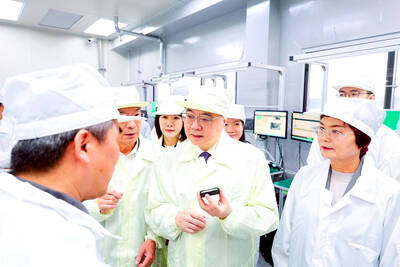
KEY INDUSTRY: The vice premier discussed a plan to create a non-red drone supply chain by next year, which has been allocated a budget of more than NT$7.2 billion The government has budgeted NT$44.2 billion (US$1.38 billion) to cultivate Taiwan’s uncrewed aerial vehicle (UAV) industry over the next five years, which would make the nation a major player in the industry’s democratic supply chain in the Asia-Pacific region, Premier Cho Jung-tai (卓榮泰) said yesterday. Cho made the remarks during a visit to the facilities of Cub Elecparts Inc (為升電裝). Democratic Progressive Party (DPP) Legislator Chen Su-yueh (陳素月) and Chinese Nationalist Party (KMT) Legislator Hsieh Yi-fong (謝依鳳) also participated in the trip. Cub Elecparts has transitioned from the automotive industry to the defense industry, which is the top priority among the nation’s
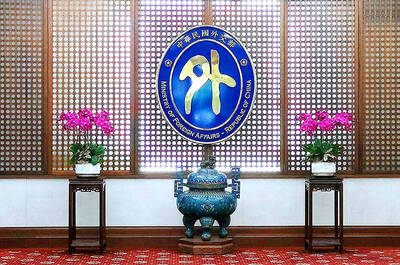
SOUTH KOREA DISPUTE: If Seoul continues to ignore its request, Taiwan would change South Korea’s designation on its arrival cards, the foreign ministry said If South Korea does not reply appropriately to a request to correct Taiwan’s name on its e-Arrival card system before March 31, the government would take corresponding measures to change how South Korea is labeled on the online Taiwan Arrival Card system, the Ministry of Foreign Affairs said yesterday. South Korea’s e-Arrival card system lists Taiwan as “China (Taiwan)” in the “point of departure” and “next destination” fields. Taipei has asked Seoul to change the wording. Since March 1, South Koreans who hold government-issued Alien Resident Certificates (ARC) have been identified as from “South Korea” rather than the “Republic of Korea,” the
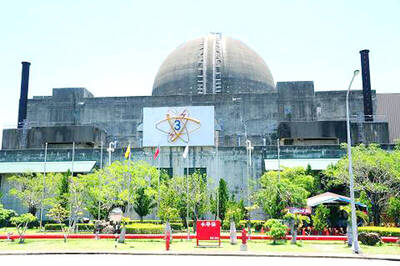
SUFFICIENT: The president said Taiwan has enough oil for next month, with reserves covering more than 100 days and natural gas enough for 12 to 14 days A restart plan for the Guosheng Nuclear Power Plant in New Taipei City’s Wanli District (萬里) and the Ma-anshan Nuclear Power Plant in Pingtung County’s Hengchun Township (恆春) would be submitted to the Nuclear Safety Commission by the end of the month, President William Lai (賴清德) said yesterday, reversing the government’s policy to abolish nuclear energy. On May 17 last year, Taiwan shut down its last nuclear reactor and became the first non-nuclear nation in East Asia, fulfilling the Democratic Progressive Party (DPP) government’s pledge of a “nuclear-free homeland.” Even without nuclear power, Taiwan can maintain a stable electricity supply until 2032,
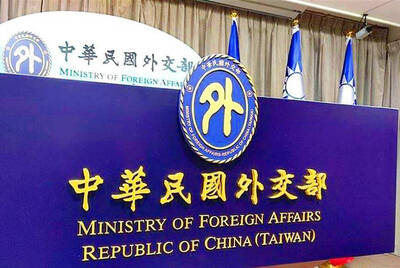
DEROGATORY: WTO host Cameroon’s designation of Taiwan as a ‘province of China’ seriously undermines the nation’s status and rights as a WTO member, MOFA said The Ministry of Foreign Affairs (MOFA) yesterday condemned Cameroon for listing Taiwan as “Taiwan, Province of China” in visa documents for an upcoming WTO ministerial conference, a move that led to Taiwan’s withdrawal from the event. The designation “seriously undermined” Taiwan’s status and rights as a WTO member, the ministry said in a statement. It is the first time since 2001 that Taiwan has declined to attend a WTO Ministerial Conference. The conference is scheduled to take place from Thursday to Sunday next week in Yaounde, the capital of Cameroon. Taiwan had planned to send a delegation led by Minister Without Portfolio


 RSS
RSS