


China’s military yesterday warned of growing risks along its borders, including in the disputed waters of the South and East China seas.
The Chinese military, the world’s largest, has embarked upon an ambitious modernization program in recent years.
That, along with rising defense spending, has jangled nerves around the region. China said it is a threat to nobody, but needs to update outdated equipment and has to be able to defend what is now the world’s second largest economy.
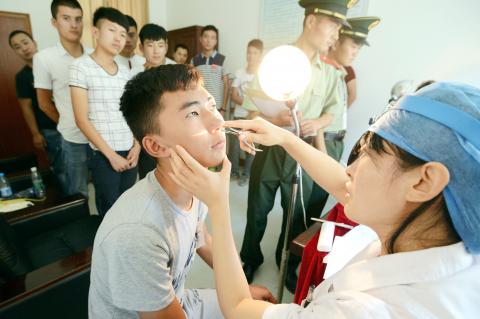
Photo: AP
In a front page editorial, the official People’s Liberation Army Daily said the world was facing unprecedented changes.
“The situation surrounding our country is generally stable, but the risks and challenges are extremely severe, and the possibility of chaos and war on our doorstep has increased,” it said.
“The maritime security environment is more complicated, and the undercurrents in the East and South China seas have been gushing up,” the paper wrote.
China has become increasingly assertive in its dispute with Japan over a group of uninhabited islets in the East China Sea, while in the South China Sea it has been reclaiming land in waters where Taiwan, Vietnam, the Philippines, Malaysia and Brunei all have competing claims.
China also looks warily at threats from extremists in countries like Afghanistan, the possibility of war on the Korean Peninsula, instability on the border with Myanmar and India, and the festering question of the status of self-ruled Taiwan.
“The mission of protecting national unity, territorial integrity and development interests is difficult and strenuous,” the paper said.
In a separate piece, the paper quoted Chinese Minister of Defense General Chang Wanquan (常萬全) as saying China was committed to being a force for peace, but would not compromise on core principles like Taiwan.
“We will uphold the principle that people on both sides of the Taiwan Strait are one family and go down the path of peaceful development of relations [but will] resolutely oppose and hold back the plots of Taiwan independence separatists,” Chang said.
China claims Taiwan as its own and has never renounced the use of force to bring it under its control.
Defeated Chinese Nationalist Party (KMT) forces withdrew to the island after losing the Chinese Civil War with Chinese Communist Party (CCP) forces in 1949.
China’s military has also been dealing with a deep-rooted corruption problem, and last week announced another former Former CMC vice chairman Guo Boxiong (郭伯雄), would be prosecuted for graft.
The party’s official People’s Daily said that these cases had “blacked the name” of the military, but that they were not representative of the loyalty and bravery of the broad mass of service personnel.
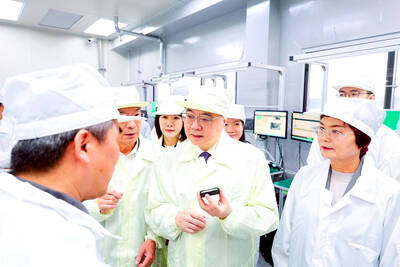
KEY INDUSTRY: The vice premier discussed a plan to create a non-red drone supply chain by next year, which has been allocated a budget of more than NT$7.2 billion The government has budgeted NT$44.2 billion (US$1.38 billion) to cultivate Taiwan’s uncrewed aerial vehicle (UAV) industry over the next five years, which would make the nation a major player in the industry’s democratic supply chain in the Asia-Pacific region, Premier Cho Jung-tai (卓榮泰) said yesterday. Cho made the remarks during a visit to the facilities of Cub Elecparts Inc (為升電裝). Democratic Progressive Party (DPP) Legislator Chen Su-yueh (陳素月) and Chinese Nationalist Party (KMT) Legislator Hsieh Yi-fong (謝依鳳) also participated in the trip. Cub Elecparts has transitioned from the automotive industry to the defense industry, which is the top priority among the nation’s
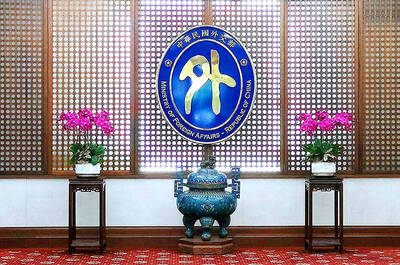
SOUTH KOREA DISPUTE: If Seoul continues to ignore its request, Taiwan would change South Korea’s designation on its arrival cards, the foreign ministry said If South Korea does not reply appropriately to a request to correct Taiwan’s name on its e-Arrival card system before March 31, the government would take corresponding measures to change how South Korea is labeled on the online Taiwan Arrival Card system, the Ministry of Foreign Affairs said yesterday. South Korea’s e-Arrival card system lists Taiwan as “China (Taiwan)” in the “point of departure” and “next destination” fields. Taipei has asked Seoul to change the wording. Since March 1, South Koreans who hold government-issued Alien Resident Certificates (ARC) have been identified as from “South Korea” rather than the “Republic of Korea,” the
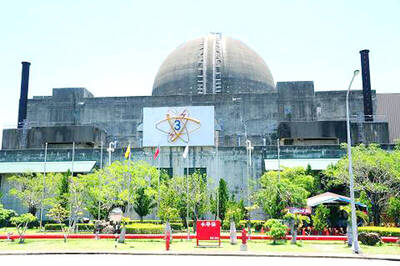
SUFFICIENT: The president said Taiwan has enough oil for next month, with reserves covering more than 100 days and natural gas enough for 12 to 14 days A restart plan for the Guosheng Nuclear Power Plant in New Taipei City’s Wanli District (萬里) and the Ma-anshan Nuclear Power Plant in Pingtung County’s Hengchun Township (恆春) would be submitted to the Nuclear Safety Commission by the end of the month, President William Lai (賴清德) said yesterday, reversing the government’s policy to abolish nuclear energy. On May 17 last year, Taiwan shut down its last nuclear reactor and became the first non-nuclear nation in East Asia, fulfilling the Democratic Progressive Party (DPP) government’s pledge of a “nuclear-free homeland.” Even without nuclear power, Taiwan can maintain a stable electricity supply until 2032,
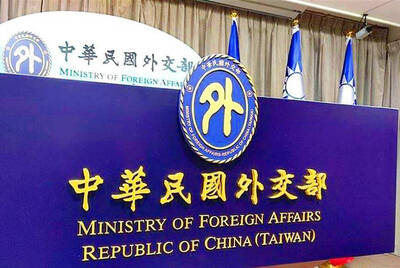
DEROGATORY: WTO host Cameroon’s designation of Taiwan as a ‘province of China’ seriously undermines the nation’s status and rights as a WTO member, MOFA said The Ministry of Foreign Affairs (MOFA) yesterday condemned Cameroon for listing Taiwan as “Taiwan, Province of China” in visa documents for an upcoming WTO ministerial conference, a move that led to Taiwan’s withdrawal from the event. The designation “seriously undermined” Taiwan’s status and rights as a WTO member, the ministry said in a statement. It is the first time since 2001 that Taiwan has declined to attend a WTO Ministerial Conference. The conference is scheduled to take place from Thursday to Sunday next week in Yaounde, the capital of Cameroon. Taiwan had planned to send a delegation led by Minister Without Portfolio


 RSS
RSS