


China needs to develop a long-range strategic bomber to strike adversaries farther away from its coast in the event of conflict, Chinese media reported yesterday, quoting defense experts.
Beijing has been steadily beefing up its military through years of double-digit increases in defense spending, rapidly expanding its naval power, commissioning its first aircraft carrier, and adding to its submarine and surface fleets.
However, the government-run China Daily newspaper said in a full-page article that a recent military meeting had deemed the nation’s air force a “strategic force,” citing the latest issues of Kanwa Defense Review, a Canada-based defense and weapons technology publication.
The title had previously been reserved for the military’s Second Artillery Corps, which the paper described as China’s “de facto strategic missile force.”
The meeting agreed that a long-range strategic bomber would enable the air force to attack farther out into the Pacific Ocean, as far as the “second island chain,” the paper quoted Kanwa Defense Review as reporting.
Chinese strategists conceive of the first island chain as the arc stretching from Japan to Taiwan, which includes numerous US military bases on the Japanese island of Okinawa. The second chain refers to islands farther east in the Pacific, including the Marianas, the Carolines and the US territory of Guam, with its Andersen Air Force Base. A third island chain encompassing Hawaii is also sometimes mentioned.
China’s increased military posture has come as Beijing asserts its territorial claims in the East and South China Seas, where it has disputes with several Asian neighbors, including Taiwan, Japan, the Philippines, Malaysia, Vietnam and Brunei.
China’s moves have raised tensions with the US, still the region’s top military power.
A capacity to strike the second island chain would hinder foreign military from intervening in “an emergency or conflict,” the China Daily said, citing the report.
In May, China’s State Council said in a white paper that the nation would project its military power further beyond its sea borders and more assertively in the air.
The Chinese military defines a long-range strategic bomber as one that can carry more than 10 tonnes of air-to-ground munitions, with a minimum range of 8,000km without refueling, the China Daily said.
Chinese defense technology magazine Aerospace Knowledge last month said in a series of articles that China needs a long-range stealth bomber, the China Daily said.
“A medium-range bomber cannot essentially fix the PLA [Chinese People’s Liberation Army] air force’s shortcomings in terms of strategic strike and strategic deterrence,” it cited one of the reports as saying. “Thus the air force does need an intercontinental strategic bomber capable of penetrating an enemy’s air defenses.”
However, the China Daily quoted the publication’s deputy editor-in-chief Wang Yanan (王亞男) as saying that such an aircraft would require “a state-of-the-art structure and aerodynamic configuration as well as a high-performance turbofan engine.”
“All of these are major problems facing the Chinese aviation industry,” he added. “I don’t think these difficulties can be resolved within a short period of time.”
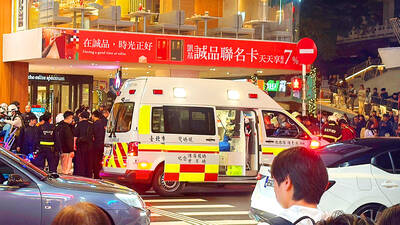
TRAGEDY STRIKES TAIPEI: The suspect died after falling off a building after he threw smoke grenades into Taipei Main Station and went on a killing spree in Zhongshan A 27-year-old suspect allegedly threw smoke grenades in Taipei Main Station and then proceeded to Zhongshan MRT Station in a random killing spree that resulted in the death of the suspect and two other civilians, and seven injured, including one in critical condition, as of press time last night. The suspect, identified as a man surnamed Chang Wen (張文), allegedly began the attack at Taipei Main Station, the Taipei Fire Department said, adding that it received a report at 5:24pm that smoke grenades had been thrown in the station. One man in his 50s was rushed to hospital after a cardiac arrest
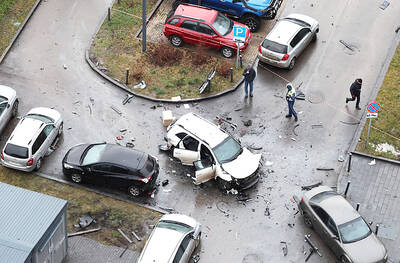
A car bomb killed a senior Russian general in southern Moscow yesterday morning, the latest high-profile army figure to be blown up in a blast that came just hours after Russian and Ukrainian delegates held separate talks in Miami on a plan to end the war. Kyiv has not commented on the incident, but Russian investigators said they were probing whether the blast was “linked” to “Ukrainian special forces.” The attack was similar to other assassinations of generals and pro-war figures that have either been claimed, or are widely believed to have been orchestrated, by Ukraine. Russian Lieutenant General Fanil Sarvarov, 56, head

SAFETY FIRST: Double the number of police were deployed at the Taipei Marathon, while other cities released plans to bolster public event safety Authorities across Taiwan have stepped up security measures ahead of Christmas and New Year events, following a knife and smoke bomb attack in Taipei on Friday that left four people dead and 11 injured. In a bid to prevent potential copycat incidents, police deployments have been expanded for large gatherings, transport hubs, and other crowded public spaces, according to official statements from police and city authorities. Taipei Mayor Chiang Wan-an (蔣萬安) said the city has “comprehensively raised security readiness” in crowded areas, increased police deployments with armed officers, and intensified patrols during weekends and nighttime hours. For large-scale events, security checkpoints and explosives
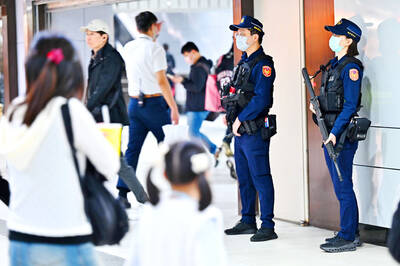
PUBLIC SAFETY: The premier said that security would be tightened in transport hubs, while President Lai commended the public for their bravery The government is to deploy more police, including rapid response units, in crowded public areas to ensure a swift response to any threats, President William Lai (賴清德) said yesterday after a knife attack killed three people and injured 11 in Taipei the previous day. Lai made the remarks following a briefing by the National Police Agency on the progress of the investigation, saying that the attack underscored the importance of cooperation in public security between the central and local governments. The attack unfolded in the early evening on Friday around Taipei Main Station’s M7 exit and later near the Taipei MRT’s Zhongshan


 RSS
RSS