


More than 100 people gathered in a mostly flattened ancient village in Taoyuan’s Guishan District (龜山) to help move a half-century-old house away from a planned road to preserve the last remnants of the community.
“We want to keep the house, so that when younger generations come back they will have a landmark to identify where the village used to stand and they will have something to help them imagine how life used to be in the village,” Leshan Borough (樂善) resident Amber Shyu (徐玉紅) said when asked why volunteers were going to move the fragile brick house 80m to make way for a planned road.
Other homes in the village had been demolished.
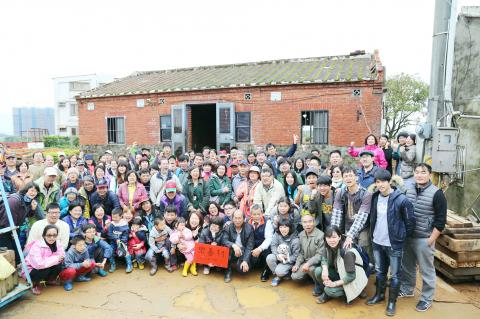
Photo: Loa Iok-sin, Taipei Times
Originally home to a small village surrounded by a forest, the land was selected by the Ministry of the Interior to build commercial, industrial and housing complexes surrounding an airport express train station.
The Executive Yuan approved the project in 2010 and by 2013, most of the village had been flattened, despite opposition and repeated protests by villagers.
Besides a small shrine for the God of the Land nearby, the house Shyu shares with her husband, Huang Shih-hsiung (黃世雄), is the only remaining building in the village.
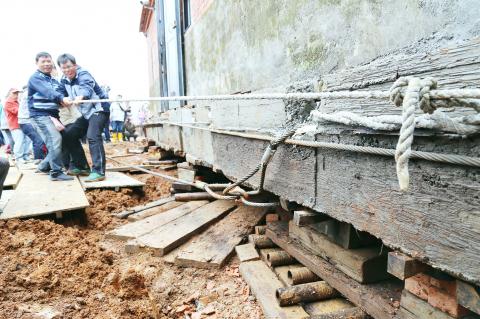
Photo: Loa Iok-sin, Taipei Times
“We want to keep the house, also because it was hand-built by my father-in-law in 1964,” she said. “He worked hard to save enough money to buy the bricks, washed each of them, stacked them up and then went to places like Taipei to find abandoned, but usable, timber to construct the structure of the house.”
“The house is the result of his lifetime of hard work and saving, so I have to preserve it,” Shyu added.
Many people shared her idea, since more than 100 people, some traveling as far as from Miaoli and Tainan, took turns pulling the ropes to move the house.
After symbolically moving the house by hand, the rest of the work is to be done by machinery and, weather permitting, the move could be completed within two weeks, an engineer working on the project said.
Taiwan Rural Front spokesperson Frida Tsai (蔡培慧), who attended the event, said that the project should serve as a reminder and an inspiration for efforts to revise land seizure laws, as the house bears witness to suffering caused by the forced seizure of property.

The nation’s fastest supercomputer, Nano 4 (晶創26), is scheduled to be launched in the third quarter, and would be used to train large language models in finance and national defense sectors, the National Center for High-Performance Computing (NCHC) said. The supercomputer, which would operate at about 86.05 petaflops, is being tested at a new cloud computing center in the Southern Taiwan Science Park in Tainan. The exterior of the server cabinet features chip circuitry patterns overlaid with a map of Taiwan, highlighting the nation’s central position in the semiconductor industry. The center also houses Taiwania 2, Taiwania 3, Forerunner 1 and

FIRST TRIAL: Ko’s lawyers sought reduced bail and other concessions, as did other defendants, but the bail judge denied their requests, citing the severity of the sentences Former Taipei mayor Ko Wen-je (柯文哲) was yesterday sentenced to 17 years in prison and had his civil rights suspended for six years over corruption, embezzlement and other charges. Taipei prosecutors in December last year asked the Taipei District Court for a combined 28-year, six-month sentence for the four cases against Ko, who founded the Taiwan People’s Party (TPP). The cases were linked to the Core Pacific City (京華城購物中心) redevelopment project and the mismanagement of political donations. Other defendants convicted on separate charges included Chinese Nationalist Party (KMT) Taipei City Councilor Angela Ying (應曉薇), who was handed a 15-year, six-month sentence; Core Pacific
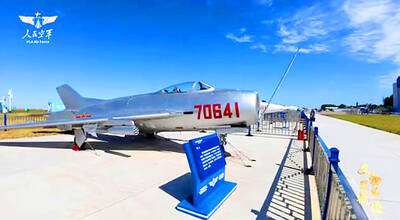
J-6 REMODEL: The converted drones are part of Beijing’s expanding mix of airpower weapons, including bombers with stand-off missiles and UAV swarms, the report said China has stationed obsolete supersonic fighters converted to attack drones at six air bases close to the Taiwan Strait, a report published this month by the Arlington, Virginia-based Mitchell Institute for Aerospace Studies said. Satellite imagery of the airfields from the institute’s “China Airpower Tracker” shows what appear to be lines of stubby, swept-winged aircraft matching the shape of J-6 fighters that first flew with the Chinese People’s Liberation Army (PLA) Air Force in the 1960s. Since their conversion to drones, the aircraft have been identified at five bases in China’s Fujian Province and one in Guangdong Province, the report said. J.

China used fake LinkedIn profiles to harvest sensitive data from NATO and EU institutions by soliciting information from staff, a European security source said on Friday. The operation, allegedly orchestrated by the Chinese Ministry of State Security, targeted dozens of employees at the military alliance or EU organizations through fictitious accounts, the source said, confirming reports in French and Belgian media. Posing as recruiters on the online professional networking platform, Chinese spies would initially request paid reports before later soliciting non-public or even classified information. One particularly active fake profile used the name “Kevin Zhang,” claiming to be the head


 RSS
RSS