

The statue of Chiang Kai-shek (蔣介石) in the Chiang Kai-shek Memorial Hall in Taipei was vandalized by a group of activists from the “Taiwan Republic Campaign” yesterday in an apparent political protest timed to coincide with 228 Memorial Day.
The activists threw eggs and water balloons filled with black paint onto the statue, while shouting: “Chiang was a murderer” and “there is no forgiveness if there is no truth,” referring to the 228 Incident and the White Terror era.
Police said that two activists — Peter Wang (王獻極) and Chen Chun-han (陳峻涵) — were taken in for questioning and might be charged with violating the Social Order Maintenance Act (社會秩序維護法).
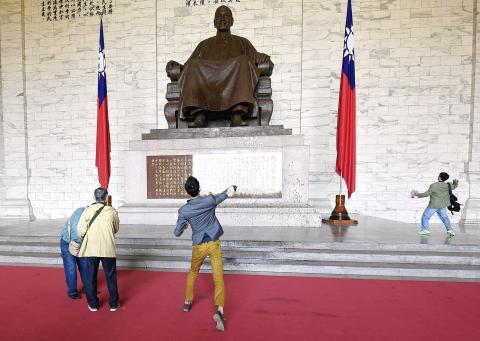
Photo: George Tsorng, Taipei Times
In a press conference held earlier in the day, Chen said that the campaigners would remind Taiwan of its history and facilitate transitional justice through their annual activities commemorating the 228 Incident.
The 228 Incident, which began on Feb. 27, 1947, refers to an uprising against the then-Chinese Nationalist Party (KMT) administration, which led to the killings of tens of thousands of Taiwanese and nearly four decades of martial law.
Chiang statues and symbols on college campuses nationwide were vandalized in a similar manner on Thursday, including those in National Chiao Tung University, National Yang Ming University, Soochow University and Fu Jen Catholic University.
Statues were covered with red paint or draped in folds of cloth, on which words like “murderer” or “repent for the dead” were graffitied — apparently referring to Chiang’s involvement in the 228 Incident and the ensuing White Terror era.
Chen Yu-hsiang (陳佑詳), a senior at National Yang Ming University, said in a statement that “the public cannot do justice to the victims of the [White Terror] era if we observe 228 Memorial Day while turning a blind eye to totalitarian symbols that are ubiquitous on campuses.”
“Regardless of Chiang’s accomplishments and faults, what is more terrifying than the ubiquity of Chiang statues is the sacred and inviolable image of Chiang Gong (蔣公) [meaning revered generalissimo Chiang] and a slave mentality that many people still hold on to,” he said.
A student campaigner surnamed Chen (陳) at Soochow University said that petitions to remove a Chiang statue from the university library had been submitted several times to authorities, only to meet with perfunctory responses, so the campaigners decided to escalate their campaign by doing something “radical.”
Students have taken the campaign onto the Internet by setting up a Facebook page that encourages vandalism of Chiang statues, calling the vandalism “installation art.”
Most college authorities said that they would not take any disciplinary actions against students who are allegedly involved in the vandalism, but called for the campaigners to express their opinions through proper channels.
Additional reporting by We Po-hsuan and Lee Ya-wen

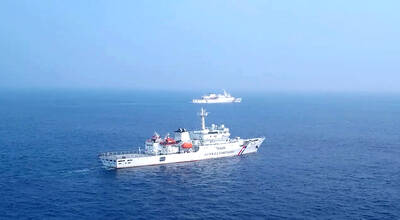
PATROL PARTNERS: The ‘Chiayi’ and the ‘Penghu’ departed for a two-day joint patrol of Palau’s exclusive economic zone, the CGA’s second diplomatic visit to the country The Coast Guard Administration (CGA) set a record for its southernmost deployment of a coast guard vessel as the vessels Chiayi and the Penghu reached Palau’s Pulo Anna Island on Saturday in a cooperative exercise between the two countries. The island, about 217 nautical miles (401km) southwest of Koror in the Palauan state of Sonsorol and 1,220 nautical miles from Taiwan’s southernmost point, Oluanpi (鵝鑾鼻), is the furthest south a CGA vessel has sailed. The two vessels are in Palau for the coast guard’s second diplomatic visit to the country. They docked at Malakal Harbor on Tuesday last week. The coast guard
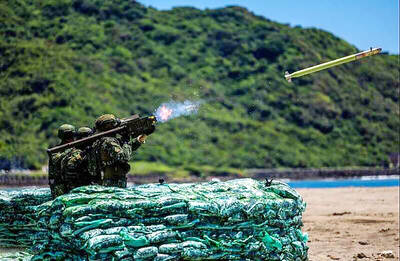
BATCH 1: The military has plans to assign the weapons to the army to defend Taiwan proper, as well as outlying islands and the navy for the Marine Corps, the official said Taiwan is to receive 500 Stinger missiles and 178 launchers from the US by the end of the year, the first batch under a planned two-stage acquisition totaling 2,621 missiles and 763 launchers, a defense official said yesterday on condition of anonymity. The portable missiles would play a vital role in the nation’s air defense capabilities, the source said. The army plans to deploy 2,235 missiles and 657 launchers to defend Taiwan proper and outlying islands, they said, citing military documents. The navy is allotted 295 missiles and 85 launchers to arm the Marine Corps and some surface vessels that lack air defense
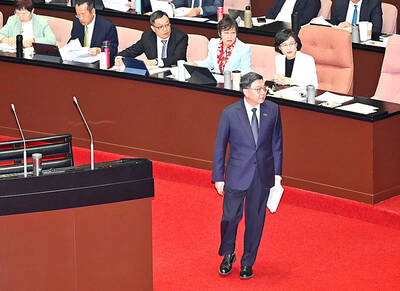
The government is monitoring online rumors that a pneumonic plague outbreak has spread from Russia into China, and it might enhance quarantine measures, Premier Cho Jung-tai (卓榮泰) said yesterday. During a legislative meeting, Democratic Progressive Party Legislator Wang Ting-yu (王定宇) said that rumors had circulated that the disease had spread across several Chinese provinces. He asked Cho whether the government was prepared to prevent the disease spreading to Taiwan, given the volume of traffic between the two sides, and how concerned the government was about the alleged outbreak. The Ministry of Health and Welfare had implemented border quarantine measures after briefing the Executive

The European Parliament on Wednesday adopted a recommendation on EU-China political relations that rejected China’s efforts to restrict Taiwan’s participation in international organizations and exchanges. The recommendation, addressed to the European Council, the European Commission and EU High Representative for Foreign Affairs and Security Policy Kaja Kallas, includes several references to EU-Taiwan relations and expresses support for closer ties, saying they would bring positive benefits and have strategic importance. Describing Taiwan as a valuable partner in trade and technology, the European Parliament said it “rejects China’s attempts to coerce international organizations, third countries and other actors into restricting Taiwan’s international participation and


 RSS
RSS