


Minister of Economic Affairs John Deng’s (鄧振中) announcement in the US that the nation’s ban on US cow offal would be lifted met with criticism from both Chinese Nationalist Party (KMT) and Democratic Progressive Party (DPP) lawmakers yesterday.
Deng, who is in Washington on a visit, told a Central News Agency reporter in Taipei by telephone that the government would ease restrictions on imports of six types of beef under consideration — bone marrow, blood vessels, head meat, cheek meat, weasand and tallow — because they are not internal organs and are therefore not banned by the Act Governing Food Safety and Sanitation (食品安全衛生管理法).
He said the move would make it easier for the nation to join the proposed Trans Pacific Partnership (TPP) trade bloc.
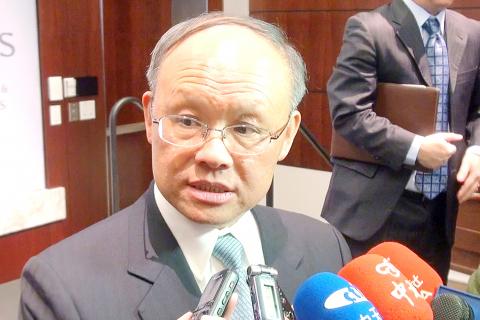
Photo: CNA
DPP lawmakers yesterday lashed out against the plan.
“The Ministry of Health and Welfare says that cow bone marrow and blood vessels are not considered organs, and thus has asked the Food and Drug Administration to allow imports,” DPP Legislator Lin Shu-fen (林淑芬) said in a message on Facebook. “The US government has been given an inch, and is taking a yard — I wonder if Taiwan is a US colony?”
DPP Legislator Kuan Bi-ling (管碧玲) said that the government has repeatedly said that making concessions on importing US beef products would help facilitate the signing of a free-trade agreement (FTA) with the US and joining the TPP, “but we’ve made concession after concession; where is the FTA or the TPP now?”
KMT Legislator Liao Cheng-ching (廖正井) said he was more worried about pork imports.
“The constituents I serve do not often eat beef, but when they do, they usually choose local beef,” Liao said, adding that was the reason he had never been worried about the US beef import issue.
However, Liao said that there were more pigs in his constituency than people and that he was worried about the US trying to push the envelope by opening Taiwan’s market to US pork.
The government must consider this issue carefully and should not give the US an inch, lest they take a yard, Liao said.
KMT Legislator Lo Shu-lei (羅淑蕾) said that she was opposed to allowing US imports before all questions pertaining to safety are resolved.
The Food and Drug Administration (FDA) said that the six beef byproducts were all identified as non-organ parts and non-specified risk materials (SRM) by the Ministry of Health and Welfare’s Bovine Spongiform Encephalopathy (BSE) advisory committee last year.
“The committee made the decision based on the conclusions of a meeting held by the ministry and the Council of Agriculture in August last year, during which several veterinary specialists and animal anatomists were invited to determine whether the six beef byproducts fell into the category of organ parts,” FDA Division of Food Safety official Wu Tsung-hsi (吳宗熹) said.
Wu said the clarification meant that the six items are not subject to an import ban on parts of cows from countries that have reported cases of mad cow disease or the disease it can cause in humans, Creutzfeldt-Jakob disease, in the past decade, including skulls, brains, eyes, spinal marrow, ground beef, viscera and other related products.
Aside from the six items, the government has allowed 11 kinds of beef byproducts to enter the country since November 2009, when it relaxed restrictions to open the country to US bone-in beef, ground beef, cow intestines, brains, spinal cords and processed beef from cattle younger than 30 months that have not been contaminated with SRM.
“Nevertheless, only one of the byproducts — cowhells — has been imported to Taiwan over the years. There is a great chance that no one would ever import the six newly listed items in the future,” Wu said.
Shrugging off concerns over mad cow disease, Wu said that although the latest mad cow disease case in the US was reported in April 2012, the World Organization for Animal Health upgraded the BSE risk classification for the country from “controlled risk” to “negligible risk” in February 2013.
Meanwhile, American Institute in Taiwan spokesperson Mark Zimmer said that in all bilateral trade and economic discussions, the US raises the importance for Taiwan to base its food safety regulations on established science and ensure laws and regulations that affect agricultural market access are in line with Taiwan’s bilateral and international trade commitments.
International standards bodies judge US meat exports safe, and Taiwanese consumers should have the freedom to choose to purchase them, Zimmer said.
He added that US agricultural exports are not the cause of Taiwan’s food safety challenges.
Additional reporting by Chen Yen-ting and CNA
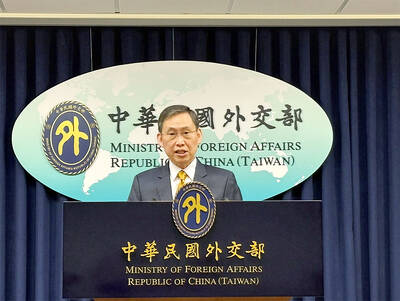
A Ministry of Foreign Affairs official yesterday said that a delegation that visited China for an APEC meeting did not receive any kind of treatment that downgraded Taiwan’s sovereignty. Department of International Organizations Director-General Jonathan Sun (孫儉元) said that he and a group of ministry officials visited Shenzhen, China, to attend the APEC Informal Senior Officials’ Meeting last month. The trip went “smoothly and safely” for all Taiwanese delegates, as the Chinese side arranged the trip in accordance with long-standing practices, Sun said at the ministry’s weekly briefing. The Taiwanese group did not encounter any political suppression, he said. Sun made the remarks when
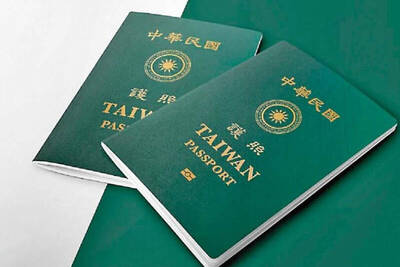
The Taiwanese passport ranked 33rd in a global listing of passports by convenience this month, rising three places from last month’s ranking, but matching its position in January last year. The Henley Passport Index, an international ranking of passports by the number of designations its holder can travel to without a visa, showed that the Taiwan passport enables holders to travel to 139 countries and territories without a visa. Singapore’s passport was ranked the most powerful with visa-free access to 192 destinations out of 227, according to the index published on Tuesday by UK-based migration investment consultancy firm Henley and Partners. Japan’s and
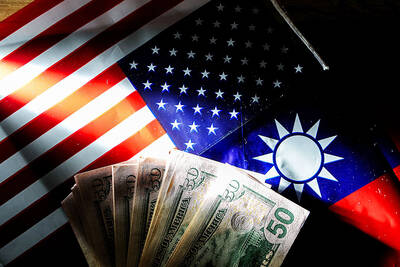
BROAD AGREEMENT: The two are nearing a trade deal to reduce Taiwan’s tariff to 15% and a commitment for TSMC to build five more fabs, a ‘New York Times’ report said Taiwan and the US have reached a broad consensus on a trade deal, the Executive Yuan’s Office of Trade Negotiations said yesterday, after a report said that Washington is set to reduce Taiwan’s tariff rate to 15 percent. The New York Times on Monday reported that the two nations are nearing a trade deal to reduce Taiwan’s tariff rate to 15 percent and commit Taiwan Semiconductor Manufacturing Co (TSMC, 台積電) to building at least five more facilities in the US. “The agreement, which has been under negotiation for months, is being legally scrubbed and could be announced this month,” the paper said,
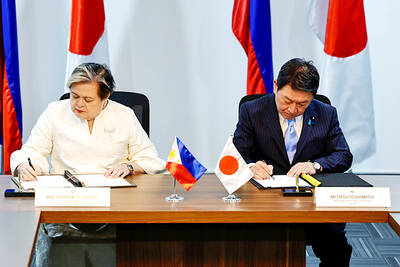
Japan and the Philippines yesterday signed a defense pact that would allow the tax-free provision of ammunition, fuel, food and other necessities when their forces stage joint training to boost deterrence against China’s growing aggression in the region and to bolster their preparation for natural disasters. Japan has faced increasing political, trade and security tensions with China, which was angered by Japanese Prime Minister Sanae Takaichi’s remark that a Chinese attack on Taiwan would be a survival-threatening situation for Japan, triggering a military response. Japan and the Philippines have also had separate territorial conflicts with Beijing in the East and South China


 RSS
RSS