


The Taipei City Government and the Farglory Land Development Co (遠雄建設) last night agreed to renegotiate the Taipei Dome contract, with Farglory promising to complete construction by end of the year.
Taipei City Government spokesman Sidney Lin (林鶴明) announced the agreement following a one-hour meeting between Taipei Mayor Ko Wen-je (柯文哲) and representatives of the firm on the future of the project.
The Taipei Dome and Farglory’s contract had become a source of controversy in recent days as Ko and his administrative team began looking at several major projects either underway or in the proposal stage.

Photo: Fang Pin-chao, Taipei Times
Prior to last night’s meeting, Ko had said the Dome contract would have to be revised to increase the penalties for failing to meet deadlines. He also said discrepancies between the initial contract terms during the bidding process and the firm’s final contract needed to be discussed.
“Farglory has already gone past the deadline for completing the project, in violation of the contract,” Ko said earlier yesterday, adding that the original contract’s penalty clauses “do not have any real impact,” because they only allow the city government to fine the firm a total of NT$3 million (US$95,300) for violations.
Over the weekend, Ko had called the penalty clauses “ridiculous.”
In addition, while the Control Yuan in 2009 ordered the city to revise 39 questionable articles in the contract for the project, the previous administration did nothing to address the revisions, Ko said before the meeting.
Taipei Dome Project executive secretary Hu Pei-lun (胡培倫) said that while previous negotiations between the city and the firm on revising the questionable articles had led to an initial consensus, the negotiations broke down after Farglory refused to agree to the city’s demands.
In related news, the Department of Rapid Transit Systems yesterday released its plans for unilateral changes to a controversial underground tunnel between the dome and National Sun Yat-sen Memorial Hall.
Ko had previously called the design of tunnel — which was supposed to be used in case the Dome needed to be evacuated — “weird” for requiring pedestrians to pass through narrow passages lined with commercial stall space.
Department of Rapid Transit Systems Commissioner Chou Li-liang (周禮良) said the redesigned tunnel — with the commercial space removed — would meet evacuation needs, while cutting costs substantially and reducing the number of trees which would have to be transplanted.
He said the new tunnel could be constructed in time for the 2017 Universiade.
Farglory executives last week said that revising the tunnel design could prevent the Dome being available for the Games.
Additional reporting by staff writer
This story has been updated since it was originally published.
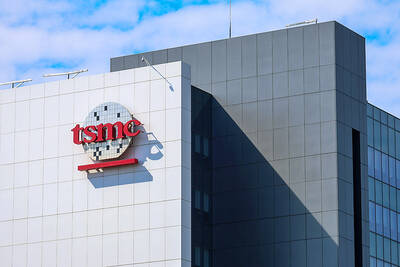
Taiwan Semiconductor Manufacturing Co (TSMC, 台積電), the world’s largest foundry service provider, yesterday said that global semiconductor revenue is projected to hit US$1.5 trillion in 2030, after the figure exceeds US$1 trillion this year, as artificial intelligence (AI) demand boosts consumption of token and compute power. “We are still at the beginning of the AI revolution, but we already see a significant impact across the whole semiconductor ecosystem,” TSMC deputy cochief operating officer Kevin Zhang (張曉強) said at the company’s annual technology symposium in Hsinchu City. “It is fair to say that in the past decade, smartphones and other mobile devices were
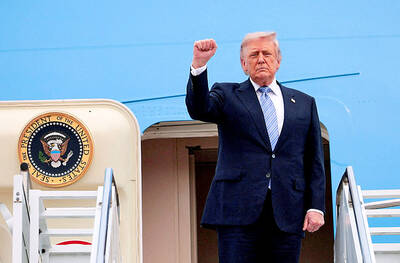
US-CHINA SUMMIT: MOFA welcomed US reassurance of no change in its Taiwan policy; Trump said he did not comment when Xi talked of opposing independence US President Donald Trump yesterday said he has not made a decision on whether to move forward with a major arms package for Taiwan after hearing concerns about it from Chinese President Xi Jinping (習近平). Trump’s comments on Taiwan came as he flew back to Washington after wrapping up critical talks in which both leaders said important progress was made in stabilizing US-China relations even as deep differences persist between the world’s two biggest powers on Iran and Taiwan. “I will make a determination,” Trump said, adding: “I’ll be making decisions. But, you know, I think the last thing we need right
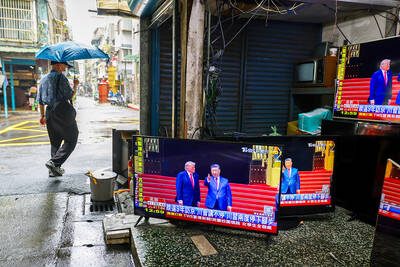
TAIWAN ISSUE: US treasury secretary Scott Bessent said on the first day of meetings that ‘it wouldn’t be a US-China summit without the Taiwan issue coming up’ There were no surprises on the first day of the summit between US President Donald Trump and Chinese President Xi Jinping (習近平), the Mainland Affairs Council (MAC) said yesterday, as the government reiterated that cross-strait stability is crucial to the Asia-Pacific region, as well as the world. As the two presidents met for a highly anticipated summit yesterday, Chinese state media reported that Xi warned Trump that missteps regarding Taiwan could push their two countries into “conflict.” Trump arrived in China with accolades for his host, calling Xi a “great leader” and “friend,” and extending an invitation to visit the White House
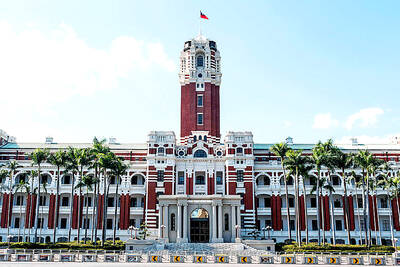
SECURITY: Taipei presses the US for arms supplies, saying the arms sales are not only a reflection of the US security commitment to Taiwan but also serve as a mutual deterrent against regional threats Taiwan is committed to preserving the cross-strait “status quo” and contributing to regional peace and stability, the Presidential Office said yesterday. “It is an undeniable fact that the Republic of China is a sovereign and independent democratic nation,” Presidential Office spokeswoman Karen Kuo (郭雅慧) reiterated, adding that Beijing has no right to claim sovereignty over Taiwan. The statements came after US President Donald Trump warned against Taiwanese independence. Trump wrapped up a state visit to Beijing on Friday, during which Chinese President Xi Jinping (習近平) had pressed him not to support Taiwan. Taiwan depends heavily on US security backing to deter China from carrying


 RSS
RSS