


Taipei Mayor Ko Wen-je (柯文哲) yesterday said he has ordered all Taipei City Government departments to draft a complete list of all municipal property, after discovering that the controversial bus lane on Zhongxiao W Road includes a bus stop that is not listed as belonging to the city.
The move followed a statement by city government spokesman Sidney Lin (林鶴明) that said former Taipei mayor Hau Lung-bin’s (郝龍斌) administration had failed to turn over a detailed inventory of city property when it handed over power to Ko’s administration.
“Because a substantial portion of the inventory was done carelessly, it is necessary to review all property records,” Ko said. “While roadside structures are difficult to inventory and it is unclear how they should be registered, they are still municipal property.”
Lee Kun-chen (李昆振), a section chief at the Taipei Transportation Department’s planning division, said that the city’s bus stops are normally not registered as belonging to the local government, but that the department is now reconsidering this.
Ko also criticized Hau’s management of city-directed construction projects, including the 2017 Universiade athletes’ village in New Taipei City’s Linkou District (林口) and a planned underground tunnel linking the Taipei Dome and the National Sun Yat-sen Memorial Hall.
Meanwhile, Ko criticized the National Taxation Bureau of the Northern Area, amid reports that it summoned his parents to provide documentation showing that NT$10 million (US$313,000) they gave him to buy a new house had been a personal “loan” and not a “gift,” which would make it liable for taxation.
The move sparked speculation that President Ma Ying-jeou’s (馬英九) administration is targeting the independent mayor.
“The election is over,” Ko said. “This way of doing things goes beyond the scope of what ordinary citizens will stand for.”
He asked rhetorically if the government had nothing better to do, asking why officials had suddenly become so “industrious.”
Ko refused to comment further on the bureau’s actions, instead calling repeatedly for a “high-enough ranking” bureau official to give a public explanation before he says anything more on the issue.
“No one makes their children write out a receipt when lending them money,” Ko’s mother, Ho Jui-ying (何瑞英), said separately yesterday.
In a statement, the bureau said it was simply carrying out its duty to investigate all reports of tax fraud.
Bureau Director-General Lee Ching-hua (李慶華) was quoted by media as saying that the bureau had intentionally waited until last year’s Nov. 29 nine-in-one elections were over before pursuing the case against Ko’s parents.

Taiwan Semiconductor Manufacturing Co (TSMC, 台積電), the world’s largest foundry service provider, yesterday said that global semiconductor revenue is projected to hit US$1.5 trillion in 2030, after the figure exceeds US$1 trillion this year, as artificial intelligence (AI) demand boosts consumption of token and compute power. “We are still at the beginning of the AI revolution, but we already see a significant impact across the whole semiconductor ecosystem,” TSMC deputy cochief operating officer Kevin Zhang (張曉強) said at the company’s annual technology symposium in Hsinchu City. “It is fair to say that in the past decade, smartphones and other mobile devices were
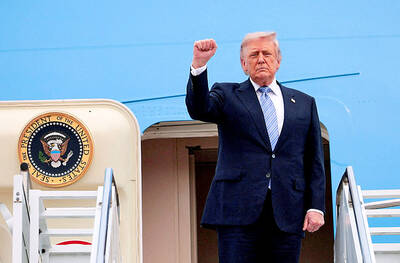
US-CHINA SUMMIT: MOFA welcomed US reassurance of no change in its Taiwan policy; Trump said he did not comment when Xi talked of opposing independence US President Donald Trump yesterday said he has not made a decision on whether to move forward with a major arms package for Taiwan after hearing concerns about it from Chinese President Xi Jinping (習近平). Trump’s comments on Taiwan came as he flew back to Washington after wrapping up critical talks in which both leaders said important progress was made in stabilizing US-China relations even as deep differences persist between the world’s two biggest powers on Iran and Taiwan. “I will make a determination,” Trump said, adding: “I’ll be making decisions. But, you know, I think the last thing we need right
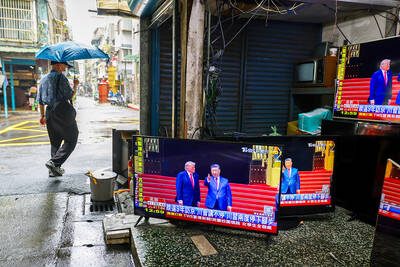
TAIWAN ISSUE: US treasury secretary Scott Bessent said on the first day of meetings that ‘it wouldn’t be a US-China summit without the Taiwan issue coming up’ There were no surprises on the first day of the summit between US President Donald Trump and Chinese President Xi Jinping (習近平), the Mainland Affairs Council (MAC) said yesterday, as the government reiterated that cross-strait stability is crucial to the Asia-Pacific region, as well as the world. As the two presidents met for a highly anticipated summit yesterday, Chinese state media reported that Xi warned Trump that missteps regarding Taiwan could push their two countries into “conflict.” Trump arrived in China with accolades for his host, calling Xi a “great leader” and “friend,” and extending an invitation to visit the White House
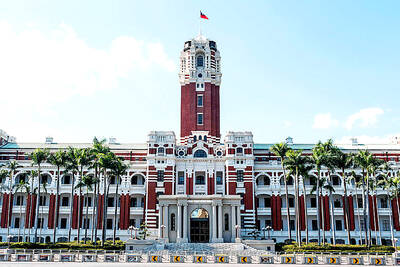
SECURITY: Taipei presses the US for arms supplies, saying the arms sales are not only a reflection of the US security commitment to Taiwan but also serve as a mutual deterrent against regional threats Taiwan is committed to preserving the cross-strait “status quo” and contributing to regional peace and stability, the Presidential Office said yesterday. “It is an undeniable fact that the Republic of China is a sovereign and independent democratic nation,” Presidential Office spokeswoman Karen Kuo (郭雅慧) reiterated, adding that Beijing has no right to claim sovereignty over Taiwan. The statements came after US President Donald Trump warned against Taiwanese independence. Trump wrapped up a state visit to Beijing on Friday, during which Chinese President Xi Jinping (習近平) had pressed him not to support Taiwan. Taiwan depends heavily on US security backing to deter China from carrying


 RSS
RSS