


Vice President and Acting Chinese Nationalist Party (KMT) Chairman Wu Den-yih (吳敦義) yesterday said that there is no single asset the party owns that it obtained improperly, dismissing longstanding allegations of improper ownership.
Accusations that party assets worth NT$70 billion (US$2.2 billion) have gone unaccounted for over the past 13 years and that there might be irregularities involved in their handling were “false and baseless,” Wu said.
He made the remarks after KMT Deputy Secretary-General Lin Te-jui (林德瑞) yesterday presented a report on the status of the party’s assets at a meeting of the Central Standing Committee.
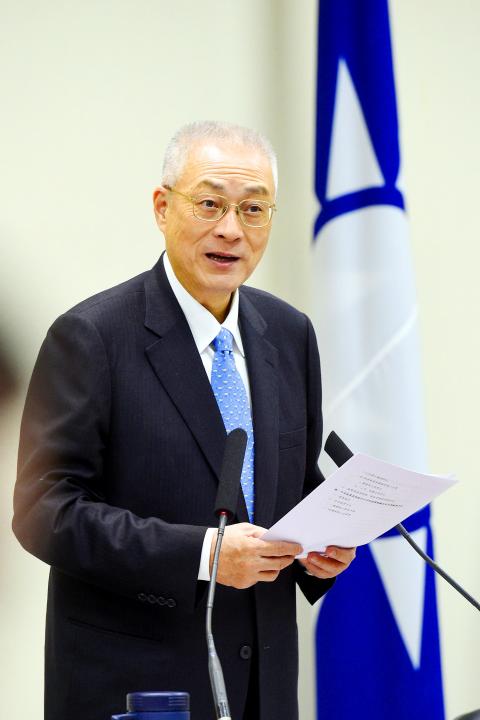
Photo: George Tsorng, Taipei Times
Wu scheduled the meeting after New Taipei City Mayor Eric Chu (朱立倫) — the only candidate in the party’s chairmanship election — said when he declared his candidacy that the party “must return any ill-gotten assets to the nation.”
According to Lin’s report, the value of the real estate — including 147 pieces of land and 152 buildings — that the KMT owns is about NT$1 billion, calculated on the basis of assessed value as opposed to market prices, which are usually much higher. The report adds that the party’s assets in the form of enterprises, including Central Investment Co (中央投資公司) and Hsinyutai Co (欣裕台股份有限公司), are valued at NT$23.226 billion.
The KMT’s assets dwindled from NT$62.8 billion in 2000 to NT$23.3 billion in 2006 as a result of investment losses, Lin said.
Lin added that before 2000, the Asian financial crisis of 1997 and 1998 had already taken a toll on the KMT’s assets, with the party providing funds to assist the government in bailing out businesses.
Critics have labeled the KMT’s assets “ill-gotten” because the party took them from the Japanese colonial government, private businesses and individuals when it took control of Taiwan in the late 1940s.
Wu said the description of “ill-gotten assets” was incorrect because all the KTM’s assets were acquired through legal means.
“There is not a single piece of property the party owns that was obtained improperly,” Wu said.
In the face of doubts surrounding the assets’ legitimacy, “the KMT has held itself to a high moral standard” by offering “rewards” to their original owners, Wu said.
Lin said the KMT has offered rewards for 99 percent of its assets.
Meanwhile, Wu said that President Ma Ying-jeou (馬英九), who resigned as chairman early last month following the party’s loss in the Nov. 29 nine-in-one elections last year, never promised that he would “return the party’s assets to zero.”
What Ma vowed was to dispose of its enterprises, Lin said, adding that the ruling party has not operated for-profit corporations since 2007 and the enterprises that it used to run have been placed into a trust.
During Ma’s tenure as chairman, the KMT attempted to sell the enterprises via public auctions five times, but the process was stalled for various reasons, Lin said.
“We were not happy with the result either,” Lin said.
Democratic Progressive Party spokesperson Huang Di-ying (黃帝穎) challenged the KMT to explain the legitimacy of its assets in detail.
“The KMT did not bring any land or buildings when it fled to Taiwan in 1949, but it now owns massive real-estate holdings. It should specify how it legally acquired these assets,” Huang said.
For example, the Supreme Court in August last year ruled that the Broadcasting Corp of China’s (中廣) ownership claim over a 5,000-ping (1.65 hectares) plot of land in New Taipei City’s Banciao District (板橋) violated the National Property Act (國有財產法) and that registration must therefore be returned to the nation — its rightful owner, Huang said.
When Ma became KMT chairman he said at his inauguration that the party would settle the assets issue by 2008, Huang said.
The issue could be resolved through the enactment of a political party act and a statute on the disposition of assets improperly obtained by political parties, he said.
A draft of the act has been stalled in the legislature for years.
If Chu becomes KMT chairman, forcing KMT lawmakers to push the stalled legislation through would prove that he is the reformer he has touted himself to be, but if he does not, then he would show that he is just another Ma Ying-jeou, Huang added.

‘NO SECURITY RISK’: The Railway Bureau reassured the public that the technicians’ activities were limited to technical guidance and did not involve sensitive systems The Railway Bureau yesterday said it had invited eight Chinese technicians to assist with an airport MRT construction project. The bureau issued the confirmation after an Internet user said Chinese nationals had entered the construction zone of Taiwan Taoyuan International Airport’s Terminal 3 project. They asked why “individuals from an enemy state” were allowed access to such a major national infrastructure project, which raised serious concerns over Taiwan’s industrial safety, sensitive systems and information security. The bureau’s Northern Region Engineering Branch Office said subcontractor Taiwan Handle Industrial Co (台灣手把工業) of the Taoyuan airport MRT’s “Contract No. CU05 Project A14 Station Civil, MEP &

A US uncrewed surface vessel (USV) encountered multiple Chinese warships during an autonomous transit of the Taiwan Strait, US defense company Seasats said in a statement on Wednesday. Seasats announced that a Lightfish USV had completed the first autonomous transit of the Taiwan Strait. Over five days, the USV traversed the entire length of the Strait while constantly monitoring surface vessel traffic, the company said. The Lightfish encountered multiple Chinese warships, one of which was a Chinese People’s Liberation Army Navy (PLAN) Type 056 corvette, it said. The Chinese vessels were operating “well within Taiwan’s exclusive economic zone without transmitting their identity via the
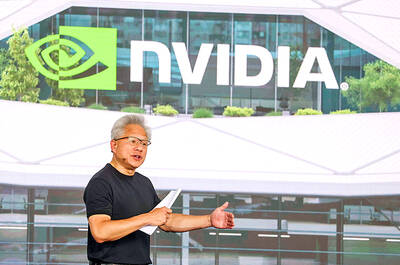
‘BOOMING’: ’ The number of partners we have here is incredible. You can see from their stock prices. They’re doing so well, they’re so happy,’ Jensen Huang said Nvidia Corp’s spending in Taiwan has ballooned to about US$150 billion a year, 10 times the US$10 billion to US$15 billion the company spent five years ago, Nvidia chief executive officer Jensen Huang (黃仁勳) said yesterday, suggesting Taiwan’s strategic importance in the global artificial intelligence (AI) supply chain. “Taiwan is the epicenter of the AI revolution. This is where the chips come, packaging comes. This is where the systems are made. This is where AI supercomputers were created,” Huang said at a meeting for the company’s employees in Beitou-Shilin Technology Park (北投士林科技園區) in Taipei, the planned site of Nvidia’s Taipei headquarters. “Taiwan
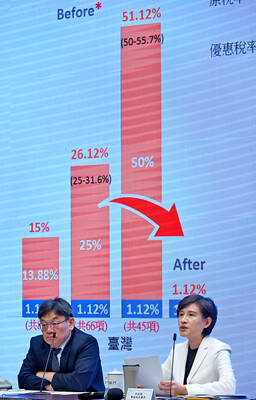
GREATER REACH? Auto parts and wood products would face tariffs of up to 15%, matching those targeting the EU, Japan and South Korea, Vice Premier said The US has announced that preferential tariff treatment for Taiwan’s non-semiconductor Section 232 goods would take effect retroactively from May 1, the Executive Yuan said yesterday. The US government yesterday posted a notice on the Federal Register’s public inspection Web site previewing tariff concessions for Taiwan under a memorandum of understanding (MOU) on Taiwan-US investment after two months of negotiations. The MOU signed on Jan. 15 stipulated three major preferential tariff arrangements: a 15 percent “reciprocal” tariff rate for Taiwan without stacking most-favored nation (MFN) rates; preferential Section 232 treatment for semiconductors and related products; and preferential Section 232 treatment for non-semiconductor


 RSS
RSS