


Allegations that President Ma Ying-jeou (馬英九) received a NT$200 million (US$6.2 million) off-the-books political donation from Ting Hsin International Group (頂新集團) made by media personality Clara Chou (周玉蔻) are being investigated by the Special Investigation Division (SID) of the Supreme Prosecutors’ Office, while Ma said yesterday that he was suing Chou in an individual capacity to defend the dignity of the head of state.
Chou has cited anonymous sources at the National Security Council that said the “Ma administration” — which she said referred to Ma himself — had privately accepted a NT$200 million political donation, severely tarnishing the image of the Ma administration as honest.
Chou said that Senhwa Biosciences (生華生物科技) chairman Benny Hu (胡定吾) was a key person in the process and the relationship between Hu, Ma and Ting Hsin had caused the Ma administration to cover up for Ting Hsin during food safety scandals earlier this year.
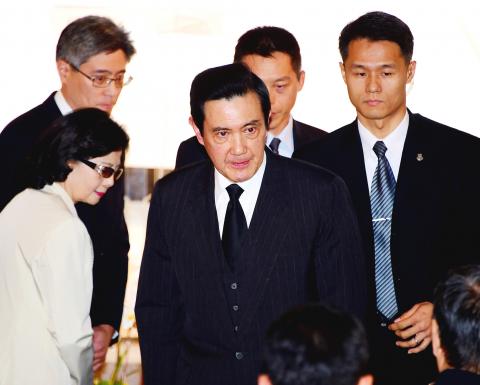
Photo: Pan Shao-tang, Taipei Times
SID Director Kuo Wen-tung (郭文東) said the division has assigned Prosecutor Lin Cheng-tsung (林承宗) to head the investigation of alleged violations of the Political Donations Act (政治獻金法).
The case is still in the evidence-gathering stage and there is no clear defendant as of yet, Kuo said, adding that the division was not ruling out questioning Chou.
The SID is only gathering evidence to determine whether the case would fall under the division’s jurisdiction, Kuo said, adding that if that was not the case, it would be transferred to the Taipei District Prosecutors’ Office.
The district prosecutors’ office would be kept in the loop during the investigation, Kuo said.
Presidential Office spokesperson Ma Wei-kuo (馬瑋國) said yesterday that the allegations were baseless slander and added that Ma had applauded the SID’s initiative to investigate the allegations.
The president has expressed his hope that the judiciary would be able to clear up the incident as soon as possible, Ma Wei-kuo said.
Ma Wei-kuo said the government’s stance on the food safety scandals involving Ting Hsin was that the judiciary should investigate the cases and punish violators of the law heavily.
Meanwhile, in response to Ma Ying-jeou’s litigation against her, Chou said yesterday that she had mentioned specific sources in all recent reports and should the case be taken to court she could prove that all her claims are based on truth by calling witnesses to the stand.
“Since I am the defendant in the suit Ma raised against me, I need not make any statements to the SID that would be disadvantageous to me,” Chou said.
However, she added that an exception could be made if the SID wished to look deeper into the possibility that the Ma administration has been covering for Ting Hsin.
Chou said that by law, the legality of the political donations lay within the jurisdiction of the Control Yuan and not the SID, adding that she would decide whether she would talk with the SID concerning the case today.
Additional reporting by CNA

A signaling system malfunction disrupted high-speed rail (HSR) services beginning at 8am today, with trains temporarily reduced to three northbound and three southbound trains per hour as authorities conduct inspections. The malfunction occurred on a section of track in Miaoli County during pre-operation checks early this morning, forcing northbound and southbound trains to use a single track, the HSR operator said. The regular schedule has been replaced with three hourly trains offering only nonreserved seating in each direction, stopping at every station, it said, adding that business class cars would still have reserved seating. Departures from terminal stations are scheduled at the top

DRONE CENTRAL: Taiwan aims to become Asia’s democratic hub for drones, with most exports focused on high-quality military-grade models, an official said Taiwan’s drone industry is expected to expand significantly by 2030, producing 100,000 units per month and exporting half of them, the Ministry of Economic Affairs said yesterday. Current drone production capacity is about 15,000 units per month, but the industry can quickly scale up as demand increases, Industrial Development Administration Director-General Chiou Chyou-huey (邱求慧) told a news conference in Taipei. Taiwan’s drone output grew 2.5-fold last year to NT$12.9 billion (US$408.3 million) under a government program to develop the uncrewed vehicle sector, he said. The Executive Yuan in October last year approved plans to invest NT$44.2 billion into domestic production of uncrewed aerial

VERBOSE VESSELS: A CGA cutter and a China Coast Guard exchanged verbal barbs for more than a day in Taiwanese-controlled waters before the Chinese vessel left The Taiwanese and Chinese coast guards had a standoff near the strategically located Pratas Islands (Dongsha Islands, 東沙群島) in the north of the South China Sea, the Coast Guard Administration (CGA) said yesterday. The two sides engaged in intense radio exchanges over sovereignty claims during the 33-hour standoff. China Coast Guard vessel 3501 eventually left the restricted waters, 26.6 nautical miles (49.2km) west of the Pratas Islands, at 5pm yesterday, the CGA said. Lying approximately between southern Taiwan and Hong Kong, the Taiwan-controlled Pratas are seen by some security experts as vulnerable to Chinese attack due to their distance — more than
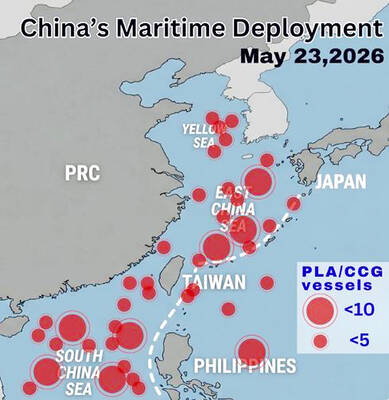
WARNING: China should stop engaging in actions that undermine regional peace and stability, as it would only build resentment among people across the Strait, the CGA said China has deployed more than 100 navy, coast guard and other vessels in waters from the Yellow Sea to the South China Sea and the western Pacific since US President Donald Trump and Chinese President Xi Jinping (習近平) met in Beijing, National Security Council Secretary-General Joseph Wu (吳釗燮) said yesterday. “In this part of the world, #China is the one & only PROBLEM wrecking the #StatusQuo & threatening regional peace & stability,” Wu wrote on X. In a separate post, he said Beijing was coercing Taiwan’s maritime domain, calling it illegal and provocative, after the Coast Guard Administration (CGA) expelled a


 RSS
RSS