


Allegations that President Ma Ying-jeou (馬英九) and his campaign team received an off-the-books political donation from Ting Hsin International Group (頂新集團) continued yesterday as media personality Clara Chou (周玉蔻), in a new revelation, accused the Ma administration of being Ting Hsin’s gatekeeper and identifying Ma himself as the person who had received a NT$200 million (US$6.34 million) donation from the company.
Chou said Ma had received the secret donation from Ting Hsin through a confidant and took it to be within legal boundaries for campaign fund-raising.
He might have thought that as the money was used solely for campaign activities and did not end up in his pocket, it was not corruption, Chou said, but added that the move showed seriously flawed moral integrity.
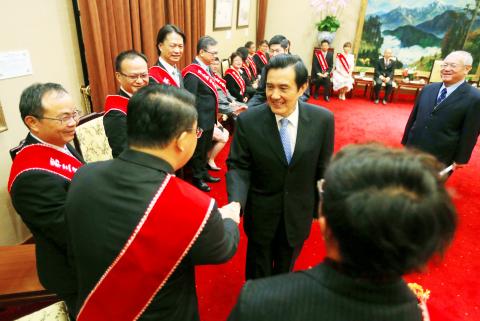
Photo: CNA
Chou wrote an open letter to Ma on Facebook on Monday, naming Benny Hu (胡定吾), Ma’s friend and a board member of Taipei Financial Center Corp (TFCC, 台北金融大樓), the firm that operates Taipei 101, as a key person involved in the donation, suggesting that the president have a “long conversation” with him.
Later the same day, the Chinese Nationalist Party (KMT) filed a lawsuit against Chou for claiming that the KMT received a secret NT$200 million donation from Ting Hsin.
The Presidential Office late on Monday evening released a statement denying the accusations and demanding that Chou provide proof rather than making allegations, saying it suspected that Chou used the term “Ma’s team” to shun legal responsibility.
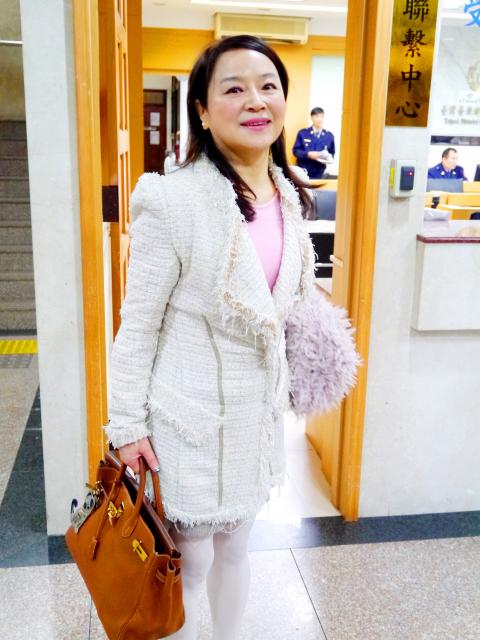
Photo: Chang Hsiao-Ti, Taipei Times
In response, Chou published an article yesterday directly identifying “Ma’s team” with the president himself.
“Hu is the top aide of the Wei (魏) family, which owns Ting Hsin; Ma is Hu’s guardian angel [“men shen (門神)”]; the Ma administration then became Ting Hsin’s gatekeeper,” Chou said in the article.
She said that according to a “reliable source,” Ma knew about the donation and that Hu was the go-between for Ma and Ting Hsin who wore “white gloves” — referring to a middleman who launders money behind a legitimate front, trusted by both parties.
She also accused Ma, the head of the team, of receiving the clandestine donation.
In the article, Chou said that Ma once said “the money was for the election; it was public expenditure, not corruption.”
However, this was self-hypnosis, Chou said, adding that Ma’s team was referring to Ma himself, and that Ma believed that if both Ting Hsin and those within his team denied a donation had been received nothing could be exposed.
Chou called Monday’s Presidential Office statement “dodgy” and talk of investigating in accordance with the law without mercy “empty talk and self-deception” if Ma does not initiate an investigation.
“How do you investigate in accordance with the law when neither the president nor the judicial system have done anything?” she said, calling on Ma to explain the matter and take the initiative to begin an investigation.
“As far as I know, these off-the-books donations have firewalls built in” that make them beyond legal reach, Chou said.
Chou said she was questioning Ma’s “moral integrity” and called on the president to clarify the issue.
Later yesterday, Presidential Office spokesperson Ma Wei-kuo (馬瑋國), in response to Chou’s new allegations, accused her of “distorting the facts and making malign accusations,” and said that while the president has always respected freedom of speech, it is regretful that Chou has continued to defame the president with false allegations.
The president would not exclude the possibility of taking legal action to defend the reputation of his office, the spokesperson said.
Additional reporting by Wang Yu-chung
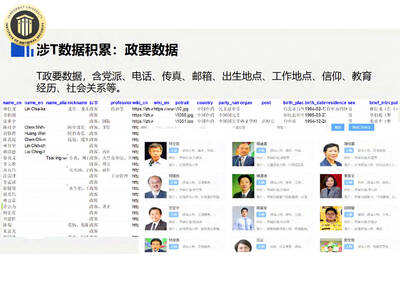
NETWORK-MAPPING PROJECT: The database contains 170 detailed files of Taiwanese politicians and about 23 million records of household registration data in Taiwan China has developed a network-mapping project targeting political figures and parties in Taiwan to monitor public opinion during elections and to craft tailored influence campaigns aimed at dividing Taiwanese society, according to documents leaked by Chinese technology firm GoLaxy (中科天璣). The documents, collected by Taipei-based Doublethink Lab, showed a database was specifically created to gather detailed information on Taiwanese political figures, including their political affiliations, job histories, birthplaces, residences, education, religion and a brief biography about them. Several notable Taiwanese politicians are in the database, including President William Lai (賴清德), former president Tsai Ing-wen (蔡英文), Minister of Foreign Affairs Lin Chia-lung (林佳龍),
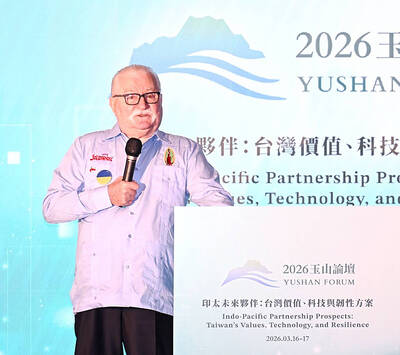
RECOGNITION: Former Fijian prime minister Mahendra Chaudhry said that Taiwan’s New Southbound Policy serves as a stabilizing force in the Indo-Pacific region Taiwan can lead the unification of the Chinese people, Nobel Peace Prize laureate and former Polish president Lech Walesa said in Taipei yesterday, adding that as the world order is changing, peaceful discussion would find good solutions, and that the use of force and coercion would always fail. Walesa made the remarks during his keynote address at a luncheon of the Yushan Forum in Taipei, titled “Indo-Pacific Partnership Prospects: Taiwan’s Values, Technology and Resilience,” organized by the Taiwan-Asia Exchange Foundation with the Ministry of Foreign Affairs. Walesa said that he had been at the forefront of a big peaceful revolution and “if
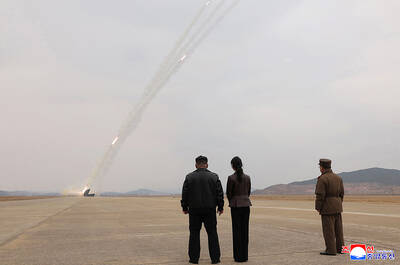
North Korea tested nuclear-capable rocket launchers, state media reported yesterday, a day after Seoul detected the launch of about 10 ballistic missiles. The test comes after South Korean and US forces launched their springtime military drills, due to run until Thursday. North Korean leader Kim Jong-un on Saturday oversaw the testing of the multiple rocket launcher system (MRLS), the Korean Central News Agency (KCNA) said. The test involved 12 600mm-caliber ultra-precision multiple rocket launchers and two artillery companies, it said. Kim said the drill gave Pyongyang’s enemies, within the 420km striking range, a sense of “uneasiness” and “a deep understanding
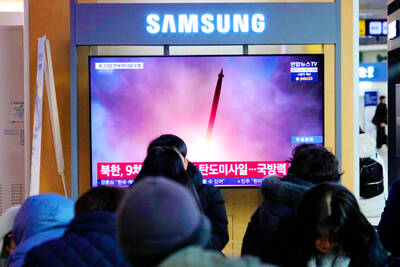
North Korea yesterday fired about 10 ballistic missiles to the sea toward Japan, the South Korean Joint Chiefs of Staff (JCS) said, days after Pyongyang warned of “terrible consequences” over ongoing South Korea-US military drills. Pyongyang recently dashed hopes of a diplomatic thaw with Seoul, Washington’s security ally, describing its latest peace efforts as a “clumsy, deceptive farce.” Seoul’s military detected “around 10 ballistic missiles launched from the Sunan area in North Korea toward the East Sea [Sea of Japan] at around 1:20pm,” JCS said in a statement, referring to South Korea’s name for the body of water. The missiles


 RSS
RSS