


Premier Jiang Yi-huah (江宜樺) is “the most evil man of banality,” prominent Taiwanese literature academic Yang Tsui (楊翠) said yesterday, amid calls for his resignation from the public and legislators across party lines who accused the premier of bad management of the tainted cooking oil scandal, as well as the damage it has done to exports and the reputation of Taiwanese food.
Yang, whose grandfather is Yang Kui (楊逵), a leading Taiwanese writer best known for the books The Newspaper Boy (送報伕) and The Indomitable Rose (壓不扁的玫瑰花), also accused Jiang of acting heavy-handedly toward student protesters, but appearing unhesitant to give perks to the most prominent oil scandal accused, senior Ting Hsin International Group (頂新集團) executive Wei Ying-chun (魏應充).
Yang Tsui, an associate professor at National Dung Hwa University, said on Facebook yesterday that the prosecutors and the police were “caring and gentle” while searching Wei’s luxury apartment earlier this week, and did not even dare to go into his kitchen. Wei was also not handcuffed when he was taken from a prosecutors’ inquiry session to the court, as is regular practice.

Photo: Wang Min-wei, Taipei Times
Compared with the “gentleness” reserved for Wei, she said, the students in the Sunflower movement who stormed the Executive Yuan were pitilessly handled and arrested, with their wrists scraped by handcuffs. The police even used cable ties to confine students’ movement, “tying [their wrists] dead tight,” said Yang Tsui, who is the mother of one of the Sunflower movement leaders, Dennis Wei (魏揚).
The Chinese Nationalist Party (KMT) government offered a legal basis to justify the opposite treatments of Wei Ying-chun and the students, which Yang Tsui furiously called the “KMT’s arbitrary use, non-use and interpretation of the law.”
A wave of boycotts has hit Ting Hsin’s products and the workers at its subsidiary, Wei Chuan Foods Corp (味全), have voiced concerns over their livelihood, she said, but Jiang has done nothing to safeguard the workers’ rights and has been nonchalant about animosity between consumers and Wei Chuan’s workers.
“Shouldn’t you be demanding compensation from the corporation for the workers? Why are you letting the situation degenerate into a state where the workers’ rights are pitted against consumers’ rights?” Yang Tsui asked the premier.
The government had also allowed a private jet belonging to the Wei (魏) family — Ting Hsin International Group’s founder-owners — to fly to China without hindrance.
“Can you be 100 percent sure that there is no relevant evidence whatsoever on the jet?” Yang Tsui asked.
“What policies in the world has this ‘Executive’ Yuan ‘executed?’” she added.
The phrase “administrating according to the law” that has been repeatedly used by the KMT government now sounds extremely grating, Yang Tsui said.
“The phrase was used when the government strong-armed small families into a deplorable state, such as in a case of land expropriation in [Miaoli County’s] Dapu [Borough, 大埔], but it has also been used to allow the wealthy [accused] to have more time to destroy evidence and hide their assets. The KMT simply has the final say on everything,” she said.
Despite Jiang’s claim that he “abhors evils as deadly foes,” as far as he is concerned, “the students who stand against him are the most evil, while the KMT-supporting Ting Hsin is not,” Yang Tsui said.
He is either the most hypocritical villain or the “most evil man of banality,” she said.
Meanwhile, a number of civic groups were discussing a plan to stage a large-scale demonstration to protest the string of food safety scandals that have occurred under the watch of President Ma Ying-jeou’s (馬英九) administration and what they described as the government’s negligence in reining in businesspeople moving freely across the Taiwan Strait, such as the Wei family.
Taiwan Association of University Professors president Lu Chung-chin (呂忠津) said the Ma administration has been cozying up to China since Ma was elected in 2008, adding that Ting Hsin was allowed to set up its business in Taiwan shortly after Ma came into office.
The recent scandals over food security show that the government is too lenient and protective of these businesspeople who move freely between Taiwan and China, Lu said, calling on Ma and Jiang to take responsibility.
Saying that the public’s ongoing boycott of Ting Hsin products would only solve the problem on the surface, Alliance of Referendum for Taiwan convener Tsay Ting-kuei (蔡丁貴) said that the Ma administration’s cozying up to corporations lay at the root of all the issues.
Additional reporting by Lee Hsin-fang

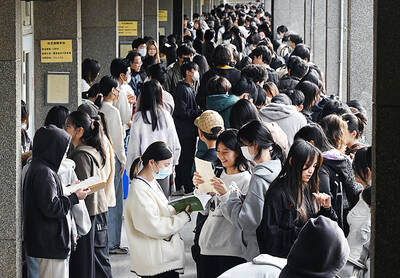
A global survey showed that 60 percent of Taiwanese had attained higher education, second only to Canada, the Ministry of the Interior said. Taiwan easily surpassed the global average of 43 percent and ranked ahead of major economies, including Japan, South Korea and the US, data from the Organisation for Economic Co-operation and Development (OECD) for 2024 showed. Taiwan has a high literacy rate, data released by the ministry showed. As of the end of last year, Taiwan had 20.617 million people aged 15 or older, accounting for 88.5 percent of the total population, with a literacy rate of 99.4 percent, the data

NEW LOW: The council in 2024 based predictions on a pessimistic estimate for the nation’s total fertility rate of 0.84, but last year that rate was 0.69, 17 percent lower An expected National Development Council (NDC) report expects the nation’s population to drop below 12 million by 2065, with the old-age dependency ratio to top 100 percent sooner than 2070, sources said yesterday. The council is slated to release its latest population projections in August, using an ultra-low fertility model, the sources said. The previous report projected that Taiwan’s population would fall to 14.37 million by 2070, but based on a new estimate of the total fertility rate (TFR) — the average number of children born to a woman over her lifetime — the population is expected to reach 12 million by
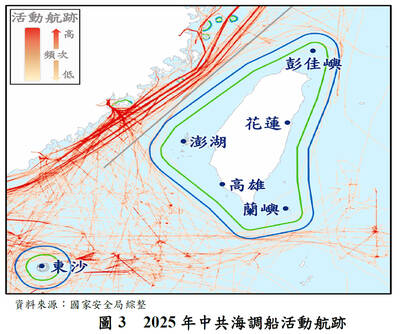
INTENSIFYING THREATS: Beijing’s tactics include massive attacks on the government service network, aircraft and naval vessel incursions and damaging undersea cables China is prepared to interfere in November’s nine-in-one local elections by launching massive attacks on the Taiwanese government’s service network (GSN), a report published by the National Security Bureau showed. The report was submitted to the Legislative Yuan ahead of the bureau’s scheduled briefing at the Foreign Affairs and National Defense Committee tomorrow. The national security team has identified about 13,000 suspicious Internet accounts and 860,000 disputed messages, the bureau said of China’s cognitive warfare against Taiwan. The disputed messages focus on major foreign affairs, national defense and economic issues, which were produced using generative artificial intelligence (AI) and distributed through Chinese
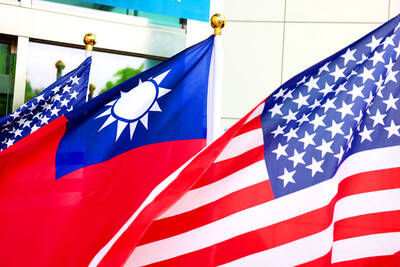
COUNTERING HOSTILITY: The draft bill would require the US to increase diplomatic pressure on China and would impose sanctions on those who sabotage undersea cable networks US lawmakers on Thursday introduced a bipartisan bill to bolster the resilience of Taiwan’s submarine cables to counter China’s hostile activities. The proposal, titled the critical undersea infrastructure resilience initiative act, was cosponsored by Republican representatives Mike Lawler and Greg Stanton, and Democratic Representative Dave Min. US Senators John Curtis and Jacky Rosen also introduced a companion bill in the US Senate, which has passed markup at the chamber’s Committee on Foreign Relations. The House’s version of the bill would prioritize the deployment of sensors to detect disruptions or potential sabotage in real-time and enhance early warning capabilities through global intelligence sharing frameworks,


 RSS
RSS