


The Food and Drug Administration (FDA) yesterday said that Ting Hsin Oil and Fat Industrial Co (頂新製油實業), a subsidiary of Ting Hsin International Group (頂新集團), allegedly used animal feed oil in the production of its cooking lard products.
“The Taipei Economic and Cultural Office in Hanoi notified us on Thursday that the cooking lard oil Ting Hsin Oil and Fat had imported from Vietnam-based oil manufacturer Dai Hanh Phuc Co last year and this year was actually meant for animal feed,” FDA interim Director-General Chiang Yu-mei (姜郁美) told a press conference late yesterday.
Chiang said the FDA made the discovery after trying to ascertain the sources of the nation’s imported cooking lard oil, most of which comes from Hong Kong, Spain, Vietnam and Japan.
The FDA has temporarily suspended a Ting Hsin Oil and Fat factory in Pingtung County, where two sumps containing a total of 358 tonnes of lard have been sealed as a precaution, Chiang said.
Chiang said a ban has also been imposed on imports of butter and lard from Vietnam, while other cooking oil products imported from the Southeast Asian country have been subjected to batch-by-batch inspections starting yesterday.
“The FDA will reconfirm with the office regarding the nature of the oil imported from the Vietnamese firm and investigate whether Ting Hsin Oil and Fat have mixed animal feed oil in its lard products,” Chiang said.
Earlier yesterday, former minister of health and welfare Chiu Wen-ta (邱文達) said in an interview published yesterday that there are two more companies in addition to Cheng I Food Co (正義股份) — also a subsidiary of Ting Hsin International — that have purchased suspicious amounts of animal feed oil.
However, the information has not been made public, Chiu said.
Chiu, who resigned on Oct. 3 over a recycled waste oil scandal involving manufacturer Chang Guann Co (強冠企業) last month, made the allegations in an interview with the Chinese-language CommonWealth Magazine.
He said that besides Ting Hsin, another conglomerate has been engulfed in multiple food scandals since the 2011 plasticizer food scare, but has yet to be caught.
When questioned at a press conference yesterday morning, FDA Northern Center for Regional Administration director Feng Jun-lan (馮潤蘭) said the agency could not comment because it has not obtained evidence for the claim.
However, Chiang held another press conference hours later announcing that the two companies were Chiayi County’s Yung Cheng Oil Co (永成油脂) and Hsu Jih Yu Trading Co (旭日友商行).
“On Sept. 18, the FDA referred six of Cheng I Food’s upstream suppliers to investigative authorities due to suspicious discrepancies between the accounts of their business dealings with Cheng I Food,” Chiang said. “Yung Cheng Oil and Hsu Jih Yu were on the second list of suspicious suppliers to Cheng I Food. We ordered investigations into the two firms on Sept. 30.”
Chiang said that preliminary investigations have only discovered that Yung Cheng peddled a total of 1,600 tonnes of lard to Cheng I Food via Hsu Jih Yu this year, and it has yet to be determined whether any irregularities are involved.
As for the identity of the “unscrupulous large corporation,” Chiang said she had no knowledge of the issue and would double check with Chiu — whom she said is on a “mind-emptying trip” abroad — to find out what he meant.
Meanwhile, the FDA also faced mounting criticism over its repeated refusal to make public a list of 363 food manufacturers, restaurants and street vendors that have purchased Cheng I Food’s potentially tainted oil to avoid confusion over names, as seen in the waste oil scandal triggered by Chang Guann last month.
The agency softened its stance later yesterday, with Chiang pledging to decide whether to release the list by the end of the day.
No list was ready at press time.
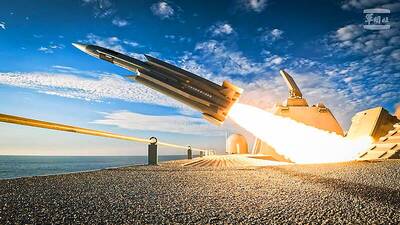
DETERRENCE: With 1,000 indigenous Hsiung Feng II and III missiles and 400 Harpoon missiles, the nation would boast the highest anti-ship missile density in the world With Taiwan wrapping up mass production of Hsiung Feng II and III missiles by December and an influx of Harpoon missiles from the US, Taiwan would have the highest density of anti-ship missiles in the world, a source said yesterday. Taiwan is to wrap up mass production of the indigenous anti-ship missiles by the end of year, as the Chungshan Institute of Science and Technology has been meeting production targets ahead of schedule, a defense official with knowledge of the matter said. Combined with the 400 Harpoon anti-ship missiles Taiwan expects to receive from the US by 2028, the nation would have

POSSIBILITIES EMERGE: With Taiwan’s victory and Japan’s narrow win over Australia, Taiwan now have a chance to advance if South Korea also beat the Aussies Taiwan has high hopes that the national baseball team would advance to the World Baseball Classic (WBC) quarter-finals after clinching a crucial 5-4 victory over South Korea in a nail-biting extra-inning game at the Tokyo Dome yesterday. Boosted by three home runs — two solo shots by Yu Chang (張育成) and Cheng Tsung-che (鄭宗哲) and a two-run homer by Stuart Fairchild — the triumph gave Taiwan a much-needed second victory in the five-team Pool C, where only the top two finishers would advance to the knockout stage in Miami, Florida. Entering extra innings with the game tied at four apiece, Taiwan scored
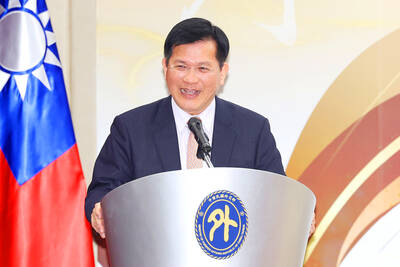
MISSION OF PEACE: The foreign minister urged Beijing to respect Taiwan’s existence as an independent nation, and work together to ensure peace and stability in the region Minister of Foreign Affairs Lin Chia-lung (林佳龍) yesterday rejected Chinese Minister of Foreign Affairs Wang Yi’s (王毅) comments about Taiwan, criticizing China as a “troublemaker” in the international community and a disruptor of cross-strait peace. Speaking at a news conference on the sidelines of the Chinese National People’s Congress, Wang said that Taiwan has always been a territory of China and that it would be impossible for it to become its own country. The “return” of Taiwan to China was the natural outcome of the Chinese people’s resistance against Japan in World War II, and that any pursuit of independence was “doomed

‘UNWAVERING FRIENDSHIP’: A representative of a Japanese group that co-organized a memorial, said he hopes Japanese never forget Taiwan’s kindness President William Lai (賴清德) yesterday marked the 15th anniversary of the Tohoku earthquake and tsunami, urging continued cooperation between Taiwan and Japan on disaster prevention and humanitarian assistance. Lai wrote on social media that Taiwan and Japan have always helped each other in the aftermath of major disasters. The magnitude 9 earthquake struck northeastern Japan on March 11, 2011, triggering a massive tsunami that claimed more than 19,000 lives, according to data from Japanese authorities. Following the disaster, Taiwan donated more than US$240 million in aid, making it one of the largest contributors of financial assistance to Japan. In addition to cash donations and


 RSS
RSS