


Premier Jiang Yi-huah (江宜樺) should make clear to the public if the Cabinet has in any way hidden the severity of adulterated-oil reports or covered for oil businesses, and also take political responsibility for mistaken guarantees that oil products are still edible, Democratic Progressive Party (DPP) Chairperson Tsai Ing-wen (蔡英文) said yesterday.
Following the adulterated lard product scandal involving Chang Guann Co (強冠企業) last month, the market has once again been shaken by reports of adulterated oil from Cheng I Food Co (正義股份), which allegedly mixed animal feed oil with lard.
According to DPP Legislative Yuan Convener Tsai Chi-chang (蔡其昌), many legislators had warned Jiang and the Cabinet that there was potential adulteration of oil supplies at Cheng I Food — a subsidiary of Ting Hsin International Group (頂新集團) — but the warnings had been met with assurances by Jiang that the oils were safe.
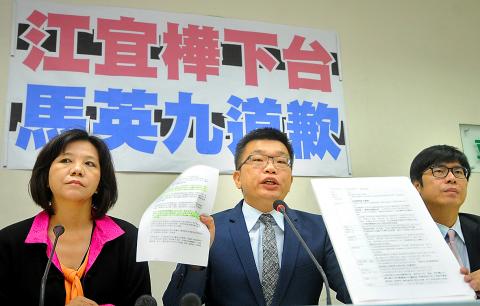
Photo: Fang Pin-chao, Taipei Times
The entirety of the Chinese Nationalist Party (KMT) government had been attempting to cover for Ting Hsin, a Taiwanese company with Chinese funding, and ignored the health of Taiwanese, Tsai Chi-chang said, adding that Jiang must resign and President Ma Ying-jeou (馬英九) should extend a public apology.
DPP spokesperson Hsu Chia-ching (徐佳青) said Jiang’s guarantee of certain companies has caused Taiwanese to ingest tainted oil for two more weeks after his statement.
Whether “political responsibility” by Tsai Ing-wen meant stepping down, “Jiang’s conscience would tell him,” Hsu said, adding that everyone in the nation knew clearly what it meant.
Despite the multiple amendments to food security laws in recent years, the crux of the issue was non-implementation of the laws, he said.
If the government could not hold companies to its laws and keep using special methods to solve problems caused by companies who transgress, it would not matter how strict the nation’s laws were, Hsu said.
Former DPP chairman Su Tseng-chang (蘇貞昌) said that the government seemed unable to come up with a permanent solution for outbreaks of food security issues.
All the government can do is to reassure the public, hold meetings and investigate, but it could not produce a safe and healthy food environment, Su said, adding that it demonstrated that the government was the problem central to the issue.
Executive Yuan spokesman Sun Lih-chuyn (孫立群) rejected the DPP’s accusation against Jiang, saying that the government has never discontinued its investigation into the waste oil scandal and handed over the relevant information to the Kaohsiung District Prosecutors’ Office as early as Sept. 19.
Sun said he would not respond to the DPP’s call demanding Jiang’s resignation.
The premier convened another cross-ministerial meeting on tainted lard yesterday and sternly denounced the use of substandard materials to manufacture lard.
Jiang also demanded that the Ministry of Health and Welfare, and other relevant agencies, make thorough and close examinations on the flow of the tainted oil products, and “reserve zero room for leniency and hold the culpable accountable to the fullest extent.”

‘NO SECURITY RISK’: The Railway Bureau reassured the public that the technicians’ activities were limited to technical guidance and did not involve sensitive systems The Railway Bureau yesterday said it had invited eight Chinese technicians to assist with an airport MRT construction project. The bureau issued the confirmation after an Internet user said Chinese nationals had entered the construction zone of Taiwan Taoyuan International Airport’s Terminal 3 project. They asked why “individuals from an enemy state” were allowed access to such a major national infrastructure project, which raised serious concerns over Taiwan’s industrial safety, sensitive systems and information security. The bureau’s Northern Region Engineering Branch Office said subcontractor Taiwan Handle Industrial Co (台灣手把工業) of the Taoyuan airport MRT’s “Contract No. CU05 Project A14 Station Civil, MEP &

A US uncrewed surface vessel (USV) encountered multiple Chinese warships during an autonomous transit of the Taiwan Strait, US defense company Seasats said in a statement on Wednesday. Seasats announced that a Lightfish USV had completed the first autonomous transit of the Taiwan Strait. Over five days, the USV traversed the entire length of the Strait while constantly monitoring surface vessel traffic, the company said. The Lightfish encountered multiple Chinese warships, one of which was a Chinese People’s Liberation Army Navy (PLAN) Type 056 corvette, it said. The Chinese vessels were operating “well within Taiwan’s exclusive economic zone without transmitting their identity via the
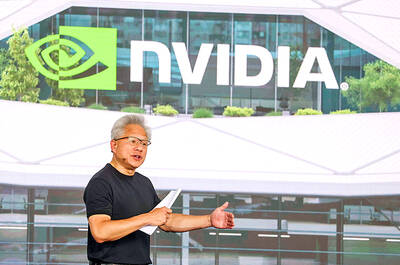
‘BOOMING’: ’ The number of partners we have here is incredible. You can see from their stock prices. They’re doing so well, they’re so happy,’ Jensen Huang said Nvidia Corp’s spending in Taiwan has ballooned to about US$150 billion a year, 10 times the US$10 billion to US$15 billion the company spent five years ago, Nvidia chief executive officer Jensen Huang (黃仁勳) said yesterday, suggesting Taiwan’s strategic importance in the global artificial intelligence (AI) supply chain. “Taiwan is the epicenter of the AI revolution. This is where the chips come, packaging comes. This is where the systems are made. This is where AI supercomputers were created,” Huang said at a meeting for the company’s employees in Beitou-Shilin Technology Park (北投士林科技園區) in Taipei, the planned site of Nvidia’s Taipei headquarters. “Taiwan
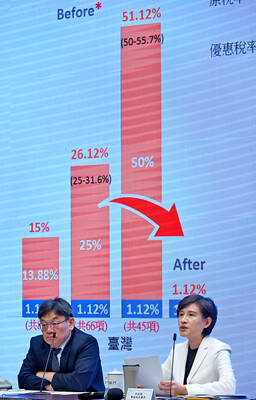
GREATER REACH? Auto parts and wood products would face tariffs of up to 15%, matching those targeting the EU, Japan and South Korea, Vice Premier said The US has announced that preferential tariff treatment for Taiwan’s non-semiconductor Section 232 goods would take effect retroactively from May 1, the Executive Yuan said yesterday. The US government yesterday posted a notice on the Federal Register’s public inspection Web site previewing tariff concessions for Taiwan under a memorandum of understanding (MOU) on Taiwan-US investment after two months of negotiations. The MOU signed on Jan. 15 stipulated three major preferential tariff arrangements: a 15 percent “reciprocal” tariff rate for Taiwan without stacking most-favored nation (MFN) rates; preferential Section 232 treatment for semiconductors and related products; and preferential Section 232 treatment for non-semiconductor


 RSS
RSS