

The Taiwan Smokers’ Rights Association yesterday accused the New Taipei City Government of breaking the law and violating students’ rights with its request that junior and senior-high schools conduct tobacco tests on suspected smokers.
“It is not about ‘you have nothing to worry about if you don’t smoke,’ the problem is that the [city’s] Education Bureau and the school have no right to ask students to take a tobacco test,” association president Chen Chi-an (陳麒安) told reporters and bureau officials during the protest at New Taipei City Hall.
“It does not matter if the student tested positive or negative — such a test is simply unlawful,” he said.
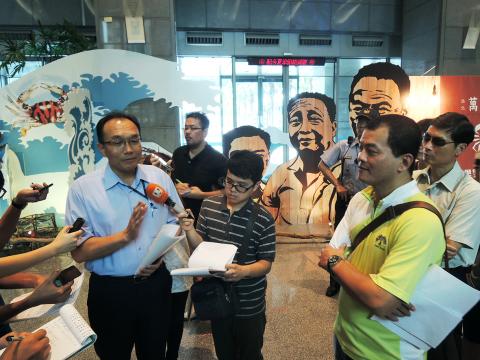
Photo: Weng Yu-huang, Taipei Times
The bureau announced early this week that it has allocated 125 tobacco detectors to junior and senior-high schools across the city, and asked school administrators and teachers to conduct tobacco tests on students who are known to be smokers or suspected to be smokers, and place smokers on quit-smoking programs.
Chen said the law mandates that such tests can only be conducted if there is a warrant from the court or a prosecutor.
“We hereby urge students to refuse to take the test when asked by their school, and if the school threatens to penalize them for refusing, they can file a lawsuit against the school for breach of freedom,” he said.
Chen added that the group would provide legal counsel or assistance to students if needed.
Peng Yun-hua (彭允華), the bureau’s Campus Security Office director, defended the policy, saying it was entirely legal and well-intentioned.
“According to relevant laws, people under the age of 18 are prohibited from smoking. Moreover, it is a known fact that smoking is harmful to health; therefore, the policy is aimed at helping students quit smoking if they are already smokers,” Peng told reporters at a press conference.
“As to the legality issue, a warrant from the court or a prosecutor is only mandatory for conducting intrusive tests, but a tobacco test only requires the student to blow into the device, and so a warrant is not needed,” he said.
Asked if students might be penalized for refusing to take the test, Peng said that he hopes that “students will not refuse.”
He added that the bureau has instructed schools to gently persuade them and that penalties would only be used as a last resort.
Separately, the Humanistic Education Foundation also voiced its opposition to the tobacco tests, as well as a request from Minister of Education Wu Se-hwa (吳思華) to add drug tests to routine physical exams in school.
The foundation said in a statement that the ministry should not act as if it is the National Police Agency, and that it should not treat students like suspects.

Taiwan, which accounts for more than half of the global outsourced semiconductor assembly and testing market, is well-positioned to develop copackaged optics (CPO) and manufacture precision silicon photonics chips, the Ministry of Economic Affairs said yesterday. Silicon photonics are emerging as a mainstream optical communications technology and is seen as key to overcoming bottlenecks in AI computing power. The technology is a key project under the government’s New 10 Major AI Infrastructure Projects, with industry, government, academia and research institutions working to overcome critical technological hurdles and build a self-reliant silicon photonics supply chain, the ministry said. Nvidia Corp in March invested US$4
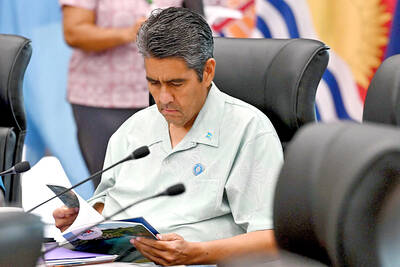
Palau’s president yesterday called for a “unified” Pacific response to a missile test by China in July, while Taiwan and its Pacific allies a day earlier at the Pacific Islands Forum (PIF) reaffirmed their commitment to peace, stability and prosperity. China gave only a handful of nations short notice before test-firing an intercontinental ballistic missile in July, sparking condemnation from several Pacific leaders. The 18-member PIF being held in Palau was expected to release a communique after press time last night, with a formal response to the test possibly included. Palau, which invited Taiwan to attend sideline events as an aid partner, urged
China’s continued efforts to inject geopolitical rivalry into the region and disrupt Pacific nations’ discussions of regional issues warrant greater international attention, a foreign affairs official said yesterday. Minister of Foreign Affairs Lin Chia-lung (林佳龍) last week led a delegation to diplomatic ally Palau to attend events related to the 55th Pacific Islands Forum (PIF) summit. However, the absence of some member-state leaders has been interpreted by some people as a sign of fracturing in Pacific unity. Thirteen PIF members were represented by their heads of state or government, while Fiji, New Caledonia, Vanuatu and Samoa sent ministerial-level representatives, a diplomatic official
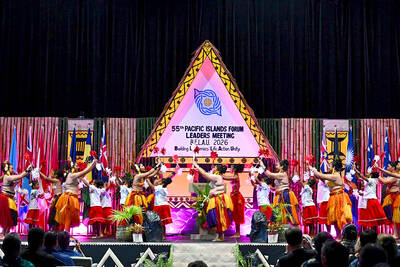
STATE DEPARTMENT: A US official said that Washington would provide more than US$150m for Pacific island nations, with Minister Lin Chia-lung welcoming the plans The US Department of State has announced partnerships with Taiwan on two Palau projects after Washington pledged more than US$150 million for Pacific island nations. Following the opening of the 55th Pacific Islands Forum (PIF) Leaders Meeting in Palau on Sunday, the department on Tuesday issued a statement titled “Promoting Pacific Prosperity: US Engagement at the Pacific Islands Forum,” which said that the US’ commitment to the security and prosperity of Pacific island nations “is steadfast and enduring, and remains a core pillar of its ‘America first’ foreign policy.” Meanwhile, US Deputy Secretary of State Christopher Landau announced at the PIF Partners


 RSS
RSS