


President Ma Ying-jeou (馬英九) yesterday called for end to “vicious political infighting” among the nation’s politicians, while repeatedly praising the views expressed in a Wall Street Journal editorial last week titled: “Taiwan Leaves Itself Behind” and urging legislators to speedily ratify the cross-strait service trade agreement.
“Once again I appeal to the minority opposition parties to stop using violent means like occupying the legislative floor to bully the majority and paralyze legislative proceedings. [If their boycott continues,] what alternatives are there to deal with issues vital to the nation’s economic development?” Ma said.
No one will emerge victorious from vicious political infighting at the expense of the nation’s interests, Ma said, adding: “We have to unite under the accord to keep our nation moving forward because Taiwan is the only homeland we have and moving forward is our only choice. There is no turning back — we must march on bravely.”
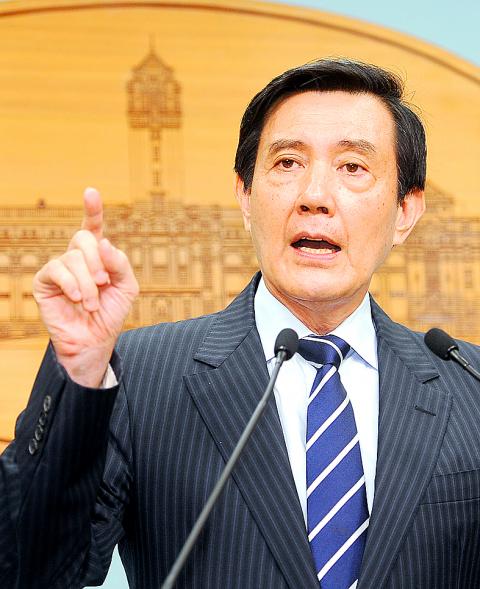
Photo: Fang Pin-chao, Taipei Times
Ma made the remarks at a press conference that the Presidential Office said had been called so the president could deliver an “important speech” on the gas pipeline explosions that devastated Greater Kaohsiung on July 31 and Aug. 1.
However, after dedicating the first three minutes of a nine-minute speech to detailing what the central government has done to assist the Greater Kaohsiung Government in rescue and relief operations, Ma quickly moved from the blasts that killed 30 people and injured 310 to “the future of Taiwan’s economy.”
“After the rescue operations come to an end, there are three things we need to do in the future: rebuild our homeland, determine what the causes of the explosion were and prevent the recurrence of such incidents,” Ma said, pledging that the central government would continue providing assistance to the city government.
He then turned to the subject of the nation’s economy, starting with the Journal editorial from Aug. 4.
“The editorial’s critique of the aura of isolation Taiwan has imposed on itself has resonated with many people,” he said, adding that the article delivered three home truths.
The first is that Taiwan will “only hurt itself” if it preserves national barriers to cross-strait trade. Second, as South Korea and China step up negotiations aimed at signing a free-trade agreement by the end of the year, the success of those talks could “be a serious problem for Taiwan,” whose exports to China overlap significantly with those of South Korea, Ma said.
The third point is that the legislature should ratify the service trade agreement stymied by the student-led Sunflower movement as soon as possible, while also passing the trade in goods agreement being negotiated with Beijing once those talks have concluded, Ma said, warning that if lawmakers do not do this, “Taiwan will be further isolated.”
The editorial echoed many of the views that the government has espoused over the past year, and which have seen it criticized by “some people who are of the opinion that the government is just exaggerating things to scare people,” the president said.
“Now, the international media is expressing the same views as us [the government],” Ma said. “We must continue to push for trade liberalization to avoid being marginalized... To that end, further cross-strait cooperation in trade and economics is inevitable.”
The president said he drew on the Journal editorial to strengthen his arguments not because he is obsequious to whatever foreigners say, but with the purpose of letting “everyone know that the international community is looking at Taiwan and, in their eyes, it is very regrettable that Taiwan is falling behind other countries in opening up its economy and that vicious political infighting has dragged down its major economic policy agenda.”
In response to media inquires on what steps can be taken to end the political squabbling, Ma said he does not — and has never — rule out sitting down with Democratic Progressive Party chairperson Tsai Ing-wen (蔡英文), but that ideally, he would start the reconciliation process by building a consensus within the Chinese Nationalist Party (KMT) that he chairs before reaching out to the opposition.
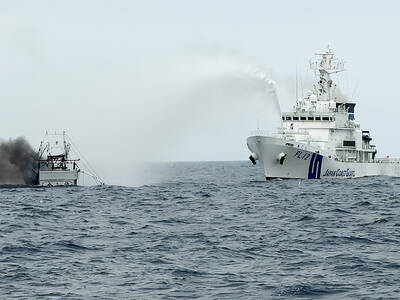
CREDIT-GRABBER: China said its coast guard rescued the crew of a fishing vessel that caught fire, who were actually rescued by a nearby Taiwanese boat and the CGA Maritime search and rescue operations do not have borders, and China should not use a shipwreck to infringe upon Taiwanese sovereignty, the Coast Guard Administration (CGA) said yesterday. The coast guard made the statement in response to the China Coast Guard (CCG) saying it saved a Taiwanese fishing boat. The Chuan Yu No. 6 (全漁6號), a fishing vessel registered in Keelung, on Thursday caught fire and sank in waters northeast of Diaoyutai Islands (釣魚台). The vessel left Keelung’s Badouzih Fishing Harbor (八斗子漁港) at 3:35pm on Sunday last week, with seven people on board — a 62-year-old Taiwanese captain surnamed Chang (張) and six
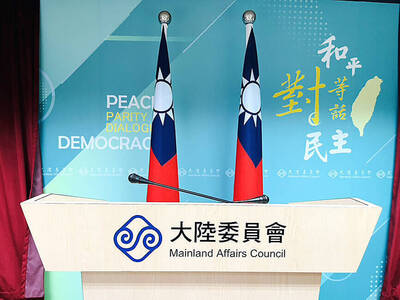
RISKY BUSINESS: The ‘incentives’ include initiatives that get suspended for no reason, creating uncertainty and resulting in considerable losses for Taiwanese, the MAC said China’s “incentives” failed to sway sentiment in Taiwan, as willingness to work in China hit a record low of 1.6 percent, a Ministry of Labor survey showed. The Directorate-General of Budget, Accounting and Statistics (DGBAS) also reported that the number of Taiwanese workers in China has nearly halved from a peak of 430,000 in 2012 to an estimated 231,000 in 2024. That marked a new low in the proportion of Taiwanese going abroad to work. The ministry’s annual survey on “Labor Life and Employment Status” includes questions respondents’ willingness to seek employment overseas. Willingness to work in China has steadily declined from

LEVERAGE: China did not ‘need to fire a shot’ to deny Taiwan airspace over Africa when it owns ‘half the continent’s debt,’ a US official said, calling it economic warfare The EU has raised concerns about overflight rights following the delay of President William Lai’s (賴清德) planned state visit to the Kingdom of Eswatini after three African nations denied overflight clearance for his charter at the last minute. Taiwanese allies Paraguay and Saint Kitts and Nevis, as well as several US lawmakers and the Inter-Parliamentary Alliance on China (IPAC) condemned China for allegedly pressuring the countries. Lai was scheduled to fly directly to Taiwan’s only African ally from yesterday to Sunday to celebrate the 40th anniversary of King Mswati III’s accession and his 58th birthday, but Seychelles, Mauritius and Madagascar suddenly revoked
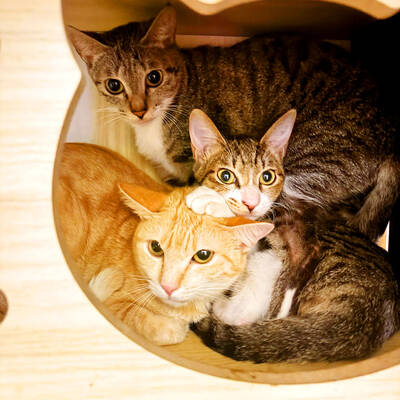
The number of pet cats in Taiwan surpassed that of pet dogs for the first time last year, reaching 1,742,033, a 32.8 percent increase from 2023, the Ministry of Agriculture said yesterday, citing a survey. By contrast, the number of pet dogs declined slightly by 1.2 percent over the same period to 1,462,528, the ministry said. Despite the shift, households with dogs still slightly outnumber those with cats by 1.2 percent. However, while the number of households with multiple dogs has remained relatively stable, households keeping more than two cats have increased, contributing to the overall rise in the feline population. The trend


 RSS
RSS