


At least 10 people died in a fresh strike on a UN school in Gaza yesterday, shortly after Israel confirmed it had begun withdrawing some troops from the enclave.
The strike on the school sheltering displaced Palestinians in the southern city of Rafah came as Israel pounded the region following the suspected capture of a soldier by militants, who was later declared dead.
It was the third time in 10 days that a UN school had been hit and came four days after Israeli tank shells slammed into a school in the northern town of Jabaliya, killing 16 in an attack denounced by UN Secretary-General Ban Ki-moon as “reprehensible.”
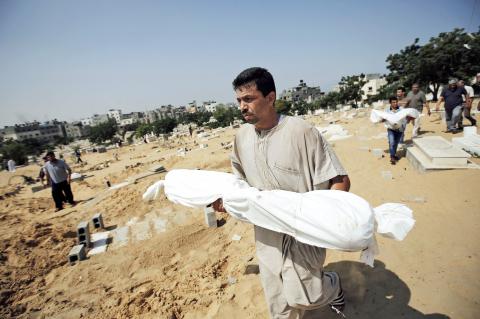
Photo: EPA
A correspondent said there was chaos at the site, with rescuers trying to evacuate the wounded any way they could, while adults sprinted through pools of blood with young children clutched in their arms.
UN Relief and Works Agency for Palestine Refugees (UNRWA) spokesman Chris Gunness said the school had been housing thousands of internally displaced people (IDPs).
“Shelling incident in vicinity of UNRWA school in Rafah sheltering almost 3,000 IDP. Initial reports say multiple deaths and injury,” he wrote on Twitter.
Regional efforts to broker a diplomatic end to the fighting between Israel and Hamas have so far proved elusive, with their confrontation in Gaza now in its 27th day with more than 1,700 people killed.
A Palestinian delegation was to hold truce talks yesterday in Cairo with senior US and Egyptian officials, but Israel has said it sees no point in sending its negotiators to the meeting, citing what it says are Hamas breaches of previous agreed truces.
Islamic Jihad was also expected to join along with US Middle East Envoy Frank Lowenstein.
Several Israeli newspapers reported that Cabinet ministers have taken a decision not to seek a further negotiated ceasefire agreement with Hamas and were considering ending the military operation unilaterally.
Israel’s military said yesterday that it had begun withdrawing some troops from Gaza.
“We are removing some [forces],” Lieutenant Colonel Peter Lerner said, adding that troops were “extremely close” to completing a mission to destroy a network of reported attack tunnels.
“We are redeploying within the Gaza Strip, taking out other positions and relieving other forces from within, so it won’t be the same type of ground operation,” he said. “But indeed we will continue to operate ... [and] have a rapid reaction force on the ground that can engage Hamas if required. It’s changing gear, but it’s still ongoing.”
Israel’s assault on the southern city of Rafah began early on Friday in the opening hours of a 72-hour humanitarian truce, which was quickly shattered when militants ambushed a group of soldiers, killing two of them.
A third was reported missing, believed snatched in a development that drew sharp condemnation from top US and UN officials.
However, early yesterday, the Israeli army formally announced the death of the soldier, 23-year-old Hadar Goldin, saying he had been “killed in battle in the Gaza Strip on Friday.”
Army radio said no body had been recovered, rendering the decision to announce his death “very delicate.”

A signaling system malfunction disrupted high-speed rail (HSR) services beginning at 8am today, with trains temporarily reduced to three northbound and three southbound trains per hour as authorities conduct inspections. The malfunction occurred on a section of track in Miaoli County during pre-operation checks early this morning, forcing northbound and southbound trains to use a single track, the HSR operator said. The regular schedule has been replaced with three hourly trains offering only nonreserved seating in each direction, stopping at every station, it said, adding that business class cars would still have reserved seating. Departures from terminal stations are scheduled at the top

Taiwan is still in the process of assessing the possibility of recruiting workers from Eswatini, the Ministry of Foreign Affairs said yesterday, adding that its goal is to help Eswatini upgrade its vocational training centers. If there are plans to recruit workers from Eswatini, safeguarding national security, protecting public health and ensuring the employment rights of Taiwanese would be prerequisites, Department of West Asian and African Affairs Director-General Yen Chia-liang (顏嘉良) told a news conference. Key considerations would also include filling labor shortages in specific industries, and fostering bilateral professional and technical exchanges, he said. Yen was asked about the progress of labor

VERBOSE VESSELS: A CGA cutter and a China Coast Guard exchanged verbal barbs for more than a day in Taiwanese-controlled waters before the Chinese vessel left The Taiwanese and Chinese coast guards had a standoff near the strategically located Pratas Islands (Dongsha Islands, 東沙群島) in the north of the South China Sea, the Coast Guard Administration (CGA) said yesterday. The two sides engaged in intense radio exchanges over sovereignty claims during the 33-hour standoff. China Coast Guard vessel 3501 eventually left the restricted waters, 26.6 nautical miles (49.2km) west of the Pratas Islands, at 5pm yesterday, the CGA said. Lying approximately between southern Taiwan and Hong Kong, the Taiwan-controlled Pratas are seen by some security experts as vulnerable to Chinese attack due to their distance — more than

WARNING: China should stop engaging in actions that undermine regional peace and stability, as it would only build resentment among people across the Strait, the CGA said China has deployed more than 100 navy, coast guard and other vessels in waters from the Yellow Sea to the South China Sea and the western Pacific since US President Donald Trump and Chinese President Xi Jinping (習近平) met in Beijing, National Security Council Secretary-General Joseph Wu (吳釗燮) said yesterday. “In this part of the world, #China is the one & only PROBLEM wrecking the #StatusQuo & threatening regional peace & stability,” Wu wrote on X. In a separate post, he said Beijing was coercing Taiwan’s maritime domain, calling it illegal and provocative, after the Coast Guard Administration (CGA) expelled a


 RSS
RSS