


A series of suspected gas explosions that shook Greater Kaohsiung from late Thursday night to early yesterday morning claimed at least 26 lives and injured 269 people.
The blasts tore through the city’s roads and dug a 100m trench up to 1.8m deep. At least 1.5km of roadways were damaged.
Cars and fire trucks were trapped and overturned in the rubble. Vehicles were hurled through the air, landing on the roofs of houses. Flames erupted from manholes after their covers were blasted off, with gouts of fire reaching 15 stories high.
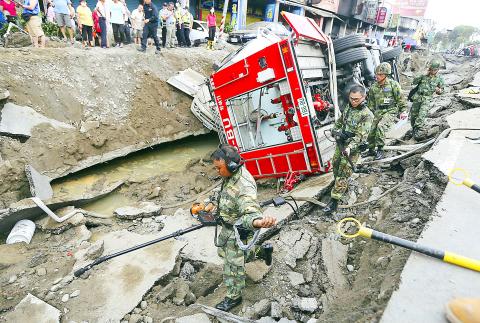
Photo: Toby Chang, Reuters
According to the Greater Kaohsiung Government, at 8:46pm on Thursday it received reports of manholes spewing white smoke and the suspected smell of gas near Kaisyuan 3rd Road and Ersheng 1st Road in Cianjhen District (前鎮). A few hours after the first report, a series of explosions took place on Yisin Road, Ersheng Road, Sanduo Road and Guanghua Road in the same district, and in neighboring Lingya District (苓雅).
At press time, city government information showed that the incident had claimed 26 lives and injured 269. Among the 26 confirmed dead were three firefighters and one volunteer who rushed to the scene after residents smelled gas. Rescuers were also searching for two others who went missing.
At 8:30pm yesterday, two people were reportedly discovered alive under debris, and rescue workers were trying to free them using excavators, shovels and their bare hands. It has not been confirmed whether the two men are the two firefighters who were reported missing.
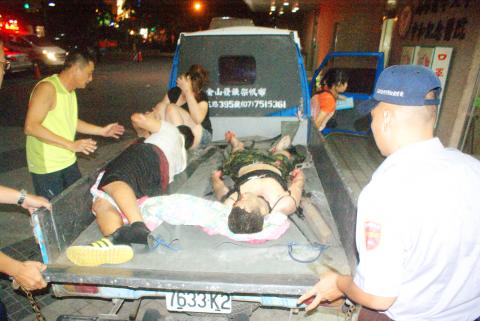
Photo: Huang Chia-lin, Taipei Times
Some of the fatalities were homeowners checking out their properties after being informed about the first blasts.
Two injured people rescued from a fourth-floor balcony said that they had been propelled to the rooftop by the blasts.
The Chinese-language Apple Daily newspaper’s reporter Wei Bin (魏斌) was injured by the explosions, receiving second and third-degree burns over about 50 percent of his body, the paper reported.
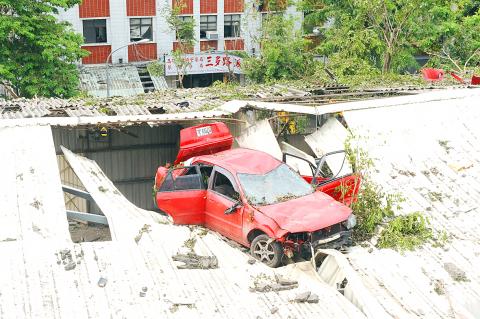
Photo: Chang Chung-yi, Taipei Times
Schools and work were called off in Cianjhen and Lingya districts yesterday.
Hundreds of troops and firefighters from neighboring Greater Tainan, Chiayi City, Taitung County and Pingtung County were deployed to support the rescue effort.
Yesterday morning, fires still burned on the streets, but the local government said that they were left burning to avoid further explosions, adding that the firefighting crew was on the scene to keep the fire from consuming nearby buildings.
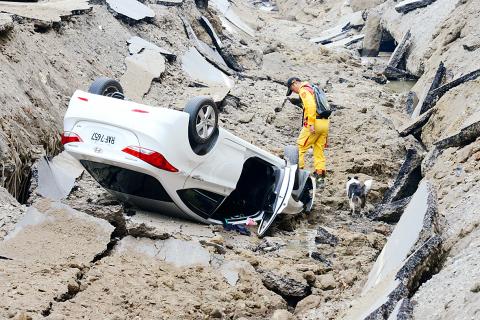
Photo: AFP/Sam Yeh
The cause of the explosions had not been determined, with authorities now focusing on the volatile chemical propene — which is carried in pipelines that run alongside the city’s underground sewage system in the area — as the suspected cause.
Chemical companies such as CPC Corp, Taiwan (台灣中油), China Petrochemical Development Corp (中石化), China General Terminal and Distribution Corp (CGTD, 華運), LCY Chemical Corp (李長榮化學) and Hsin Kao Gas Co Ltd (欣高), which have pipelines in the area, were called in by the city government’s emergency response center amid the inquiry into the cause of the fatal blasts.
Minister of Economic Affairs Chang Chia-juch (張家祝) said yesterday morning that natural gas has been excluded from the list of possible causes, adding that gas check valves in the area have been closed.
The Greater Kaohsiung Government said a 4-inch pipeline carrying propene was found to have encountered a pressure anomaly between 8:40pm and 9pm on Thursday night.
Greater Kaohsiung Deputy Mayor Lee Yung-te (李永得) said CGTD Corp was attempting to transfer propene, a compressed fuel gas, from the seaport to LCY Chemical Corp, and the correspondence between the workers of the two companies showed that the effort failed. It was suspected that the gas had leaked during the transfer process, causing the explosions.
Greater Kaohsiung Mayor Chen Chu (陳菊), at a meeting with Premier Jiang Yi-huah (江宜樺) at the city’s emergency response command center, said that Cianjhen District had seen another gas explosion that had caused serious damage in 1997 and called on the central government and the Industrial Development Bureau to examine and overhaul the city’s pipeline network.
Life detectors and rescue dogs have been employed in the rescue operation, as well as helicopters searching for signs of life within what is known as the “golden 72 hours,” during which most survivors are found.
Additional reporting by Huang Wen-huang and Wu Chun-feng
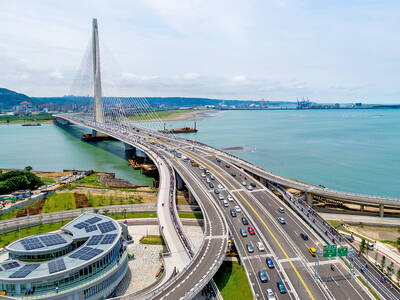
The Ministry of Transportation and Communications yesterday inaugurated the Danjiang Bridge across the Tamsui River in New Taipei City, saying that the structure would be an architectural icon and traffic artery for Taiwan. Feted as a major engineering achievement, the Danjiang Bridge is 920m long, 211m tall at the top of its pylon, and is the longest single-pylon asymmetric cable-stayed bridge in the world, the government’s Web site for the structure said. It was designed by late Iraqi-British architect Zaha Hadid. The structure, with a maximum deck of 70m, accommodates road and light rail traffic, and affords a 200m navigation channel for boats,
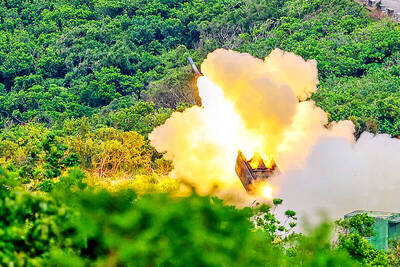
PRECISION STRIKES: The most significant reason to deploy HIMARS to outlying islands is to establish a ‘dead zone’ that the PLA would not dare enter, a source said A High Mobility Artillery Rocket System (HIMARS) would be deployed to Penghu County and Dongyin Island (東引) in Lienchiang County (Matsu) to force the Chinese military to retreat at least 100km from the coastline, a military source said yesterday. Taiwan has been procuring HIMARS and Army Tactical Missile Systems (ATACMS) from the US in batches. Once all batches have been delivered, Taiwan would possess 111 HIMARS units and 504 ATACMS, which have a range of 300km. Considering that “offense is the best defense,” the military plans to forward-deploy the systems to outlying islands such as Penghu and Dongyin so that
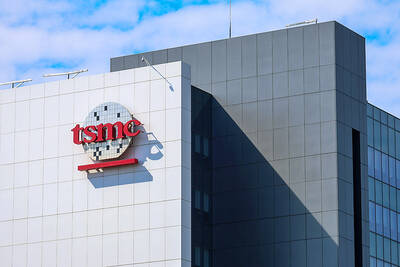
Taiwan Semiconductor Manufacturing Co (TSMC, 台積電), the world’s largest foundry service provider, yesterday said that global semiconductor revenue is projected to hit US$1.5 trillion in 2030, after the figure exceeds US$1 trillion this year, as artificial intelligence (AI) demand boosts consumption of token and compute power. “We are still at the beginning of the AI revolution, but we already see a significant impact across the whole semiconductor ecosystem,” TSMC deputy cochief operating officer Kevin Zhang (張曉強) said at the company’s annual technology symposium in Hsinchu City. “It is fair to say that in the past decade, smartphones and other mobile devices were

‘CLEAR MESSAGE’: The bill would set up an interagency ‘tiger team’ to review sanctions tools and other economic options to help deter any Chinese aggression toward Taiwan US Representative Young Kim has introduced a bill to deter Chinese aggression against Taiwan, calling for an interagency “tiger team” to preplan coordinated sanctions and economic measures in response to possible Chinese military or political action against Taiwan. “[Chinese President] Xi Jinping [習近平] has directed the People’s Liberation Army to be ready to invade Taiwan by 2027. China has a plan. America should have one too,” Kim said in a news release on Thursday last week. She introduced the “Deter PRC [People’s Republic of China] aggression against Taiwan act” to “ensure the US has a coordinated sanctions strategy ready should


 RSS
RSS