


A series of powerful gas blasts killed at least 25 people and injured up to 267 before dawn today in Greater Kaohsiung, overturning cars and ripping up roads as terrified residents fled an inferno.
The explosions sparked massive fires which tore through the Cianjhen District (前鎮), leaving a yawning trench running for hundreds of meters down the middle of a major thoroughfare and littering the streets with dead bodies.
Dramatic video footage captured by dashboard cameras inside cars showed multiple blasts and pillars of flame erupting from manholes as drivers frantically tried to avoid being engulfed.
In its latest update, the National Fire Agency said the blasts killed at least 25 people and revised the number of injured to 267. Four firefighters who rushed to the scene after residents smelled gas were among those killed in the blasts.
The explosions, believed to have been triggered by gas leaking from underground pipelines, were powerful enough to upturn whole cars and split open
paved roads. One street had been ripped along its length, swallowing several
fire engines and other vehicles.
Witnesses reported seeing bodies strewn across the streets.
“I saw fire soaring up to possibly 20 stories high after a blast and fire engines and cars being blown away while around 10 bodies lay on the street,” eyewitness Johnson Liu said.
Local television aired footage from a dashboard camera capturing a loud explosion which tore up the road in front of a blue truck as it waited at a junction. Rocks and debris could be seen showering down on the street before the footage faded to black.
A second dashboard camera uploaded online showed a car frantically making a U-turn after the initial explosion only to hurtle towards another inferno coming up from beneath the road.
“I’m scared to death”, one of the occupants was recorded saying. “It’s like a bombing, let’s hurry.”
Residents were seen carrying the injured on makeshift stretchers as ambulances rushed to the scene and firefighters in yellow overalls began removing bodies from the area.
“The explosions were like thunder and the road in front of my shop ripped open. It felt like an earthquake,” the Central News Agency (CNA) quoted a witness as saying.
The fire agency said 22 firefighters were among the injured and two were unaccounted for.
“The local fire department received calls of gas leaks late Thursday and then there were a series of blasts around midnight affecting an area of 2 to 3 square kilometers,” the fire agency said in a statement.
A city government official said the blazes had mostly been extinguished or burned themselves out by mid-day, but a few fires were continuing. City authorities said they had sealed off 6km of road.
Residents described how the neighborhood smelt strongly of gas before the disaster.
One local resident surnamed Peng said: “There was a heavy odor of gas and ... then I heard explosions and saw fire spurting from a store.”
“My house shook as if there were an earthquake and the power went out,” CNA quoted her as saying.
Emergency rooms in city hospitals were packed with casualties and officials warned that the death toll was expected to rise.
The city government was evacuating more than 1,100 residents from the affected areas to schools and shelters as they tried to locate the source of the leaks and warned people to stay away.
The Ministry of National Defense dispatched about 1,400 soldiers to the scene to help with the disaster effort.
It is not the first time Kaohsiung has experienced a fatal gas blast. In 1997, an explosion killed five people and injured around 20 when a team from Chinese Petroleum Corp, Taiwan (中油) tried to unearth a section of gas pipeline in a road construction project.
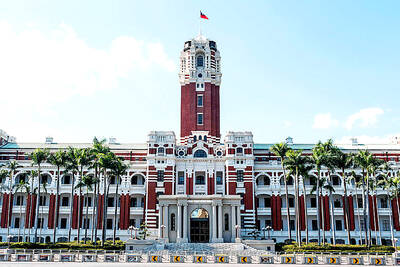
SECURITY: Taipei presses the US for arms supplies, saying the arms sales are not only a reflection of the US security commitment to Taiwan but also serve as a mutual deterrent against regional threats Taiwan is committed to preserving the cross-strait “status quo” and contributing to regional peace and stability, the Presidential Office said yesterday. “It is an undeniable fact that the Republic of China is a sovereign and independent democratic nation,” Presidential Office spokeswoman Karen Kuo (郭雅慧) reiterated, adding that Beijing has no right to claim sovereignty over Taiwan. The statements came after US President Donald Trump warned against Taiwanese independence. Trump wrapped up a state visit to Beijing on Friday, during which Chinese President Xi Jinping (習近平) had pressed him not to support Taiwan. Taiwan depends heavily on US security backing to deter China from carrying
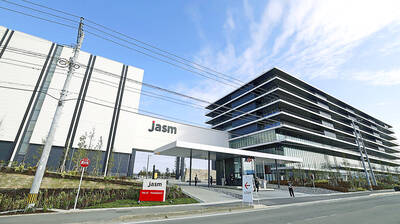
The subsidiary of Taiwan Semiconductor Manufacturing Co (TSMC, 台積電) in Kumamoto, Japan, turned a profit in the first quarter of this year, marking the first time the first fab of the unit has become profitable since mass production started at the end of 2024. According to the contract chipmaker’s financial statement released on Friday, Japan Advanced Semiconductor Manufacturing Inc (JASM), a joint venture running the fab in Kumamoto, posted NT$951 million (US$30.19 million) in profit in the January-to-March period, compared with a loss of NT$1.39 billion in the previous quarter, and a loss of NT$3.25 billion in the first quarter of
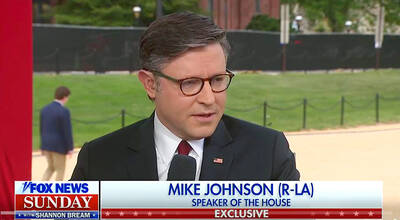
RESOLUTE BACKING: Two Republican senators are planning to introduce legislation that would impose immediate sanctions on China if it attempts to invade Taiwan US House of Representatives Speaker Mike Johnson on Sunday reaffirmed US congressional support for Taiwan, saying the US and “all freedom-loving people” have a stake in preventing China from seizing Taiwan by force. Johnson made the remarks in an interview with Fox News Sunday on US President Donald Trump’s summit with Chinese President Xi Jinping (習近平) last week. In an interview that aired on Friday on Fox News, just as Trump wrapped up a high-stakes visit to China, he said he has yet to green-light a new US$14 billion arms package to Taiwan and that it “depends on China.” “It’s a very good
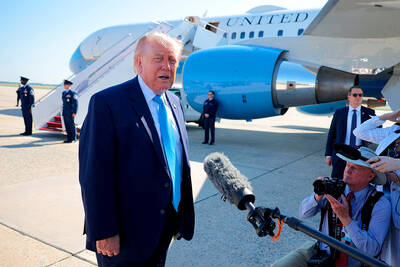
US President Donald Trump yesterday said he would speak to President William Lai (賴清德) as his administration considers whether to move ahead with a US$14 billion weapons sale to Taiwan — a potential arms deal that has drawn criticism from China. “Well, I’ll speak to him. I speak to everybody,” Trump told reporters yesterday when asked if he had any plans to call his counterpart, although he did not offer a time frame for when such a conversation could take place. Trump previously said he would speak to the person “that’s running Taiwan,” without specifying who he meant. “We have that situation very


 RSS
RSS