


Minister of Education Chiang Wei-ling (蔣偉寧) yesterday said that he has never associated either privately or professionally with the academic who allegedly published articles in an international journal using fraudulent peer reviews.
The publisher of the Journal of Vibration and Control earlier this month withdrew 60 papers submitted by former professor Chen Chen-yuan (陳震遠), also known as Peter Chen, accusing him of creating false accounts to give his articles favorable peer reviews.
Five of the 60 papers had Chen’s twin brother, Chen Chen-wu (陳震武), listed as the main author, with Chiang and Chen Chen-yuan cited as cowriters.
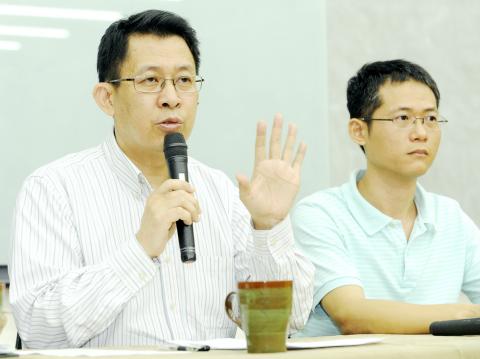
Photo: Chen Chih-chu, Taipei Times
Chen Chen-yuan was an associate professor at National Pingtung University of Education, but resigned in February after the university began to probe his peer review process at the request of the journal’s publisher.
Chiang told a press conference in Taipei yesterday afternoon that he respected the main author’s decision to list whomever he wants as a coauthor, but insisted that he had not been aware of the credits listed on the articles in question.
Saying that “a person’s integrity is their life,” Chiang said that his priority now is to get to the bottom of the matter, adding that only by working to clear the allegations up can justice be served and the nation’s reputation in academic circles restored after those “who incurred the problems” apologize for their actions.
Chiang added that he would not shirk his responsibilities if an investigation into the matter implicates him in any fraudulent behavior.
Chen Chen-wu was also present at the press conference, where he backed the minister’s claim that there is no link between him and Chen Chen-yuan.
Chen Chen-wu said his brother and Chiang had only met on two occasions: In 2004 at Chen Chen-wu’s graduation from a doctoral program at National Central University, where Chiang served as his thesis advisor, and again at a science forum in Greater Kaohsiung when he asked his twin to say hello to the minister.
Chen Chen-wu said he had listed his brother as one of the writers without Chiang’s knowledge, adding that over the past 11 years, he has worked with the minister on 17 academic pieces, some of which were based on research he carried out with Chiang’s assistance and others that were written by Chiang’s students, but edited by him at his advisor’s request.
All of those papers listed Chiang as a cowriter, Chen Chen-wu said.
Chen Chen-wu said he had sought the opinion of his twin brother on some of the articles and therefore listed him as a coauthor, but reiterated that he had not informed Chiang of this. Chen Chen-wu said his academic advisor and his brother had never met to discuss the papers.
Chiang was employed at the university as a professor until 2012, when he was appointed minister of education.
Chen Chen-wu, a professor at the National Kaohsiung Marine University, enrolled in National Central University in 1999 to pursue a master’s degree and went on to doctorate studies, which he completed in 2004.
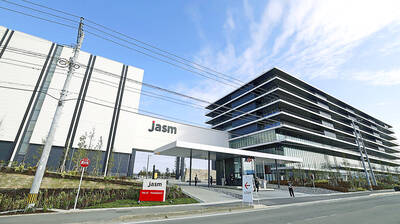
The subsidiary of Taiwan Semiconductor Manufacturing Co (TSMC, 台積電) in Kumamoto, Japan, turned a profit in the first quarter of this year, marking the first time the first fab of the unit has become profitable since mass production started at the end of 2024. According to the contract chipmaker’s financial statement released on Friday, Japan Advanced Semiconductor Manufacturing Inc (JASM), a joint venture running the fab in Kumamoto, posted NT$951 million (US$30.19 million) in profit in the January-to-March period, compared with a loss of NT$1.39 billion in the previous quarter, and a loss of NT$3.25 billion in the first quarter of
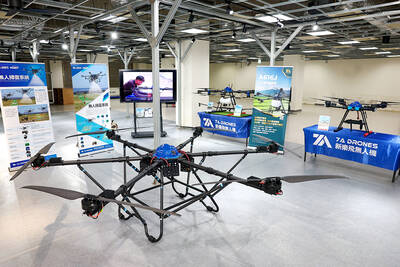
DRONE CENTRAL: Taiwan aims to become Asia’s democratic hub for drones, with most exports focused on high-quality military-grade models, an official said Taiwan’s drone industry is expected to expand significantly by 2030, producing 100,000 units per month and exporting half of them, the Ministry of Economic Affairs said yesterday. Current drone production capacity is about 15,000 units per month, but the industry can quickly scale up as demand increases, Industrial Development Administration Director-General Chiou Chyou-huey (邱求慧) told a news conference in Taipei. Taiwan’s drone output grew 2.5-fold last year to NT$12.9 billion (US$408.3 million) under a government program to develop the uncrewed vehicle sector, he said. The Executive Yuan in October last year approved plans to invest NT$44.2 billion into domestic production of uncrewed aerial
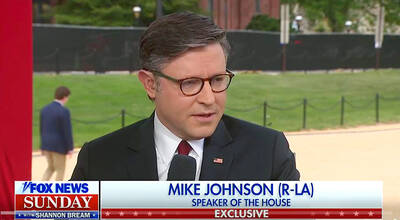
RESOLUTE BACKING: Two Republican senators are planning to introduce legislation that would impose immediate sanctions on China if it attempts to invade Taiwan US House of Representatives Speaker Mike Johnson on Sunday reaffirmed US congressional support for Taiwan, saying the US and “all freedom-loving people” have a stake in preventing China from seizing Taiwan by force. Johnson made the remarks in an interview with Fox News Sunday on US President Donald Trump’s summit with Chinese President Xi Jinping (習近平) last week. In an interview that aired on Friday on Fox News, just as Trump wrapped up a high-stakes visit to China, he said he has yet to green-light a new US$14 billion arms package to Taiwan and that it “depends on China.” “It’s a very good
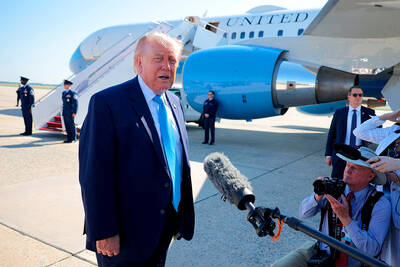
US President Donald Trump yesterday said he would speak to President William Lai (賴清德) as his administration considers whether to move ahead with a US$14 billion weapons sale to Taiwan — a potential arms deal that has drawn criticism from China. “Well, I’ll speak to him. I speak to everybody,” Trump told reporters yesterday when asked if he had any plans to call his counterpart, although he did not offer a time frame for when such a conversation could take place. Trump previously said he would speak to the person “that’s running Taiwan,” without specifying who he meant. “We have that situation very


 RSS
RSS