


Taipei Mayor Hau Lung-bin’s (郝龍斌) comments about Taiwan being “abandoned by its motherland” have prompted criticism from politicians across party lines, who said the comments came across as inappropriate.
Hau met with China’s Taiwan Affairs Office Minister Zhang Zhijun (張志軍) in Beijing on Sunday.
In response to media queries on his views about cross-strait contentions, Hau said: “Taiwan had been abandoned by its motherland” and it felt hurt and wanted emotional distance.
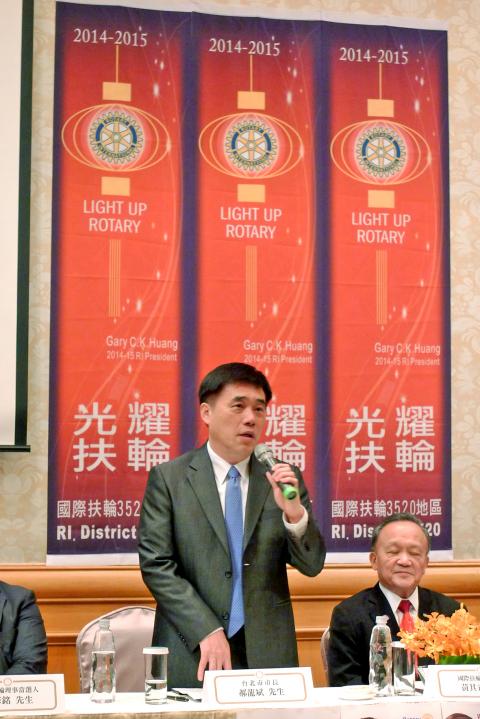
Photo: Yu Pei-ju, Taipei Times
Hau, known for supporting the idea that both sides of the Taiwan Strait belong to the Zhonghua minzu (Chinese ethnic group, 中華民族), added that the nation’s 23 million people have a consensus that they belong to the Republic of China (ROC) and that both sides of the Taiwan Strait should learn to view things from different perspectives.
Chinese Nationalist Party (KMT) Legislator Lo Shu-lei (羅淑蕾) said Hau must have been referring to the Treaty of Shimonoseki, but was confused.
The treaty ended the First Sino-Japanese War between the Qing Dynasty and the Japanese empire and ceded Taiwan to Japan.
The treaty was signed on April 17, 1895, and entered into force on May 8, 1895.
Lo said that when the treaty was signed, Qing official Lee Hongzhang (李鴻章) told Chinese Empress Dowager Cixi (慈禧太后) that Taiwan was a “backward territory where flowers do not bloom, the birds do not sing, the men are heartless and the women without love.”
“The Qing Dynasty is not our motherland. We overthrew the Qing Dynasty. Taiwan is an independent nation and no longer has feelings of being abandoned,” Lo said.
Taipei City Councilor Hsu Chia-ching (徐佳青) of the Democratic Progressive Party criticized Hau’s “slanted historical views.”
When asked for a comment, KMT Taipei City mayoral candidate Sean Lien (連勝文), said everyone in the ROC has their own thoughts on China, but did not elaborate further.
New Taipei City Mayor Eric Chu (朱立倫) said he hoped people would not judge things purely from an ideological perspective, adding that there were many things over the course of 400 years of history to reconsider.
Both sides of the Strait need to face up to the bad blood between them with seriousness and should consider the factors that could explain why Taiwanese regard China and its people with such hostility, he added.
Meanwhile, Hau yesterday said that he was speaking of historical facts from more than a century ago.
He said that the “motherland” refers to the ROC, adding that his comments were made in private and had been blown out of proportion.
The ROC was founded on Jan. 1, 1912 — 17 years after the Treaty of Shimonoseki was signed.
Hau met with Zhang as he wrapped up a four-day trip to Beijing, his first official visit to the city. He was there to take part in a travel exhibition.

A signaling system malfunction disrupted high-speed rail (HSR) services beginning at 8am today, with trains temporarily reduced to three northbound and three southbound trains per hour as authorities conduct inspections. The malfunction occurred on a section of track in Miaoli County during pre-operation checks early this morning, forcing northbound and southbound trains to use a single track, the HSR operator said. The regular schedule has been replaced with three hourly trains offering only nonreserved seating in each direction, stopping at every station, it said, adding that business class cars would still have reserved seating. Departures from terminal stations are scheduled at the top

Taiwan is still in the process of assessing the possibility of recruiting workers from Eswatini, the Ministry of Foreign Affairs said yesterday, adding that its goal is to help Eswatini upgrade its vocational training centers. If there are plans to recruit workers from Eswatini, safeguarding national security, protecting public health and ensuring the employment rights of Taiwanese would be prerequisites, Department of West Asian and African Affairs Director-General Yen Chia-liang (顏嘉良) told a news conference. Key considerations would also include filling labor shortages in specific industries, and fostering bilateral professional and technical exchanges, he said. Yen was asked about the progress of labor

A US uncrewed surface vessel (USV) encountered multiple Chinese warships during an autonomous transit of the Taiwan Strait, US defense company Seasats said in a statement on Wednesday. Seasats announced that a Lightfish USV had completed the first autonomous transit of the Taiwan Strait. Over five days, the USV traversed the entire length of the Strait while constantly monitoring surface vessel traffic, the company said. The Lightfish encountered multiple Chinese warships, one of which was a Chinese People’s Liberation Army Navy (PLAN) Type 056 corvette, it said. The Chinese vessels were operating “well within Taiwan’s exclusive economic zone without transmitting their identity via the

VERBOSE VESSELS: A CGA cutter and a China Coast Guard exchanged verbal barbs for more than a day in Taiwanese-controlled waters before the Chinese vessel left The Taiwanese and Chinese coast guards had a standoff near the strategically located Pratas Islands (Dongsha Islands, 東沙群島) in the north of the South China Sea, the Coast Guard Administration (CGA) said yesterday. The two sides engaged in intense radio exchanges over sovereignty claims during the 33-hour standoff. China Coast Guard vessel 3501 eventually left the restricted waters, 26.6 nautical miles (49.2km) west of the Pratas Islands, at 5pm yesterday, the CGA said. Lying approximately between southern Taiwan and Hong Kong, the Taiwan-controlled Pratas are seen by some security experts as vulnerable to Chinese attack due to their distance — more than


 RSS
RSS