


The Tokyo National Museum yesterday apologized over the controversy generated by some of the posters promoting the exhibition of collections from the National Palace Museum in Taipei that omitted the word “national” in reference to the official title of the Taiwanese museum, an act that was perceived by the government to have undermined the nation’s dignity.
Tokyo National Museum director Masami Zeniya said at a press conference yesterday afternoon that the museum had recognized the mistake and quickly addressed it.
He also apologized.
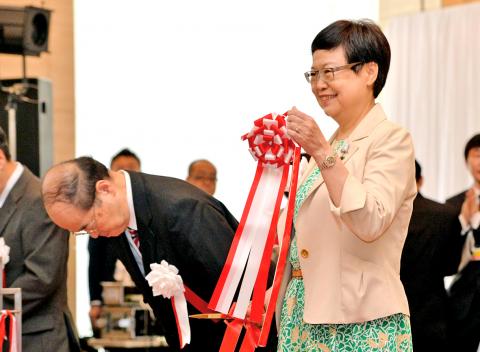
Photo: AFP
National Palace Museum Director Feng Ming-chu (馮明珠), who also attended the press conference, said that she accepted the apology on behalf of Taiwanese, adding that she believed that the apology can help Japan regain the trust and friendship of Taiwanese.
Before Feng boarded the flight to Japan yesterday morning, she told reporters that the museum did not receive confirmation that all the large controversial posters along the routes of Japan Railways were removed until 7:07am yesterday.
She said that the case carrying the Jadeite Cabbage (翠玉白菜), one of the national treasures to be shown in the Tokyo National Museum, was not unpacked after she reported the results to Premier Jiang Yi-huah (江宜樺) and secured Jiang’s permission for the suspension.
First lady Chow Mei-ching (周美青) could not make the flight yesterday morning because the confirmation came too late, she said.
Commenting on the criticism that the National Palace Museum was too slow to react to the promotional materials in question and that the Ministry of Foreign Affairs (MOFA) mainly stood on the sidelines and did nothing to help, Feng said that some of the large posters were hung in outdoor locations that the Tokyo National Museum had leased from the private sector.
Representatives of the National Palace Museum only began to notice problem with these posters when the exhibition drew close, she said.
“We and the ministry have been working tirelessly as a team in the past three days, and I personally have not been able to sleep much in the past three days. We have been jointly fighting against a museum that has failed to keep its promise and betrayed our trust toward it,” she said.
“Aside from attending the opening ceremony, there is another important purpose of my trip. I believe that the Tokyo National Museum owes Taiwanese an apology. Taiwanese have been trusting and feeling warmly toward the Japanese. It was regrettable that such thing happened,” she added.
In Tokyo, Takeo Hiranuma, a member in Japan’s House of Representatives who chairs the Japan-China Diet Members’ Discussion Group, said it is comforting to see the Tokyo National Museum meet the demands from the National Palace Museum.
The exhibition continuing as planned is the best outcome, he added.
The Democratic Progressive Party (DPP) and the Taiwan Solidarity Union (TSU) both questioned President Ma Ying-jeou’s (馬英九) handling of the incident.
They said that Ma’s reaction smacks of double standards and may be an attempt to pander to China.
“Hopefully, Ma can be as assertive and determined when he deals with similar controversies related to sovereignty against other countries in the future,” DPP caucus director-general Tsai Chi-chang (蔡其昌) said.
“We hope that the way he responded to the dispute with Japan this time will be a barometer for future disputes and he will not always be hawkish only against the Japanese and soft against the Chinese,” Tsai added.
TSU caucus whip Lai Cheng-chang (賴振昌) said the cancelation of Chow’s visit to Japan could jeopardize future bilateral ties.
“It is ironic that Ma cares about the word ‘national’ all of a sudden because he was the one who gave orders that no national flags should be displayed during the visit of former Association of Relations Across the Taiwan Strait chairman Chen Yunlin (陳雲林),” Lai said.
Minister of Culture Long Ying-tai (龍應台) called for unity when dealing with incidents involving foreign countries.
The exhibition, titled: Treasured Masterpieces from the National Palace Museum, Taipei, is scheduled to open today in the Tokyo National Museum.
The National Palace Museum asked the Tokyo National Museum on Thursday last week to remove all posters that ommitted the word “national.”

‘NO SECURITY RISK’: The Railway Bureau reassured the public that the technicians’ activities were limited to technical guidance and did not involve sensitive systems The Railway Bureau yesterday said it had invited eight Chinese technicians to assist with an airport MRT construction project. The bureau issued the confirmation after an Internet user said Chinese nationals had entered the construction zone of Taiwan Taoyuan International Airport’s Terminal 3 project. They asked why “individuals from an enemy state” were allowed access to such a major national infrastructure project, which raised serious concerns over Taiwan’s industrial safety, sensitive systems and information security. The bureau’s Northern Region Engineering Branch Office said subcontractor Taiwan Handle Industrial Co (台灣手把工業) of the Taoyuan airport MRT’s “Contract No. CU05 Project A14 Station Civil, MEP &
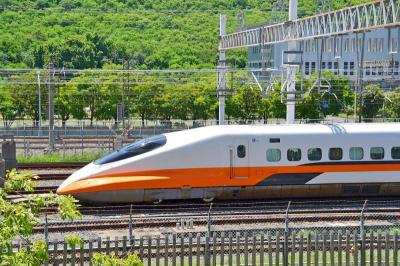
A signaling system malfunction disrupted high-speed rail (HSR) services beginning at 8am today, with trains temporarily reduced to three northbound and three southbound trains per hour as authorities conduct inspections. The malfunction occurred on a section of track in Miaoli County during pre-operation checks early this morning, forcing northbound and southbound trains to use a single track, the HSR operator said. The regular schedule has been replaced with three hourly trains offering only nonreserved seating in each direction, stopping at every station, it said, adding that business class cars would still have reserved seating. Departures from terminal stations are scheduled at the top
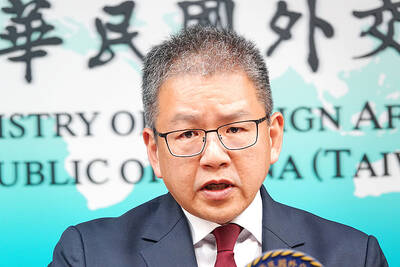
Taiwan is still in the process of assessing the possibility of recruiting workers from Eswatini, the Ministry of Foreign Affairs said yesterday, adding that its goal is to help Eswatini upgrade its vocational training centers. If there are plans to recruit workers from Eswatini, safeguarding national security, protecting public health and ensuring the employment rights of Taiwanese would be prerequisites, Department of West Asian and African Affairs Director-General Yen Chia-liang (顏嘉良) told a news conference. Key considerations would also include filling labor shortages in specific industries, and fostering bilateral professional and technical exchanges, he said. Yen was asked about the progress of labor

A US uncrewed surface vessel (USV) encountered multiple Chinese warships during an autonomous transit of the Taiwan Strait, US defense company Seasats said in a statement on Wednesday. Seasats announced that a Lightfish USV had completed the first autonomous transit of the Taiwan Strait. Over five days, the USV traversed the entire length of the Strait while constantly monitoring surface vessel traffic, the company said. The Lightfish encountered multiple Chinese warships, one of which was a Chinese People’s Liberation Army Navy (PLAN) Type 056 corvette, it said. The Chinese vessels were operating “well within Taiwan’s exclusive economic zone without transmitting their identity via the


 RSS
RSS