


Five prisoners on death row were executed yesterday, the Ministry of Justice announced last night.
The executions were carried out after Minister of Justice Luo Ying-shay (羅瑩雪) on Monday signed the orders authorizing the death sentences to be carried out.
“Convict Teng Kuo-liang (鄧國樑) was executed in Taipei Prison in the evening, Liu Yen-kuo (劉炎國) in Taichung Prison, brothers Tu Ming-hsiung (杜明雄) and Tu Ming-lang (杜明郎) in Tainan Prison, and Tai Wen-cheng (戴文慶) in Hualien Prison,” Deputy Minister of Justice Chen Ming-tang (陳明堂) told a press conference in Taipei.
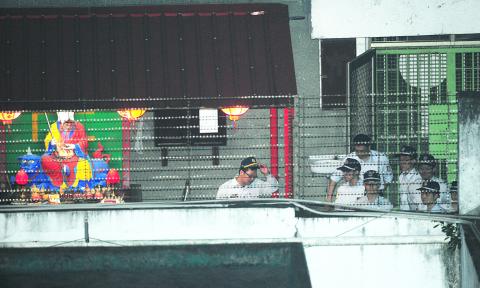
Photo: Lo Pei-der, Taipei Times
Chen said the five men had been found responsible for 11 deaths, the injuring of four people and more than 30 robberies.
“In each case there were at least two people killed, and five at most,” he said, adding that the convicted men had tortured and killed their victims with extremely cruel methods, leaving the victims’ families with unforgettable sorrow.
Chen said opinion polls have shown that between 70 percent and 80 percent of the public supports Taiwan retaining the death penalty.
Executions do not violate the International Covenant on Civil and Political Rights because the covenant does not deny the legitimacy of countries which have not abolished the death penalty to carry out executions, and it only requests the countries to carry out executions carefully and limit the executions to cases of serious crimes, he said.
According to the ministry, Tai was sentenced for raping two female taxi drivers in May 2001 after he had been granted a two-day leave from Hualien Prison where he was serving a sentence for a previous crime. He killed one of the women, surnamed Hsieh (謝), with a knife.
Teng received the death penalty for killing a woman and her 10-year-old son in July 2009. He gave the woman drinks containing sedatives before he hit her on the head with a wooden knife and pushed her and her son into a river.
He then jumped into the water and stabbed them to death, according to the Supreme Court ruling, which found that Teng had used extraordinary cruelty in the killing of his victims because of a dispute over a small debt.
The Tu brothers were found guilty of the murders of a Taiwanese businessman, three of his Taiwanese employees and a Chinese woman in China while they were in Guangdong Province with their father in 2011.
Liu Yen-kua (劉炎國) was convicted of shooting dead a police officer in 1997 when he stormed into an illegal casino in the then-Taichung County.
Chen said there are still 47 convicts on death row nationwide.

The nation’s fastest supercomputer, Nano 4 (晶創26), is scheduled to be launched in the third quarter, and would be used to train large language models in finance and national defense sectors, the National Center for High-Performance Computing (NCHC) said. The supercomputer, which would operate at about 86.05 petaflops, is being tested at a new cloud computing center in the Southern Taiwan Science Park in Tainan. The exterior of the server cabinet features chip circuitry patterns overlaid with a map of Taiwan, highlighting the nation’s central position in the semiconductor industry. The center also houses Taiwania 2, Taiwania 3, Forerunner 1 and
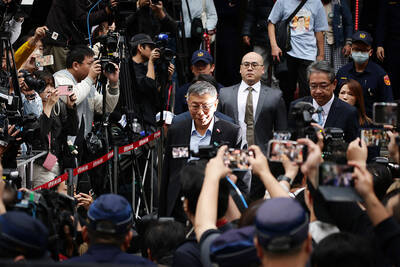
FIRST TRIAL: Ko’s lawyers sought reduced bail and other concessions, as did other defendants, but the bail judge denied their requests, citing the severity of the sentences Former Taipei mayor Ko Wen-je (柯文哲) was yesterday sentenced to 17 years in prison and had his civil rights suspended for six years over corruption, embezzlement and other charges. Taipei prosecutors in December last year asked the Taipei District Court for a combined 28-year, six-month sentence for the four cases against Ko, who founded the Taiwan People’s Party (TPP). The cases were linked to the Core Pacific City (京華城購物中心) redevelopment project and the mismanagement of political donations. Other defendants convicted on separate charges included Chinese Nationalist Party (KMT) Taipei City Councilor Angela Ying (應曉薇), who was handed a 15-year, six-month sentence; Core Pacific
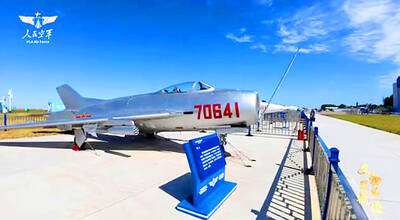
J-6 REMODEL: The converted drones are part of Beijing’s expanding mix of airpower weapons, including bombers with stand-off missiles and UAV swarms, the report said China has stationed obsolete supersonic fighters converted to attack drones at six air bases close to the Taiwan Strait, a report published this month by the Arlington, Virginia-based Mitchell Institute for Aerospace Studies said. Satellite imagery of the airfields from the institute’s “China Airpower Tracker” shows what appear to be lines of stubby, swept-winged aircraft matching the shape of J-6 fighters that first flew with the Chinese People’s Liberation Army (PLA) Air Force in the 1960s. Since their conversion to drones, the aircraft have been identified at five bases in China’s Fujian Province and one in Guangdong Province, the report said. J.

China used fake LinkedIn profiles to harvest sensitive data from NATO and EU institutions by soliciting information from staff, a European security source said on Friday. The operation, allegedly orchestrated by the Chinese Ministry of State Security, targeted dozens of employees at the military alliance or EU organizations through fictitious accounts, the source said, confirming reports in French and Belgian media. Posing as recruiters on the online professional networking platform, Chinese spies would initially request paid reports before later soliciting non-public or even classified information. One particularly active fake profile used the name “Kevin Zhang,” claiming to be the head


 RSS
RSS