


Netizens have lashed out at Executive Yuan Deputy Secretary-General Hsiao Chia-chi (蕭家淇) for seemingly attaching more importance to the sun cakes that were allegedly stolen during students’ overnight occupation of the Executive Yuan building on Monday than to the well-being of wounded protesters.
Hsiao and Cabinet Secretary-General Lee Shu-chuan (李四川) inspected the damage and losses sustained by the Executive Yuan compound on Monday morning, hours after the students were forcibly evicted by riot police at the order of Premier Jiang Yi-huah (江宜樺).
“The sun cakes on my desk were taken, my cakes in the refrigerator are also missing. Flower baskets sent by my friends to congratulate me on my recent promotion were trampled. My colleague lost a NT$1,000 bill that he left in his office,” said Hsiao, who was promoted from deputy minister of the interior to his current post earlier this month, as he showed reporters around the building.
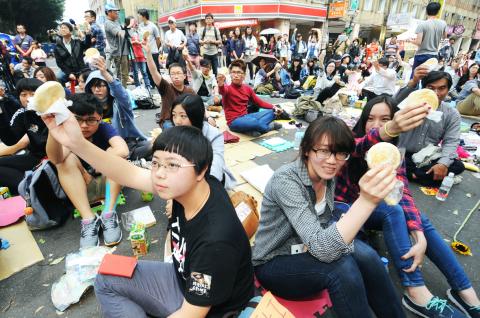
Photo: Lo Pei-der, Taipei Times
Hsiao’s comments drew immediate criticism from netizens, with some threatening to “pay him back” by ordering boxes of sun cakes to be delivered to his office.
A total of 150 boxes of sun cakes donated by netizens were delivered to Hsiao’s office yesterday morning, but Hsiao did not accept them.
The sun cakes were passed on to students occupying the legislative chamber, who are into the eighth day of a protest demanding that the government restart its review of the cross-strait service trade agreement.
Hsaio said yesterday that he did not mind that the sun cakes he reported missing had been eaten.
In a democratic society, people can express their own views to gain public support, but “taking away other people’s possessions without permission is not a way to make a case,” he said.
In response to media queries on whether he would sue the protesters, Hsiao said: “I didn’t think of that. I believe our young friends were hungry. They ate sun cakes and drank mineral water, things like that. However, I believe that they should behave in accordance with the law.”
He said that the point was that people had broken the law by breaking into government offices, going through documents and taking items.
Hsiao, who was previously Greater Taichung deputy mayor, added that he has received several phone calls from friends in Taichung, including Greater Taichung Mayor Jason Hu (胡志強), saying that demand for sun cakes — a Taichung specialty — have increased recently.
Later yesterday, when the sun cakes were delivered to the protest site, protesters broke into applause.
Protesters raised sun cakes and said: “Thank you Hsiao Chia-chi. [We have] sun cakes to give back to you.”
A protester surnamed Tung (董), who received one of the sun cakes, said she felt “outraged” over Hsiao’s complaint.
“High-level officials care only about desserts and not about students who are being suppressed and injured,” she said.
A woman surnamed Su (蘇), along with three of her colleagues at a hotel in Greater Taichung, said they traveled to Taipei to support the students because they were worried about the negative effects the pact could have on local businesses.
“There will be more hotels operated by Chinese businesspeople, which will force locally owned hotels to shut down. Chinese tourists will live in Chinese-owned hotels. Chinese will make a fortune and Taiwanese will have miserable lives,” Su said.
Additional reporting by Peng Hsien-chun and Wang Wen-hsuan

‘NO SECURITY RISK’: The Railway Bureau reassured the public that the technicians’ activities were limited to technical guidance and did not involve sensitive systems The Railway Bureau yesterday said it had invited eight Chinese technicians to assist with an airport MRT construction project. The bureau issued the confirmation after an Internet user said Chinese nationals had entered the construction zone of Taiwan Taoyuan International Airport’s Terminal 3 project. They asked why “individuals from an enemy state” were allowed access to such a major national infrastructure project, which raised serious concerns over Taiwan’s industrial safety, sensitive systems and information security. The bureau’s Northern Region Engineering Branch Office said subcontractor Taiwan Handle Industrial Co (台灣手把工業) of the Taoyuan airport MRT’s “Contract No. CU05 Project A14 Station Civil, MEP &

A US uncrewed surface vessel (USV) encountered multiple Chinese warships during an autonomous transit of the Taiwan Strait, US defense company Seasats said in a statement on Wednesday. Seasats announced that a Lightfish USV had completed the first autonomous transit of the Taiwan Strait. Over five days, the USV traversed the entire length of the Strait while constantly monitoring surface vessel traffic, the company said. The Lightfish encountered multiple Chinese warships, one of which was a Chinese People’s Liberation Army Navy (PLAN) Type 056 corvette, it said. The Chinese vessels were operating “well within Taiwan’s exclusive economic zone without transmitting their identity via the

Taiwan is still in the process of assessing the possibility of recruiting workers from Eswatini, the Ministry of Foreign Affairs said yesterday, adding that its goal is to help Eswatini upgrade its vocational training centers. If there are plans to recruit workers from Eswatini, safeguarding national security, protecting public health and ensuring the employment rights of Taiwanese would be prerequisites, Department of West Asian and African Affairs Director-General Yen Chia-liang (顏嘉良) told a news conference. Key considerations would also include filling labor shortages in specific industries, and fostering bilateral professional and technical exchanges, he said. Yen was asked about the progress of labor
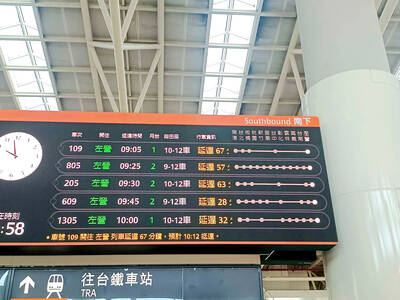
The nation’s usually punctual high-speed rail system yesterday was hit by major disruptions after all scheduled services were canceled and replaced with three hourly trains offering only non-reserved seating, affecting more than 200,000 passengers. Preliminary findings indicate the disruption was caused by a faulty power module in a track switch control cabinet, Taiwan High-Speed Rail Corp (THSRC) said, adding that as a full system inspection could only be conducted after operations end for the day, a decision on whether normal service would resume today would be announced before the first train departs. During a routine inspection early yesterday, a switch signal abnormality


 RSS
RSS