

Mounting frustration over what they see as the government’s lack of sincerity in addressing protesters’ demands over the cross-strait services trade pact led students to force their way through security barricades and razor wire into the Executive Yuan complex in Taipei last night to stage a sit-in.
At about 7:30pm, hundreds of students vaulted the barriers at the three main entrances of the Executive Yuan compound, clashing with police carrying shields and truncheons. As more students poured in, the police were outnumbered and in just half an hour, the complex was almost entirely occupied.
About one hour later, the students made it to the second floor of the Executive Yuan’s main building and, using a ladder, burst into Premier Jiang Yi-huah’s (江宜樺) office.
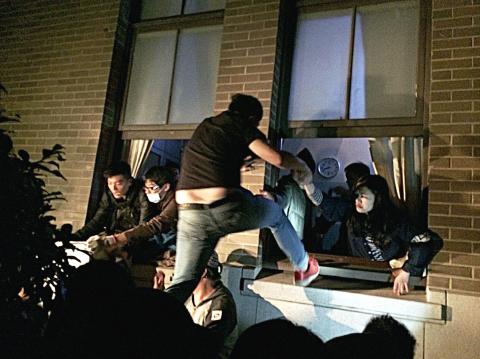
Photo: CNA
Several police officers and students were hurt in the ensuing melee as more police were deployed to contain the situation and ambulances called in to tend to the injured, which included some protesters who fainted and others injured by broken glass.
Meanwhile, more protesters gathered outside the building, shouting slogans such as: “Rejecting the cross-strait service trade agreement, defending democracy.”
They said they decided to occupy the Executive Yuan because President Ma Ying-jeou (馬英九) had apparently failed to understand the concerns they have repeatedly expressed over the past days.
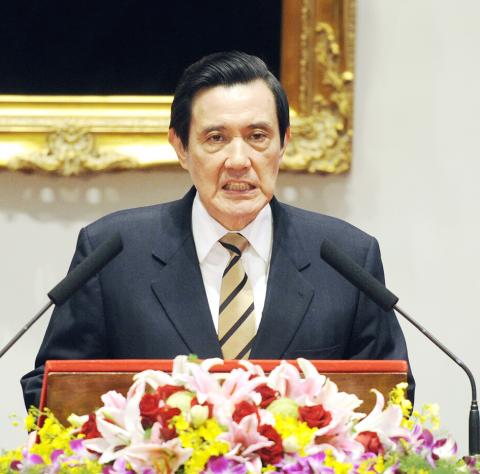
Photo: George Tsorng, Taipei Times
At a press conference yesterday morning, Ma showed that he was completely ignoring the public’s voices, the activists said.
“We are here to tell Ma that he should listen to the public’s angry shouts and listen to their voices,” the students said, adding: “We will demonstrate citizens’ strength again and again.”
“Tonight we are in the Executive Yuan. Tomorrow we will go to other government agencies to voice our concerns,” they shouted.
Taiwanese should not be afraid of the government, the government should be afraid of them, the protesters added.
Protest leader Chen Wei-ting (陳為廷), a National Tsing Hua University student, said last night that the move to break into the Executive Yuan was not initiated by members of the Black Island Nation Youth Front — the group behind the Legislative Yuan occupation.
However, he said he fully respected civic groups’ decision to occupy the Executive Yuan compound, while fellow protest leader Lin Fei-fan (林飛帆), a National Taiwan University student and another key figure in the legislative occupation, stressed the principles of peace and non-violence.
At 11pm, Premier Jiang Yi-huah (江宜樺) ordered the National Police Agency to deploy more officers to the Executive Yuan to forcibly remove the protestors.
Executive Yuan spokesperson Sun Lih-chyun (孫立群) said that Jiang was distressed by the protesters’ moves, and had vowed to hold them responsible for what he called their illegal and violent actions.
According to the Executive Yuan, protestors burst into some offices on the second floor of the main building and damaged them.
Protesters also gained entry to Jiang’s office, but were soon forced out by police, the Executive Yuan said.
No damage to Jiang’s office has been reported.
Presidential Office spokesperson Lee Chia-fei (李佳霏) said that Ma discussed the situation with Jiang by telephone last night, and supported the premier’s decision to evict the protestors.
Security has been beefed up around the Presidential Office Building and the president’s residence, the Presidential Office said.
Earlier in the day, students and other activists occupying the legislative floor lashed out at Ma over his refusal to withdraw the service pact and push for legislation to monitor cross-strait agreements, vowing to continue their occupation of the Legislative Yuan and call for a nationwide strike.
“Regrettably, the president did not agree to hold a dialogue with us, as we wanted. Instead, he repeatedly iterated his propaganda, while ignoring the public’s voice and failing to come up with a concrete response to the expectations of Taiwanese and of the students,” Lin told a press conference at the legislative chamber held after Ma’s press conference.
“We are occupying the legislature because of the government’s unlawful actions [regarding the pact] and we hereby call on Ma not to twist the facts and reverse the cause and effect so he can blame the public for the situation,” Lin added.
Lin was referring to the announcement by Chinese Nationalist Party (KMT) Legislator Chang Ching-chung (張慶忠) on Monday last week that the trade agreement would skip the legislative committee phase of the review and be referred directly to the general assembly.
Lin said what Chang did was undemocratic, adding that “the government is setting the worst possible example for the public.”
He went on to say that the protesters would continue to demand that the government withdraw the trade pact and draft laws to oversee cross-strait agreements, before issuing a new demand that the government hold a nationwide conference to resolve the deadlock.
“Our occupation of the legislative chamber is meant to show how ridiculous the system is and to remind the government that, the citizens of a democratic country should take part in said country’s policymaking so they can help decide their nation’s future,” Lin said. “Taiwan must be a country for all Taiwanese.”
This story has been updated since it was first published.

The Hualien District Prosecutors’ Office yesterday launched an investigation following allegations by a former foreign correspondent in Taiwan of widespread vote-buying in Hualien County. In an interview with Formosa TV (FTV, 民視) aired on Saturday, former Financial Times Taiwan correspondent Kathrin Hille spoke about Taiwan’s democracy and said that she now lives in rural Hualien, where “all the votes are bought.” Neighbors would talk about who had come by and leave cash on the table showing “how much each vote was worth that year,” Hille said. The practice needs to be addressed, considering Taiwan has been a democracy for many
SAFETY RISKS: A Taiwanese man who was traveling to Shanghai for business was allegedly questioned for six hours due to his past work for Amnesty International The Mainland Affairs Council (MAC) urged Taiwanese to exercise caution when considering trips to China after a Taiwanese man was allegedly questioned for six hours in Shanghai over past work with Amnesty International. The council on Saturday said in a report that 426 Taiwanese have gone missing or been detained or had their freedom of movement restricted in China since Jan. 1, 2024. The figure is up by seven from the previous week. New Chinese entry and exit regulations are due to take effect on Sept. 15, the council said. Of the 426 cases, 160 people have gone missing, up
Palau’s president yesterday called for a “unified” Pacific response to a missile test by China in July, while Taiwan and its Pacific allies a day earlier at the Pacific Islands Forum (PIF) reaffirmed their commitment to peace, stability and prosperity. China gave only a handful of nations short notice before test-firing an intercontinental ballistic missile in July, sparking condemnation from several Pacific leaders. The 18-member PIF being held in Palau was expected to release a communique after press time last night, with a formal response to the test possibly included. Palau, which invited Taiwan to attend sideline events as an aid partner, urged

DEFENSE PROCUREMENT: The Pentagon has told a US congressional hearing that Taiwan has ‘top priority worldwide’ in the delivery of Harpoon missile systems The US Navy and Boeing Co have conducted a series of tests for land-based Harpoon anti-ship missile system being supplied to Taiwan and released footage showing the system striking a target vessel at sea. The weapons system and support equipment tested were reportedly tailored for Taiwan, while the first launch vehicles and other components have already begun arriving in Taiwan, with the full delivery of 100 systems scheduled to be completed by the end of 2028. Pentagon officials have previously told a US congressional hearing that Taiwan has “top priority worldwide” in the delivery of Harpoon missile systems, with production


 RSS
RSS