


Taiwan Solidarity Union lawmakers yesterday called into question the effectiveness of the government’s border control measures, accusing authorities of being lax in keeping tabs on Chinese visitors entering the country.
Without identifying their source, the legislators said that since 1988, a total of 2,768 Chinese nationals have overstayed their permits to visit Taiwan, while 2,327 others entered the nation and are unaccounted for.
The legislators also accused the National Immigration Agency (NIA) of deliberately underreporting the numbers, saying that just 303 undocumented Chinese nationals are mentioned on an NIA Web page.
In response, Huang Yung-jui (黃永睿), a section chief at the National Security Bureau, said the government has maintained its efforts to locate Chinese nationals who entered Taiwan legally, but are now listed as undocumented because their whereabouts are unknown.
The government has always paid great attention to the issue because these people could be engaging in illegal activities in Taiwan and may pose a threat to the country’s security, he added.
NIA First Specialized Operation Corps Deputy Chief Lu Yu-min (魯佑民) said that the Web page was established for the purpose of soliciting the public’s help in locating some undocumented Chinese nationals and does reflect the total number.
At the request of the lawmakers, Lu promised to provide comprehensive statistics regarding overstaying or undocumented Chinese nationals within two weeks and update the numbers every month.
Earlier this month, statistics from the NIA suggested that while Chinese now enjoy facilitated travel to Taiwan, criminal activities perpetrated by Chinese have also remained high.
More than 700 Chinese are on a list for overstaying their visa and 211 of them may be involved in illegal activities, the agency said, adding that these were only the numbers officially recorded.
The actual numbers could be as high as 1,000 Chinese overstays, it added.

National Taiwan University (NTU) yesterday said it disqualified a person from an entrance examination for using AI smart glasses to cheat, along with two others for making untruthful statements in their curriculum vitae. The three applicants were given null scores, Taiwan’s highest-ranked university said, calling on prospective students to be honest in the admissions process. NTU registrar Lee Hung-sen (李宏森) said that the cheating applicant wore a hat and thick-rimmed glasses to the second written exam for medical school, claiming that they felt cold. Suspicions were aroused when the applicant stared oddly at the test for long stretches while steadily bringing the paper
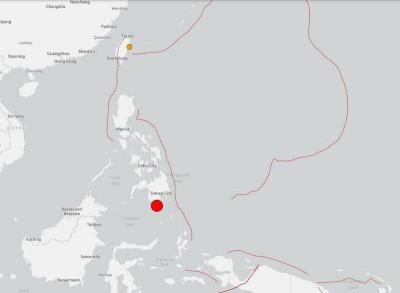
A magnitude 7.8 earthquake struck off the southern coast of Mindanao in the Philippines at 7:38am today, prompting the US Tsunami Warning System to issue an alert for neighboring countries, including Taiwan. The system issued a purple alert indicating a "tsunami threat." The potential threat zone includes Taiwan, the Philippines, Papua New Guinea, Yap and Palau. Philippine authorities were assessing the damage from the quake, with the office of civil defense seeking to verifying initial reports that 15 people had been killed and 129 injured in the region, mostly from falling debris. Arlene Hollero, disaster chief of Maasim town in the Philippines' Sarangani Province,

‘GRAY ZONE’ PRESSURE: Beijing’s activities are intended to create the deceitful impression that China has jurisdiction over the area around Taiwan, the CGA said Taiwan’s rights over its territorial waters and exclusive economic zone must not be violated by any country, the Mainland Affairs Council said yesterday, adding that it will not accept any unprovoked actions. The council issued the remarks in response to the China Coast Guard conducting maritime enforcement drills near eastern Taiwan and claiming to fully exercise China’s maritime administrative law enforcement authority. The Coast Guard Administration (CGA) has been closely monitoring the situation and is taking concrete steps to defend the nation’s sovereignty and secure its waters, the council said. China has no sovereign rights over the waters off eastern
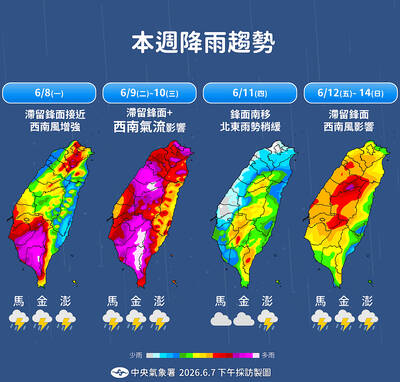
Heavy rain is expected to affect parts of Taiwan this week, the Central Weather Administration (CWA) said yesterday as a meteorologist said the active part of the annual plum rain season has started. A stationary plum rain front and southwesterly winds would bring unstable weather and abundant moisture to Taiwan from today for about a week, with the heaviest rainfall forecast for tomorrow and Wednesday, the CWA said. The agency said western and northeastern Taiwan, and mountainous areas in the east and southeast, could expect showers or thunderstorms on those two days, with localized heavy rain possible. Other parts of


 RSS
RSS