


Citizen 1985, a rights group that was set up to lodge protests with the Ministry of National Defense over the death of army corporal Hung Chung-chiu (洪仲丘), yesterday voiced disappointment after 13 of the 18 indicted military officials were sentenced to less than a year in jail.
The major defendants in the high-profile case were found guilty of abusing their power in restricting Hung’s personal freedom and were given sentences ranging from three to eight months in prison.
Citizen 1985 spokesman Wang Hsi (王希) said the ruling was contrary to what the public expected and a majority found it “unacceptable.”
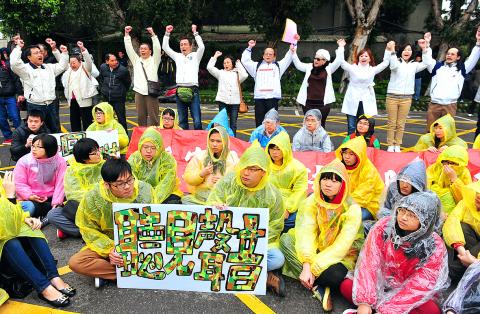
Photo: Chien Jung-fong, Taipei Times
“We had hoped the judicial system could settle who was responsible, and to what extent they should be held responsible for the death of a life,” Wang said. “I believe every citizen knows the answer to the question of whether they find the ruling acceptable.”
Netizens also weighed in on the ruling, with some voicing their disagreement and saying they plan to launch another mass demonstration.
“I’m not a legal expert. Everyone, including myself, must abide by the rule of the law. If the maximum sentence for manslaughter is only six months, then no amount of public rage can change that sentence, short of a legal amendment. To say otherwise is to invite tyranny of the masses,” Giddens Ko (柯景騰) wrote on Facebook.
“People mistreating animals receive a heavier sentence. It is evident that the life of a man is worth less than that of an animal,” a netizen named Chen Yeh-cheng (陳業程) said.
On the other hand, netizen Lin Tsung-hsi (林宗熙) said the Hung family had managed to attract society’s attention to the issue and should know when to draw the line.
In the legislature, Premier Jiang Yi-huah (江宜樺) was asked by lawmakers about his opinion on the ruling. Jiang said he respected any court decision, but he would ask the Ministry of Justice to carefully review the statement of the ruling and decide whether to file an appeal with a higher court.
The Ministry of National Defense also said it respected the ruling.
Democratic Progressive Party Legislator Ho Hsin-chun (何欣純) said the ruling fell far short of public expectations and demanded that Jiang and Minister of Justice Luo Ying-shay (羅瑩雪) promise that prosecutors would appeal the case.
Chinese Nationalist Party (KMT) Legislator Tsai Chin-Lung (蔡錦隆) asked Jiang to convey his concerns to the Hung family and let them know the government would provide them with any assistance they need.
Additional reporting by Yu Rui-jen and Chen Yen-ting

DRONE CENTRAL: Taiwan aims to become Asia’s democratic hub for drones, with most exports focused on high-quality military-grade models, an official said Taiwan’s drone industry is expected to expand significantly by 2030, producing 100,000 units per month and exporting half of them, the Ministry of Economic Affairs said yesterday. Current drone production capacity is about 15,000 units per month, but the industry can quickly scale up as demand increases, Industrial Development Administration Director-General Chiou Chyou-huey (邱求慧) told a news conference in Taipei. Taiwan’s drone output grew 2.5-fold last year to NT$12.9 billion (US$408.3 million) under a government program to develop the uncrewed vehicle sector, he said. The Executive Yuan in October last year approved plans to invest NT$44.2 billion into domestic production of uncrewed aerial
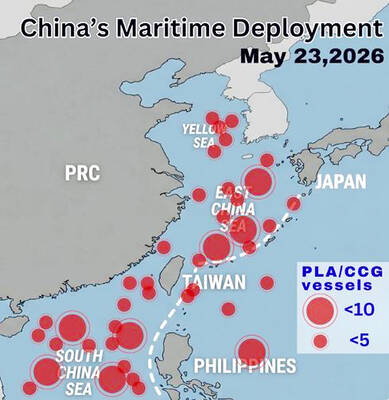
WARNING: China should stop engaging in actions that undermine regional peace and stability, as it would only build resentment among people across the Strait, the CGA said China has deployed more than 100 navy, coast guard and other vessels in waters from the Yellow Sea to the South China Sea and the western Pacific since US President Donald Trump and Chinese President Xi Jinping (習近平) met in Beijing, National Security Council Secretary-General Joseph Wu (吳釗燮) said yesterday. “In this part of the world, #China is the one & only PROBLEM wrecking the #StatusQuo & threatening regional peace & stability,” Wu wrote on X. In a separate post, he said Beijing was coercing Taiwan’s maritime domain, calling it illegal and provocative, after the Coast Guard Administration (CGA) expelled a

VERBOSE VESSELS: A CGA cutter and a China Coast Guard exchanged verbal barbs for more than a day in Taiwanese-controlled waters before the Chinese vessel left The Taiwanese and Chinese coast guards had a standoff near the strategically located Pratas Islands (Dongsha Islands, 東沙群島) in the north of the South China Sea, the Coast Guard Administration (CGA) said yesterday. The two sides engaged in intense radio exchanges over sovereignty claims during the 33-hour standoff. China Coast Guard vessel 3501 eventually left the restricted waters, 26.6 nautical miles (49.2km) west of the Pratas Islands, at 5pm yesterday, the CGA said. Lying approximately between southern Taiwan and Hong Kong, the Taiwan-controlled Pratas are seen by some security experts as vulnerable to Chinese attack due to their distance — more than
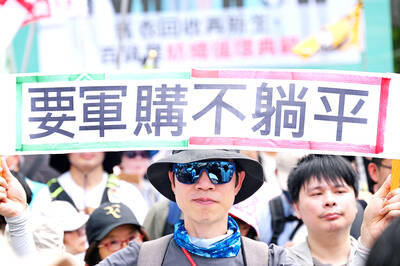
More than 8,000 people took part in a rally in Taipei yesterday to express support for more defense spending, after the opposition slashed the Cabinet’s proposed NT$1.25 trillion (US$39.6 billion) special defense budget and capped it at NT$780 billion. The demonstrators urged the Cabinet to propose another bill. Taiwan Economic Democracy Union convener Lai Chung-chiang (賴中強) said the main problem of the passed budget plan is the removal of funding for critical items, not just that the total amount is smaller. Critical budget items included purchasing or developing uncrewed vehicles, Strong Bow (強弓) missile systems, additional ammunition, artificial intelligence-powered combat systems and Taiwan-US


 RSS
RSS