


Greater Taichung chef Chen Lan-shu (陳嵐舒) was named this year’s “Asia’s Best Female Chef” in Singapore on Monday at an event organized by William Reed Business Media.
“This award recognizes the commitment, creativity and talent of women in Asia’s restaurant industry and [Chen] is a hugely worthy recipient,” said Jean Marc Lacave, president and chief executive of the award’s corporate sponsor, Veuve Clicquot.
In her speech upon receiving the award at the ceremony — part of the “Asia’s 50 Best Restaurants” program — Chen said she felt very honored and was proud to share the award with her team.
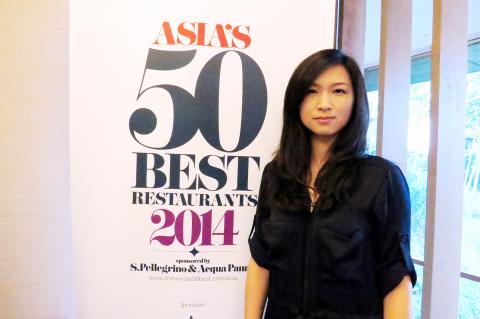
Photo: CNA
“I could not believe it when I learned I had won the title. I thought I would get it at a later time,” Chen said.
Chen is the head chef at French restaurant Le Mout, which she opened in the then-Taichung in 2008.
Her restaurant serves a menu inspired by Chen’s extensive culinary training in France as well as local ingredients, and she stressed that she would continue to use homegrown ingredients to create unique French cuisine for her patrons.
“Taiwanese ingredients have a lot of potential and variations, which can be highlighted in French cuisine. It’s amazing and quite fun to create [new dishes],” she said.
“It has become a trend in recent years for chefs to use local ingredients in their dishes and doing so helps us reflect on how to better interact with our environment. It shows respect for the land, and is a sign of sustainable thinking on the part of chefs,” she said.
The 33-year-old received a classical food education in France at the Ferrandi School of Culinary Arts and earned a diploma in pastry at Le Cordon Bleu in Paris, before moving on to work with culinary heavyweights such as Pierre Herme and Thomas Keller.
She once described her work producing new dishes as an extension of every step in her life, adding that she feels she is “creating a culinary map belonging to myself and this land.”
The “Asia’s 50 Best Restaurants” program, launched in February last year, is an offshoot of the “World’s 50 Best Restaurants” competition launched by William Reed Business Media in 2002.

PROVOCATIVE: Chinese Deputy Ambassador to the UN Sun Lei accused Japan of sending military vessels to deliberately provoke tensions in the Taiwan Strait China denounced remarks by Japan and the EU about the South China Sea at a UN Security Council meeting on Monday, and accused Tokyo of provocative behavior in the Taiwan Strait and planning military expansion. Ayano Kunimitsu, a Japanese vice foreign minister, told the Council meeting on maritime security that Tokyo was seriously concerned about the situation in the East China and South China seas, and reiterated Japan’s opposition to any attempt to change the “status quo” by force, and obstruction of freedom of navigation and overflight. Stavros Lambrinidis, head of the EU delegation to the UN, also highlighted South China Sea

SILENCING CRITICS: In addition to blocking Taiwan, China aimed to prevent rights activists from speaking out against authoritarian states, a Cabinet department said The Ministry of Foreign Affairs (MOFA) yesterday condemned transnational repression by Beijing after RightsCon, a major digital human rights conference scheduled to be held in Zambia this week, was abruptly canceled due to Chinese pressure over Taiwanese participation. This year’s RightsCon, the world’s largest conference discussing issues “at the intersection of human rights and technology,” was scheduled to take place from tomorrow to Friday in Lusaka, and expected to draw 2,600 in-person attendees from 150 countries, along with 1,100 online participants. However, organizers were forced to cancel the event due to behind-the-scenes pressure from China, the ministry said, expressing its “strongest condemnation”
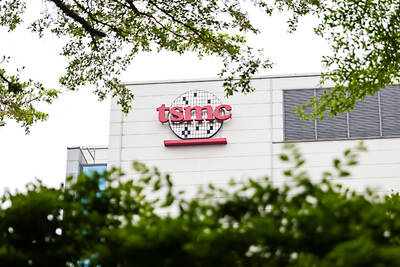
Taiwan Semiconductor Manufacturing Co (TSMC, 台積電), the world’s largest contract chipmaker, said it expects its 2-nanometer (2nm) chip capacity to grow at a compound annual rate of 70 percent from this year to 2028. The projection comes as five fabs begin volume production of 2-nanometer chips this year — two in Hsinchu and three in Kaohsiung — TSMC senior vice president and deputy cochief operating officer Cliff Hou (侯永清) said at the company’s annual technology symposium in Silicon Valley, California, last week. Output in the first year of 2-nanometer production, which began in the fourth quarter of last year, is expected to
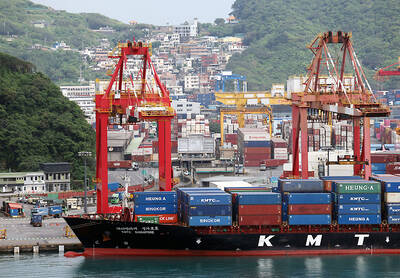
Taiwan’s economy grew far faster than expected in the first quarter, as booming demand for artificial intelligence (AI) applications drove a surge in exports, spilling over into investment and consumption, the Directorate-General of Budget, Accounting and Statistics (DGBAS) said yesterday. GDP growth was 13.69 percent year-on-year during the January-to-March period, beating the DGBAS’ February forecast by 2.23 percentage points and marking the most robust growth in nearly four decades, DGBAS senior official Chiang Hsin-yi (江心怡) told a news conference in Taipei. The result was powered by exports, which remain the backbone of Taiwan’s economy, Chiang said. Outbound shipments jumped 51.12 percent year-on-year to


 RSS
RSS