

China rejected what it said was “unreasonable criticism” of Beijing in a new UN report on human rights abuses in North Korea, but it would not be drawn on whether it would veto any proceedings in the UN Security Council to bring Pyongyang to book.
North Korean security chiefs and possibly even North Korean leader Kim Jong-un should face international justice for ordering systematic torture, starvation and killings comparable to Nazi-era atrocities, UN investigators said on Monday.
The unprecedented public rebuke and warning to a head of state by a UN inquiry is likely to further antagonize Kim and complicate efforts to persuade him to rein in his isolated country’s nuclear weapons program and belligerent confrontations with South Korea and the West.
The UN investigators also told China, North Korea’s main ally, that it might be “aiding and abetting crimes against humanity” by sending migrants and defectors back to North Korea to face torture or execution, a charge that prompted a sharp rebuke from Beijing.
“Of course, we cannot accept this unreasonable criticism,” Chinese Ministry of Foreign Affairs spokeswoman Hua Chunying (華春瑩) said at a briefing yesterday.
“We believe that politicizing human rights issues is not conducive toward improving a country’s human rights. We believe that taking human rights issues to the International Criminal Court is not helpful to improving a country’s human rights situation,” she added.
The investigators told Kim in a letter that they were advising the UN to refer North Korea to the International Criminal Court to make sure any culprits, “including possibly yourself,” were held accountable.
In a statement in Geneva, North Korea “categorically and totally” rejected the accusations set out in the 372-page report, saying they were based on material faked by hostile forces backed by the US, the EU and Japan.
The findings came out of a year-long investigation involving public testimony by defectors, including former prison camp guards, at hearings in South Korea, Japan, Britain and the US.
The investigators said human rights abuses were mainly perpetrated by officials in structures that ultimately reported to Kim, including those in state security, the Ministry of People’s Security, the army, the judiciary and the Workers’ Party of Korea.
The team recommended targeted UN sanctions against civil officials and military commanders suspected of the worst crimes.
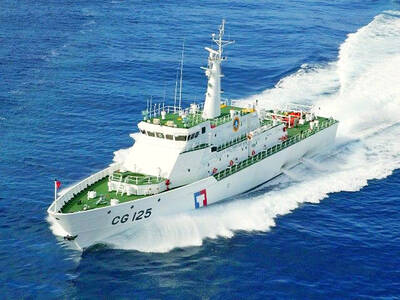
GEOPOLITICAL SIGNIFICANCE: The CGA’s nonmilitary role makes it a tool to avert diplomatic issues, an official said, while confirming the donation of a ship to Manila Coast Guard Administration (CGA) ships are scheduled to sail to the Philippines bearing the words “Taiwan Coast Guard” in a high-profile visit in October next year, the first such visit by a Taiwanese maritime law enforcement vessel to the Southeast Asian nation, the agency said yesterday. The CGA also confirmed that it had donated one of its decommissioned patrol vessels to the Philippines in a rare transfer of a retired ship to a nondiplomatic ally. The Republic of China (ROC) Navy last made such a visit in 1974, shortly before the Philippines switched diplomatic recognition to the People’s Republic of China in

‘GLOBAL WARNING’: The infiltration is not just a local problem, as Beijing has been deploying the same tactics worldwide against Western democracies, a report said Between 50,000 and 100,000 Chinese spies are operating in Taiwan, far more than the National Security Bureau’s previous estimate of 5,000, German journalist and author Jurgen Kremb said on Monday. Kremb presented his research, titled “The War of Spies: How China’s Intelligence Services Are Infiltrating Taiwan — and What Europe Must Learn from It,” at a joint event held by the Taiwan offices of the Friedrich Naumann Foundation and the European Values Center for Security Policy. The report was published in June in the Ministry of Justice Investigation Bureau’s Prospect & Exploration Monthly (展望與探索月刊). By spies, he said he was referring to informants,
CALL FOR CHANGE: They urged the UN to facilitate Taiwan’s involvement in the body, recognize its peace efforts and to work with members in preventing military conflict Representatives to the UN from five of Taiwan’s diplomatic allies sent a joint letter to UN Secretary-General Antonio Guterres on Friday, calling for the country’s inclusion in the body. Allies in the letter sent ahead of the 81st session of the UN General Assembly General Debate made three demands in support of Taiwan: inclusion, recognition and camaraderie. They implored the UN to seek an appropriate way to facilitate Taiwan’s meaningful involvement in the world governing body, saying that UN Resolution 2758, which accepted the People’s Republic of China (PRC) as a member of the UN, does not exclude Taiwan. Beijing claims that the
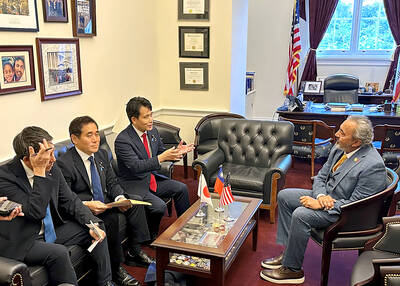
WASHINGTON MEETING: Japan’s Hirofumi Takinami said participants rejected the idea that the US should limit its defensive perimeter to the Second Island Chain US and Japanese lawmakers agree that the US must defend the First Island Chain, including Taiwan, and should not fall back to the Second Island Chain, while “a Taiwan contingency is a Japan contingency and therefore a US-Japan alliance contingency,” media reported after a meeting between officials of the two nations in Washington on Tuesday. A delegation of Japanese lawmakers from the Liberal Democratic Party met with US Senator Thom Tillis, co-chair of the Senate Taiwan Caucus, and US Representative Ami Bera, co-chair of the US Congressional Taiwan caucus, to discuss issues concerning East Asia and the Taiwan Strait. The Japanese and


 RSS
RSS