


The Legislative Yuan’s two-day extra session concluded yesterday with a controversial amendment to the Act Governing Food Sanitation (食品衛生管理法) passing its third reading and the legislature approving the Executive Yuan’s veto of the amendment of the Land Administration Agents Act (行政士法).
After lengthy negotiations, parties reached a consensus on legislation that would place stricter regulations on compound additives and labeling, and tracing of genetically modified (GM) foods.
In an effort to prevent food scandals, food manufacturers can only use compound additives made from the 799 additives currently approved by the Ministry of Health and Welfare’s Food and Drug Administration (FDA) and they are required to register previously unlisted additives with the agency so that the ingredients can be monitored and supervised.
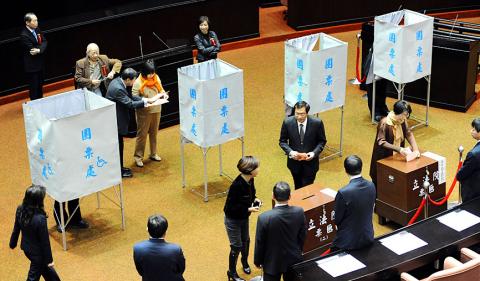
Photo: Chang Chia-ming, Taipei Times
Compound additives are not required to be registered if it could be interpreted by foreign companies and countries as a trade barrier in violation of WTO regulations.
Regulations on GM food labeling, tracing and risk assessment are to be tightened after the passage of the amendment, but a two-year cushion period would help manufacturers deal with the transition.
FDA Director Yeh Ming-kung (葉明功) said the final amendment was a win-win situation which enhanced food safety and trade practices at the same time.
However, Democratic Progressive Party (DPP) Legislator Tien Chiu-chin (田秋堇) described the amendment as a “reluctant concession.”
The act will be renamed the Act Governing Food Safety and Sanitation (食品安全衛生管理法).
Lawmakers also approved the Executive Yuan’s veto of an amendment to the Land Administration Agents Act, the primary reason for convening the extra session.
The result meant that any land administration agent who fails to submit correct information on a property transaction within 30 days of the deal could be punished.
The previous amendment stipulated that land agents should be given a “correction period” of between seven and 15 days, the same span that property sellers and buyers are given, after the 30-day “submission period” before a fine.
The Executive Yuan said it vetoed the amendment because it could create loophole that might undermine the actual-price registration system for property transactions launched on Aug. 1, 2012, to curb property speculation and increase transparency in the housing market.
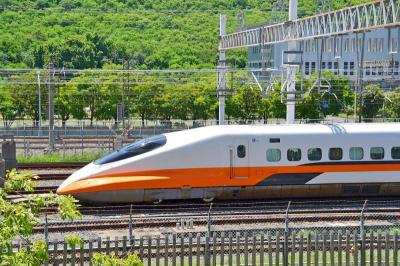
A signaling system malfunction disrupted high-speed rail (HSR) services beginning at 8am today, with trains temporarily reduced to three northbound and three southbound trains per hour as authorities conduct inspections. The malfunction occurred on a section of track in Miaoli County during pre-operation checks early this morning, forcing northbound and southbound trains to use a single track, the HSR operator said. The regular schedule has been replaced with three hourly trains offering only nonreserved seating in each direction, stopping at every station, it said, adding that business class cars would still have reserved seating. Departures from terminal stations are scheduled at the top

Taiwan is still in the process of assessing the possibility of recruiting workers from Eswatini, the Ministry of Foreign Affairs said yesterday, adding that its goal is to help Eswatini upgrade its vocational training centers. If there are plans to recruit workers from Eswatini, safeguarding national security, protecting public health and ensuring the employment rights of Taiwanese would be prerequisites, Department of West Asian and African Affairs Director-General Yen Chia-liang (顏嘉良) told a news conference. Key considerations would also include filling labor shortages in specific industries, and fostering bilateral professional and technical exchanges, he said. Yen was asked about the progress of labor

A US uncrewed surface vessel (USV) encountered multiple Chinese warships during an autonomous transit of the Taiwan Strait, US defense company Seasats said in a statement on Wednesday. Seasats announced that a Lightfish USV had completed the first autonomous transit of the Taiwan Strait. Over five days, the USV traversed the entire length of the Strait while constantly monitoring surface vessel traffic, the company said. The Lightfish encountered multiple Chinese warships, one of which was a Chinese People’s Liberation Army Navy (PLAN) Type 056 corvette, it said. The Chinese vessels were operating “well within Taiwan’s exclusive economic zone without transmitting their identity via the

VERBOSE VESSELS: A CGA cutter and a China Coast Guard exchanged verbal barbs for more than a day in Taiwanese-controlled waters before the Chinese vessel left The Taiwanese and Chinese coast guards had a standoff near the strategically located Pratas Islands (Dongsha Islands, 東沙群島) in the north of the South China Sea, the Coast Guard Administration (CGA) said yesterday. The two sides engaged in intense radio exchanges over sovereignty claims during the 33-hour standoff. China Coast Guard vessel 3501 eventually left the restricted waters, 26.6 nautical miles (49.2km) west of the Pratas Islands, at 5pm yesterday, the CGA said. Lying approximately between southern Taiwan and Hong Kong, the Taiwan-controlled Pratas are seen by some security experts as vulnerable to Chinese attack due to their distance — more than


 RSS
RSS