


Iraqi Prime Minister Nouri al-Maliki yesterday urged residents and tribes of Fallujah to “expel” al-Qaeda militants from the western city to avoid an all-out battle — remarks that may signal an imminent military move to retake the former insurgent stronghold.
Al-Maliki’s message came as dozens of families were fleeing from Fallujah, 65km west of the Iraqi capital, Baghdad, in fear of a major showdown.
Iraqi government troops have surrounded the city, which lies in the western Sunni-dominated Anbar Province and which was overrun by al-Qaeda fighters last week.

Photo: AFP
Al-Maliki did not say how he expects Fallujah residents and pro-government tribesmen to push the militants out.
In his message, broadcast over state TV, al-Maliki also urged Iraqi troops to avoid targeting Fallujah’s residential areas.
Along with Fallujah, al-Qaeda fighters last week also took control of most parts of the provincial capital of Ramadi.
Iraqi troops have since been trying to dislodge militants from the group, known as the Islamic State in Iraq and the Levant, or ISIL, from the two cities. On Sunday, fighting in Anbar killed at least 34 people, including 22 soldiers.
The recent gains by al-Qaeda in Iraq have been a blow to the country’s Shiite-led government, as sectarian violence has escalated since the US withdrawal.
US Secretary of State John Kerry on Sunday said that Washington was “very, very concerned” by the fighting, but would not send in US troops.
Yesterday, Iranian Army Deputy Chief of Staff General Mohammed Hejazi said Iran was also ready to help Iraq with military equipment and advisers, should Baghdad ask for it. Any Iranian help would exacerbate tensions, as Iraqi Sunnis accuse Tehran of backing what they say are their Shiite-led government’s unfair policies against them.
Fallujah residents said clashes continued into early morning yesterday along the main highway that links Baghdad to Syria and Jordan.
Al-Qaeda fighters and their supporters are still controlling the center of the city, where they can be seen on the streets and around government buildings. Al-Qaeda black flags have been seen on government and police vehicles captured by the militants during the clashes.
In Ramadi, sporadic clashes were taking place in some parts of in and outside the city yesterday, residents there said. All residents in Anbar that talked to reporters spoke on condition of anonymity, fearing for their own safety.
Dozens of families were fleeing the two cities to nearby towns, crammed in cars loaded with their belongings.
Fighters from a pro-government Sunni militia killed six militants in a firefight outside Fallujah yesterday, a police officer said.
In Baghdad’s western suburb of Abu Ghraib, militants in speeding car attacked and Iraqi army checkpoint, killing two soldiers and wounding four, a police officer and a medical official said.
All officials spoke on condition of anonymity as they were not authorized to talk to media.
On Sunday, at least 22 soldiers and 12 civilians were killed, along with an unknown number of militants, and 58 people were wounded during clashes between al-Qaeda fighters on one side and the army and its allied tribesmen on the other.
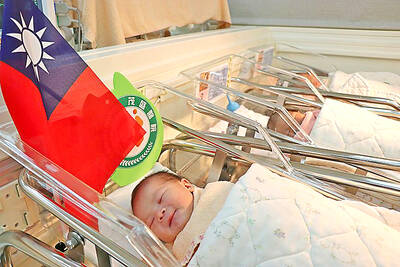
AGING: As of last month, people aged 65 or older accounted for 20.06 percent of the total population and the number of couples who got married fell by 18,685 from 2024 Taiwan has surpassed South Korea as the country least willing to have children, with an annual crude birthrate of 4.62 per 1,000 people, Ministry of the Interior data showed yesterday. The nation was previously ranked the second-lowest country in terms of total fertility rate, or the average number of children a woman has in her lifetime. However, South Korea’s fertility rate began to recover from 2023, with total fertility rate rising from 0.72 and estimated to reach 0.82 to 0.85 by last year, and the crude birthrate projected at 6.7 per 1,000 people. Japan’s crude birthrate was projected to fall below six,
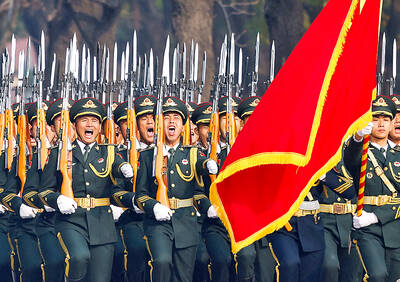
Conflict with Taiwan could leave China with “massive economic disruption, catastrophic military losses, significant social unrest, and devastating sanctions,” a US think tank said in a report released on Monday. The German Marshall Fund released a report titled If China Attacks Taiwan: The Consequences for China of “Minor Conflict” and “Major War” Scenarios. The report details the “massive” economic, military, social and international costs to China in the event of a minor conflict or major war with Taiwan, estimating that the Chinese People’s Liberation Army (PLA) could sustain losses of more than half of its active-duty ground forces, including 100,000 troops. Understanding Chinese
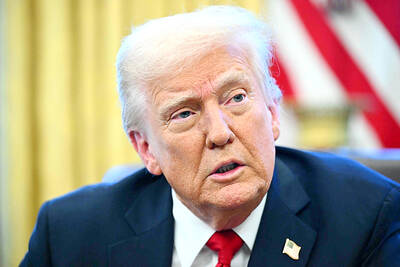
US President Donald Trump in an interview with the New York Times published on Thursday said that “it’s up to” Chinese President Xi Jinping (習近平) what China does on Taiwan, but that he would be “very unhappy” with a change in the “status quo.” “He [Xi] considers it to be a part of China, and that’s up to him what he’s going to be doing, but I’ve expressed to him that I would be very unhappy if he did that, and I don’t think he’ll do that. I hope he doesn’t do that,” Trump said. Trump made the comments in the context
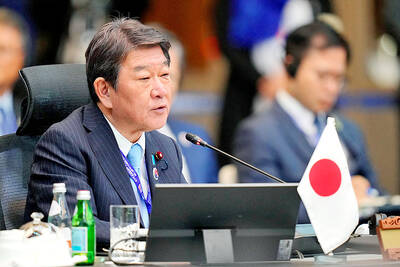
SELF-DEFENSE: Tokyo has accelerated its spending goal and its defense minister said the nation needs to discuss whether it should develop nuclear-powered submarines China is ramping up objections to what it sees as Japan’s desire to acquire nuclear weapons, despite Tokyo’s longstanding renunciation of such arms, deepening another fissure in the two neighbors’ increasingly tense ties. In what appears to be a concerted effort, China’s foreign and defense ministries issued statements on Thursday condemning alleged remilitarism efforts by Tokyo. The remarks came as two of the country’s top think tanks jointly issued a 29-page report framing actions by “right-wing forces” in Japan as posing a “serious threat” to world peace. While that report did not define “right-wing forces,” the Chinese Ministry of Foreign Affairs was


 RSS
RSS