


A call by Hong Kong activists to “evacuate to Taiwan” appears to have hit a nerve, with government data showing a sixfold increase in the number of applications for residency from Hong Kongers.
The National Immigration Agency (NIA) said it received an average of 100 such applications per month between January and August. However, 632 applications were filed in September, the most recent data available.
Applications by residents of Hong Kong and Macau to live in Taiwan totaled 1,598 through August, while there were 486 applications for permanent residency during the same period.
Residents of the two former colonies can apply for permanent residency after living in Taiwan for a specific period of time and the figures are seen as “leading indicators” of an intention to settle in Taiwan, an agency official said.
“We have definitely seen an increasing trend in the past few years. We had a historic high last year in the number of Hong Kongers applying for residency in Taiwan. The amount of applications for permanent residence also hit a new high last year since China took over Hong Kong [in 1997],” the official said.
There has been a growing groundswell of discontent in Hong Kong in recent months, with massive protests being held against the government. The situation has been exacerbating by the skyrocketing price of housing and falling wages, along with many Hong Kong residents feeling that their social welfare entitlements are being squeezed by the upsurge in Chinese residents in the territory.
Media in Hong Kong have been reporting on a generation of “angry youth,” who are prompting the calls to emigrate.
The Hong Kong government last month granted television broadcast licenses to two networks, both controlled by business tycoons, while denying a license to Hong Kong Television Network, which is perceived as more aligned with democracy and media freedom causes. The decision led to more than 100,000 people attending anti-government rallies to protest the move.
Some young people have initiated an “Evacuate to Taiwan” campaign on their Facebook pages, which has received a positive response and appears to be gathering steam among the territory’s youth.
The Rules Governing Permits for People from Hong Kong and Macau Setting Up Residence or Permanent Residence in Taiwan (香港澳門居民進入臺灣地區及居留定居許可辦法) set out the requirements that residents of the former British colony who wish to move to Taiwan must follow.
Like other foreigners, some Hong Kongers can come to Taiwan on employment contracts, or if they possess special skills.
Hong Kong residents can also apply under the “investment immigrant” category if they invest NT$5 million (US$169,000) or more in Taiwan or deposit NT$5 million or more into a Taiwanese bank account for more than a year.
Analysts say the amount, equivalent to about HK$1.35 million, would only buy about 1 ping (3.305m2) of property in the territory’s pricey hillside residential districts.

LEVERAGE: China did not ‘need to fire a shot’ to deny Taiwan airspace over Africa when it owns ‘half the continent’s debt,’ a US official said, calling it economic warfare The EU has raised concerns about overflight rights following the delay of President William Lai’s (賴清德) planned state visit to the Kingdom of Eswatini after three African nations denied overflight clearance for his charter at the last minute. Taiwanese allies Paraguay and Saint Kitts and Nevis, as well as several US lawmakers and the Inter-Parliamentary Alliance on China (IPAC) condemned China for allegedly pressuring the countries. Lai was scheduled to fly directly to Taiwan’s only African ally from yesterday to Sunday to celebrate the 40th anniversary of King Mswati III’s accession and his 58th birthday, but Seychelles, Mauritius and Madagascar suddenly revoked
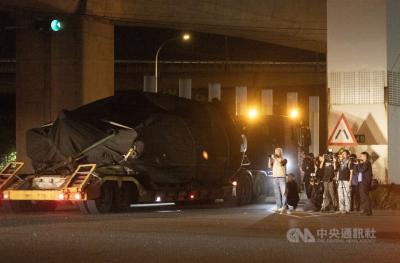
The final batch of 28 M1A2T Abrams tanks purchased from the US arrived at Taipei Port last night and were transported to the Armor Training Command in Hsinchu County’s Hukou Township (湖口), completing the military’s multi-year procurement of 108 of the tanks. Starting at 12:10am today, reporters observed more than a dozen civilian flatbed trailers departing from Taipei Port, each carrying an M1A2T tank covered with black waterproof tarps. Escorted by military vehicles, the convoy traveled via the West Coast Expressway to the Armor Training Command, with police implementing traffic control. The army operates about 1,000 tanks, including CM-11 Brave Tiger
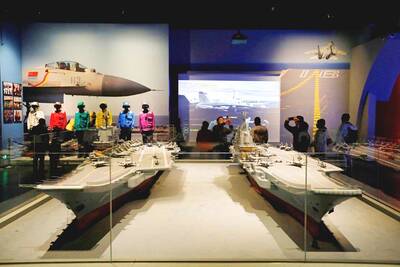
China on Wednesday teased in a video an aircraft carrier that could be its fourth, and the first using nuclear power, while making an allusion to Taiwan and vowing to further build up its islands, as it looks to boost maritime power, secure resources and bolster territorial claims. The video, issued on the eve of the 77th founding anniversary of the Chinese People’s Liberation Army Navy, featured fictional officers with names that are homophones of three commissioned aircraft carriers, the Liaoning (遼寧), Shandong (山東) and Fujian (福建). Titled Into the Deep, it showed a 19-year-old named “Hejian” (何劍) joining the group, sparking
BIG YEAR: The company said it would also release its A12 chip the same year to keep a ‘reliable stream of new silicon technologies’ flowing to its customers Taiwan Semiconductor Manufacturing Co (TSMC, 台積電) yesterday said its newest A13 chip is to enter volume production in 2029 as the chipmaker seeks to hold onto its tech leadership and demand for next-generation chips used in artificial intelligence (AI), high-performance-computing (HPC) and mobile applications. TSMC, the world’s biggest contract chipmaker, also unveiled its A12 chip at its annual technology symposium in Santa Clara, California. The A12 chip, which features TSMC’s super-power-rail technology to provide backside power delivery for AI and HPC applications, is also to enter volume production in 2029, a year after the scheduled release of the A14 chip. The technology moves


 RSS
RSS