


German Chancellor Angela Merkel’s top foreign affairs and intelligence advisers were due to quiz officials in Washington yesterday over the activities of US spies in Germany, including allegations they tapped Merkel’s phone.
The visit is one of a series of trips by high-ranking German and EU officials to the US this week after revelations of the scale of the surveillance triggered outrage and shattered European trust in Washington.
Merkel wants the US to agree a “no spying” deal with Berlin and Paris by the end of the year, and to stop alleged espionage against two of Washington’s closest EU allies.
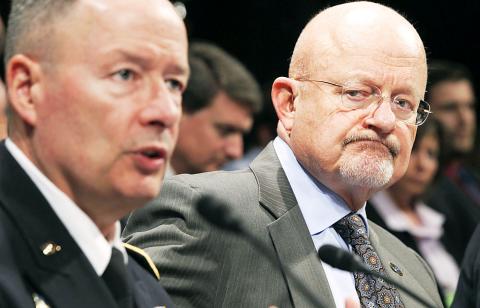
Photo: Reuters
“I can confirm that the two top aides from the chancellery are in Washington for talks today [Wednesday],” Merkel’s spokesman Steffen Seibert said. “As you see, we are in a process of intense contact with our US partners on the intelligence and political levels, and this process of contact and investigation will take more time. The talks aim to set up a new foundation for trust.”
The White House did not deny reports that the US’ National Security Agency (NSA) had monitored Merkel’s phone, but said no such surveillance was taking place now.
Yesterday’s visit comes a day after an EU team met the head of the NSA, Army General Keith Alexander, and US Senator Dianne Feinstein, the California Democrat who leads the Senate Select Committee on Intelligence.
Later this week, the heads of Germany’s domestic and foreign intelligence agencies are also due to travel to Washington.
EU lawmaker Elmar Brok, a German national, told German daily Bild that his meeting with US officials produced no breakthroughs, but did generate good signals.
“Our talks showed that the Americans recognize the immense political damage caused by this affair and are open to more transparency,” Brok said.
The visit came a day after espionage chiefs turned the tables on the US’ European allies in the transatlantic spat, saying in many cases it was European agencies — not the NSA — that gathered data and shared it with the US.
They dismissed as “completely false” allegations that US spy agencies had swept up data on millions of phone calls and said European newspapers that had made those claims did not understand the data they were using to make the allegations.
The assertion came as a senior official said US President Barack Obama was considering banning US spies from tapping the phones of allied leaders.
Alexander and US Director of National Intelligence James Clapper testified to Congress that the reports were based on a misunderstanding of information passed to European newspapers.
“The assertions by reporters in France, Spain, Italy that NSA collected tens of millions of phone calls are completely false,” Alexander told the US House Committee on Intelligence. “To be perfectly clear, this is not information that we collected on European citizens.”
Hours earlier, the Wall Street Journal reported that the electronic spying was carried out by the intelligence agencies of France and Spain outside their own borders, and sometimes in war zones, and then passed onto the NSA.
The claims, if true, could embarrass European governments, which have vehemently protested to the US about alleged overreaching and infringements of the privacy of their citizens by the NSA.
Feinstein backed up claims that the European media reports were wrong.
“This was not the United States collecting on France and Germany. This was France and Germany collecting and it had nothing to do with their citizens, it had to do with collecting in NATO areas of war, like Afghanistan,” she said.
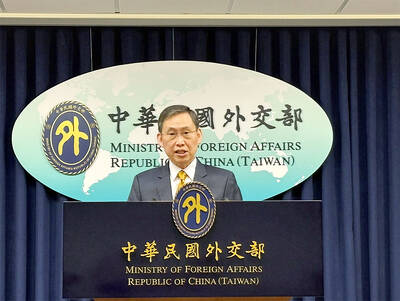
A Ministry of Foreign Affairs official yesterday said that a delegation that visited China for an APEC meeting did not receive any kind of treatment that downgraded Taiwan’s sovereignty. Department of International Organizations Director-General Jonathan Sun (孫儉元) said that he and a group of ministry officials visited Shenzhen, China, to attend the APEC Informal Senior Officials’ Meeting last month. The trip went “smoothly and safely” for all Taiwanese delegates, as the Chinese side arranged the trip in accordance with long-standing practices, Sun said at the ministry’s weekly briefing. The Taiwanese group did not encounter any political suppression, he said. Sun made the remarks when
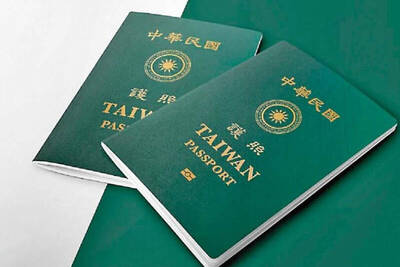
The Taiwanese passport ranked 33rd in a global listing of passports by convenience this month, rising three places from last month’s ranking, but matching its position in January last year. The Henley Passport Index, an international ranking of passports by the number of designations its holder can travel to without a visa, showed that the Taiwan passport enables holders to travel to 139 countries and territories without a visa. Singapore’s passport was ranked the most powerful with visa-free access to 192 destinations out of 227, according to the index published on Tuesday by UK-based migration investment consultancy firm Henley and Partners. Japan’s and
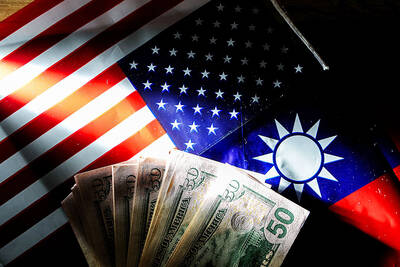
BROAD AGREEMENT: The two are nearing a trade deal to reduce Taiwan’s tariff to 15% and a commitment for TSMC to build five more fabs, a ‘New York Times’ report said Taiwan and the US have reached a broad consensus on a trade deal, the Executive Yuan’s Office of Trade Negotiations said yesterday, after a report said that Washington is set to reduce Taiwan’s tariff rate to 15 percent. The New York Times on Monday reported that the two nations are nearing a trade deal to reduce Taiwan’s tariff rate to 15 percent and commit Taiwan Semiconductor Manufacturing Co (TSMC, 台積電) to building at least five more facilities in the US. “The agreement, which has been under negotiation for months, is being legally scrubbed and could be announced this month,” the paper said,

MIXED SOURCING: While Taiwan is expanding domestic production, it also sources munitions overseas, as some, like M855 rounds, are cheaper than locally made ones Taiwan and the US plan to jointly produce 155mm artillery shells, as the munition is in high demand due to the Ukraine-Russia war and should be useful in Taiwan’s self-defense, Armaments Bureau Director-General Lieutenant General Lin Wen-hsiang (林文祥) told lawmakers in Taipei yesterday. Lin was responding to questions about Taiwan’s partnership with allies in producing munitions at a meeting of the legislature’s Foreign Affairs and National Defense Committee. Given the intense demand for 155mm artillery shells in Ukraine’s defense against the Russian invasion, and in light of Taiwan’s own defensive needs, Taipei and Washington plan to jointly produce 155mm shells, said Lin,


 RSS
RSS