


German and French accusations that the US has run spying operations in their countries, including possibly bugging German Chancellor Angela Merkel’s mobile phone, are likely to dominate a meeting of EU leaders that was to start yesterday.
The two-day Brussels summit, called to tackle a range of social and economic issues, will now be overshadowed by debate on how to respond to the alleged espionage by Washington against two of its closest EU allies.
For Germany, the issue is particularly sensitive as not only does Berlin say it has evidence that Merkel’s personal phone was monitored, but the very idea of bugging dredges up memories of eavesdropping by the Stasi secret police in the former East Germany, where the chancellor grew up.
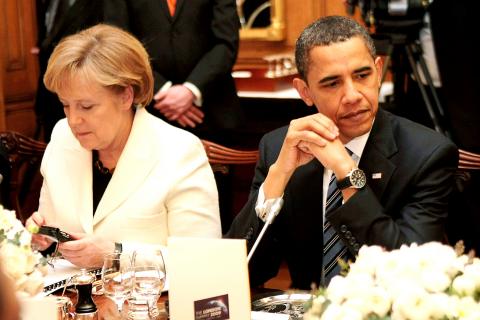
PHOTO: AFP
Following leaks by US National Security Agency (NSA) data analyst Edward Snowden, which revealed the reach of the agency’s vast data-monitoring programs, the US finds itself at odds with a host of allies, from Brazil to Saudi Arabia.
In an unusually strongly worded statement on Wednesday evening, Merkel’s spokesman said the chancellor had spoken to US President Barack Obama to seek clarity on the spying charges.
“She made clear that she views such practices, if proven true, as completely unacceptable and condemns them unequivocally,” the statement read.
White House spokesman Jan Carney said Obama had assured Merkel that the US “is not monitoring and will not monitor” the chancellor’s communications, leaving open the possibility that it has happened in the past.
A White House official declined to say whether Merkel’s phone had previously been bugged.
“I’m not in a position to comment publicly on every specific alleged intelligence activity,” the official said.
German Minister of Foreign Affairs Guido Westerwelle has summoned the US ambassador to Berlin to discuss the issue.
Germany’s frustration follows outrage in France since the Le Monde newspaper reported that the NSA had collected tens of thousands of French telephone records between December last year and January.
French President Francois Hollande has made clear he plans to put the spying issue on the summit agenda, although it is not clear what that will ultimately achieve.
While Berlin and Paris are likely to find sympathy among many of the EU’s 28 member states, domestic security issues are not a competence of the bloc. The best that may be hoped for is an expression of support from leaders and calls for a full explanation from the US.
The furor over the alleged espionage could encourage member states to back tougher data privacy rules currently being drafted by the EU. The European Parliament this week approved an amended package of legislation that would overhaul EU data protection rules that date from 1995.
The new rules would restrict how data collected in Europe by firms such as Google and Facebook is shared with non-EU countries, introduce the right of EU citizens to request that their digital traces be erased, and impose fines of 100 million euros (US$138 million) or more on rule breakers.
Despite the outrage in Paris and Berlin, the former head of France’s intelligence agency said the issue was being blown out of proportion and no one should be surprised by US spying.
“I’m bewildered by such worrying naivete. You’d think the politicians don’t read the reports they’re sent — there shouldn’t be any surprise,” former French Central Directorate of Homeland Intelligence director Bernard Squarcini told Le Figaro.
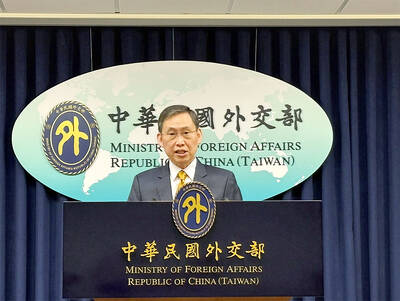
A Ministry of Foreign Affairs official yesterday said that a delegation that visited China for an APEC meeting did not receive any kind of treatment that downgraded Taiwan’s sovereignty. Department of International Organizations Director-General Jonathan Sun (孫儉元) said that he and a group of ministry officials visited Shenzhen, China, to attend the APEC Informal Senior Officials’ Meeting last month. The trip went “smoothly and safely” for all Taiwanese delegates, as the Chinese side arranged the trip in accordance with long-standing practices, Sun said at the ministry’s weekly briefing. The Taiwanese group did not encounter any political suppression, he said. Sun made the remarks when
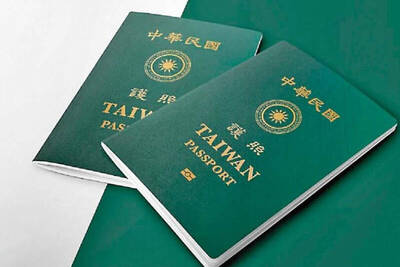
The Taiwanese passport ranked 33rd in a global listing of passports by convenience this month, rising three places from last month’s ranking, but matching its position in January last year. The Henley Passport Index, an international ranking of passports by the number of designations its holder can travel to without a visa, showed that the Taiwan passport enables holders to travel to 139 countries and territories without a visa. Singapore’s passport was ranked the most powerful with visa-free access to 192 destinations out of 227, according to the index published on Tuesday by UK-based migration investment consultancy firm Henley and Partners. Japan’s and
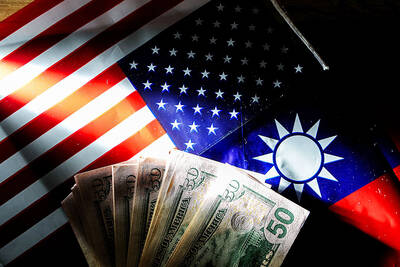
BROAD AGREEMENT: The two are nearing a trade deal to reduce Taiwan’s tariff to 15% and a commitment for TSMC to build five more fabs, a ‘New York Times’ report said Taiwan and the US have reached a broad consensus on a trade deal, the Executive Yuan’s Office of Trade Negotiations said yesterday, after a report said that Washington is set to reduce Taiwan’s tariff rate to 15 percent. The New York Times on Monday reported that the two nations are nearing a trade deal to reduce Taiwan’s tariff rate to 15 percent and commit Taiwan Semiconductor Manufacturing Co (TSMC, 台積電) to building at least five more facilities in the US. “The agreement, which has been under negotiation for months, is being legally scrubbed and could be announced this month,” the paper said,

MIXED SOURCING: While Taiwan is expanding domestic production, it also sources munitions overseas, as some, like M855 rounds, are cheaper than locally made ones Taiwan and the US plan to jointly produce 155mm artillery shells, as the munition is in high demand due to the Ukraine-Russia war and should be useful in Taiwan’s self-defense, Armaments Bureau Director-General Lieutenant General Lin Wen-hsiang (林文祥) told lawmakers in Taipei yesterday. Lin was responding to questions about Taiwan’s partnership with allies in producing munitions at a meeting of the legislature’s Foreign Affairs and National Defense Committee. Given the intense demand for 155mm artillery shells in Ukraine’s defense against the Russian invasion, and in light of Taiwan’s own defensive needs, Taipei and Washington plan to jointly produce 155mm shells, said Lin,


 RSS
RSS