


Democratic Progressive Party (DPP) Chairman Su Tseng-chang (蘇貞昌) is set to announce the party’s plan to initiate a no-confidence motion today against what it described as Presdient Ma Ying-jeou (馬英九) administration’s destruction of the Constitution and political destabilization.
Su plans to skip the Double Ten National Day ceremony and to make the announcement at a press conference titled: “Action for democracy. No-confidence motion for the people,” DPP spokesperson Lin Chun-hsien (林俊憲) said after the party’s weekly Central Standing Committee meeting yesterday.
Su said last week that the DPP would in two weeks choose the best of three constitutional mechanisms — recall, impeachment, or a no-confidence motion — to hold Ma accountable for the damage he has done to the Constitution, as well as resolve the political crisis sparked by the dispute between Ma and Legislative Speaker Wang Jin-pyng (王金平) and wiretapping controversies in the judiciary.
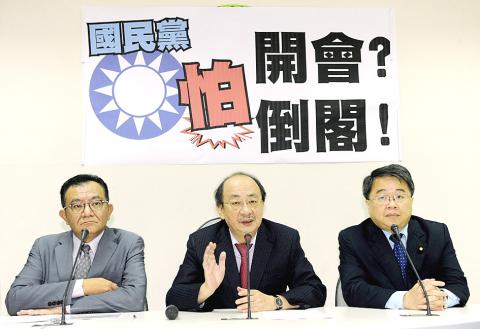
Photo: Chen Chih-chu, Taipei Times
Lin declined to confirm whether the no-confidence motion would be the only action taken by the DPP, but called on Chinese Nationalist Party (KMT) lawmakers to be “courageous enough” to stand up against their own party and support whichever proposal the DPP makes, since all three options would require votes from KMT legislators to pass.
However, it seems as if the KMT is trying to avoid the DPP launching a no-confidence motion against the Cabinet — a move which could lead to dissolution of the legislature — by paralyzing the legislative plenaries, Lin said.
“It’s obvious that the KMT is doing so out of fear of the opposition’s reactions and upsetting mainstream public opinion,” he said.
Separately yesterday, the DPP caucus criticized the KMT caucus for setting an unprecedented example by voiding the agenda of the next two legislative plenaries.
DPP Legislator Chen Chi-mai (陳其邁), the convener of Tuesday’s meeting of the legislature’s Procedure Committee, said the KMT caucus had vetoed all legislative proposals submitted by opposition lawmakers and did not propose any bills at the meeting, meaning that there are no proposals on the plenary agenda for tomorrow’s or next Tuesday’s session.
Proposed amendments to the Code of Court Martial Procedure (軍事審判法) and bills related to the monitoring of cross-strait agreements, the proposed nuclear referendum and legislative reform were all blocked by the KMT, Chen said.
DPP caucus whip Ker Chien-ming (柯建銘) said the KMT caucus “is now in an awkward position” since it criticized the DPP for paralyzing the legislature by boycotting Premier Jiang Yi-huah’s (江宜樺) mandatory report, but is now doing the same thing.
“It is ironic that the KMT caucus is paralyzing the plenaries [out of fear that the DPP will table a no-confidence motion]. However, they cannot do this forever,” Ker said.
Ker said the DPP is demanding that Ma, Jiang and Prosecutor-General Huang Shih-ming (黃世銘), who stands accused of wiretapping the legislature and illegally informing the president about an ongoing investigation — an unconstitutional practice — all step down.
KMT caucus whip Lin Hung-chih (林鴻池) denied the DPP’s accusations, saying that the KMT vetoed the proposals because the DPP had violated a consensus reached at previous cross-party negotiations.

‘NO SECURITY RISK’: The Railway Bureau reassured the public that the technicians’ activities were limited to technical guidance and did not involve sensitive systems The Railway Bureau yesterday said it had invited eight Chinese technicians to assist with an airport MRT construction project. The bureau issued the confirmation after an Internet user said Chinese nationals had entered the construction zone of Taiwan Taoyuan International Airport’s Terminal 3 project. They asked why “individuals from an enemy state” were allowed access to such a major national infrastructure project, which raised serious concerns over Taiwan’s industrial safety, sensitive systems and information security. The bureau’s Northern Region Engineering Branch Office said subcontractor Taiwan Handle Industrial Co (台灣手把工業) of the Taoyuan airport MRT’s “Contract No. CU05 Project A14 Station Civil, MEP &

A US uncrewed surface vessel (USV) encountered multiple Chinese warships during an autonomous transit of the Taiwan Strait, US defense company Seasats said in a statement on Wednesday. Seasats announced that a Lightfish USV had completed the first autonomous transit of the Taiwan Strait. Over five days, the USV traversed the entire length of the Strait while constantly monitoring surface vessel traffic, the company said. The Lightfish encountered multiple Chinese warships, one of which was a Chinese People’s Liberation Army Navy (PLAN) Type 056 corvette, it said. The Chinese vessels were operating “well within Taiwan’s exclusive economic zone without transmitting their identity via the
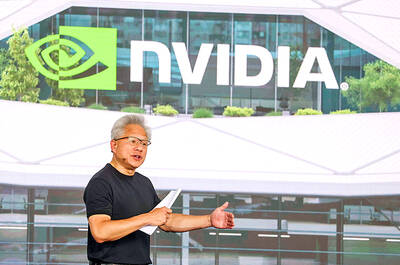
‘BOOMING’: ’ The number of partners we have here is incredible. You can see from their stock prices. They’re doing so well, they’re so happy,’ Jensen Huang said Nvidia Corp’s spending in Taiwan has ballooned to about US$150 billion a year, 10 times the US$10 billion to US$15 billion the company spent five years ago, Nvidia chief executive officer Jensen Huang (黃仁勳) said yesterday, suggesting Taiwan’s strategic importance in the global artificial intelligence (AI) supply chain. “Taiwan is the epicenter of the AI revolution. This is where the chips come, packaging comes. This is where the systems are made. This is where AI supercomputers were created,” Huang said at a meeting for the company’s employees in Beitou-Shilin Technology Park (北投士林科技園區) in Taipei, the planned site of Nvidia’s Taipei headquarters. “Taiwan
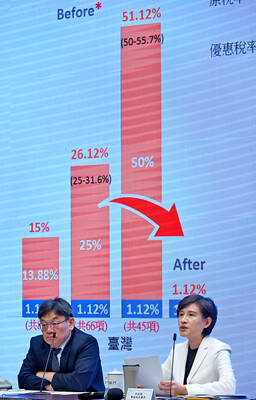
GREATER REACH? Auto parts and wood products would face tariffs of up to 15%, matching those targeting the EU, Japan and South Korea, Vice Premier said The US has announced that preferential tariff treatment for Taiwan’s non-semiconductor Section 232 goods would take effect retroactively from May 1, the Executive Yuan said yesterday. The US government yesterday posted a notice on the Federal Register’s public inspection Web site previewing tariff concessions for Taiwan under a memorandum of understanding (MOU) on Taiwan-US investment after two months of negotiations. The MOU signed on Jan. 15 stipulated three major preferential tariff arrangements: a 15 percent “reciprocal” tariff rate for Taiwan without stacking most-favored nation (MFN) rates; preferential Section 232 treatment for semiconductors and related products; and preferential Section 232 treatment for non-semiconductor


 RSS
RSS