


A 60-year-old resident of Dapu Borough (大埔), Miaoli County, whose house was forcibly torn down by the Miaoli County Government in July, was found dead in an irrigation channel near his former home yesterday in the latest in a series of incidents that have drawn attention to the county in recent months.
With family and friends in tears, the body of Chang Sen-wen (張森文) was lifted out of the water by rescuers yesterday afternoon.
“Who killed you? Tell me who killed you?” Chang’s wife, Peng Hsiu-chun (彭秀春), cried out when she saw her husband’s body, while their son, Chang Yuan-hao (張元豪) stood to the side, repeatedly calling out for his father.
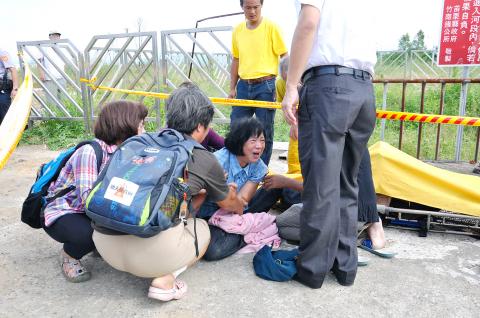
Photo: Peng Chien-li, Taipei Times
“I was quite worried when I woke up in the morning and did not see my dad, because he would usually come back home at about 6am — no later than 7am — from his morning walk,” Chang Yuan-hao told reporters in the morning before his father’s body was discovered.
“It was a bit weird, because he had left his wallet and cellphone at home,” he added.
After receiving a telephone call from Chang Yuan-hao at about 10am, the local police station checked surveillance camera footage of the area where the Changs now live, and saw Chang Sen-wen walking southward by himself at about 2:30am.
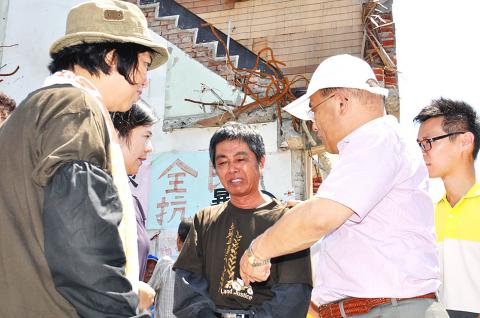
Photo: Peng Chien-li, Taipei
Searching along the road, the police found his body in an irrigation channel, about 200m from where his demolished house once stood.
Speaking on Chang Sen-wen’s death when asked by the media at a separate setting, Miaoli County Commissioner Liu Cheng-hung (劉政鴻) — who ordered the demolition of the Changs’ house and pharmacy on July 18 — said he was mourning, though only after being reminded of the tragedy by journalists.
“For the, uh, I should say, accident, that happened to Mr Chang, I would say, uh, I would lament it, I would lament it,” Liu said. “As maybe I should say, I mourn his death, I mourn his death, yes, that’s a better term, I mourn his death.”
Despite being rebuffed by the Changs when he asked to visit them, Liu insisted on going to their house to pay his respects to the deceased, leading to clashes between police officers escorting him and supporters of the Changs.
Chanting “Liu the killer,” the crowd pushed Liu and the police out of the house, throwing bottles and shoes at him before slamming the door shut.
Liu left after getting hit by a shoe.
At press time, the police and the prosecutor were still investigating the cause of Chang Sen-wen’s death.
However, netizens and supporters of the Changs have blamed Liu for his death.
Huang Fu-ji (黃福記), a former resident of one of the four homes demolished in July, told reporters that Liu should receive the death penalty and be gunned down.
Chang Sen-wen had been mentally and physically on the edge of collapse since before the forced demolition on July 18.
Two other Dapu residents had committed suicide earlier in protest against the demolitions to make way for a science park.
Additional reporting by Rich Chang


RESILIENCE: Taiwan plays a key role in semiconductors, energy, information infrastructure and advanced manufacturing, AIT Director Raymond Greene said Taiwan’s continued investment in deterrence and resilience remains vital, especially in uncrewed systems and other emerging technologies, American Institute in Taiwan (AIT) Director Raymond Greene said yesterday. Greene made the remarks at the annual National Strategic Summit on Supply Chain Resilience held by the Research Institute for Democracy, Society and Emerging Technology (DSET), a government-backed think tank. As Taiwan last year became the US’ fourth-largest trading partner and supply chain security is becoming more important, cooperation in emerging technologies continues to deepen between the two countries, he said. The US is committed to accelerating innovation, building key infrastructure, strengthening cooperation

The National Chungshan Institute of Science and Technology yesterday showcased its locally developed variants of the Vision 60 robotic patrol dog, which it plans to deploy on the nation’s outlying territories in the South China Sea. The variants were produced under the Joint Lab project — created by the institute and domestic companies — and assembled with domestically produced motors, lenses and artificial intelligence (AI) systems alongside licensed tech from the US, Missile and Rocket Systems Research Division deputy director Jen Kuo-kang (任國光) told the media event at a military base in Taipei’s Dazhi (大直) area. Taiwan has built up its strengths

RIGHT DIRECTION: Taiwan’s efforts to prevent forced labor include a proposal to ‘fully prohibit’ employers from withholding workers’ documents, an official said Taiwan is to establish a mechanism to restrict imports of goods linked to forced labor, the Executive Yuan said yesterday, after the US proposed imposing additional tariffs on Taiwanese goods over labor concerns. “The Ministry of Labor and the Ministry of Economic Affairs are to establish an interministerial review procedure,” Executive Yuan spokesperson Michelle Lee (李慧芝) said at a news briefing in Taipei. “The government is to use the Foreign Trade Act [貿易法] as the legal basis to restrict imports of goods produced with forced labor” and bring its supply chain governance more in line with international standards on human rights, resilience

NOT IMMEDIATE: Taiwan has a chance to appeal the proposed 10 percent tariff before it starts, while other countries face a 12.5 percent tariff from the trade office Taiwan is among 60 economies determined by the US to have failed to impose or enforce a ban on the importation of goods produced with forced labor, according to a notice released on Tuesday by the Office of the US Trade Representative (USTR), which proposed imposing an additional 10 percent or more tariff on them. The USTR in a statement said that following an investigation, it had determined under Section 301 of the Trade Act of 1974 that the failure of the 60 economies to impose and effectively enforce a prohibition on the importation of goods produced with forced labor is


 RSS
RSS