


A draft act to allow Taiwan and China to establish representative offices in each other’s countries failed to pass its initial legislative committee review yesterday as opposition parties paralyzed the Internal Administration Committee meeting, while Chinese Nationalist Party (KMT) lawmakers also voiced dissatisfaction with the negotiations.
The establishment of representative offices in Taiwan and China will be addressed in the ninth round of cross-strait talks between the Straits Exchange Foundation (SEF) and Association for Relations Across the Taiwan Straits (ARATS) today in Shanghai. The foundation and ARATS will also sign a cross-strait service trade agreement during the negotiations.
The Internal Administration Committee was at 9am to begin review of legislation to allow Taiwan and China to create representative offices in each other’s countries. However, lawmakers from the Democratic Progressive Party (DPP), Taiwan Solidarity Union and People First Party (PFP) arrived outside the meeting room at 7am, long before most KMT legislators arrived, at about 8:30am.
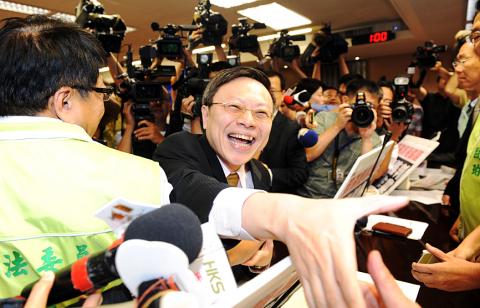
Photo: Lo Pei-der, Taipei Times
As soon as the room’s door was opened, opposition lawmakers rushed to occupy the podium to prevent the meeting from starting, and they succeeded in stalling the proceedings all day.
“A few days after a meeting between KMT Chairman Wu Po-hsiung (吳伯雄) and Chinese President Xi Jinping (習近平) during which Wu and Xi agreed on the ‘one China’ principle and creating representative offices, the government is pushing through legislation for it,” DPP caucus whip Ker Chien-ming (柯建銘) said of the reason behind the caucus’ boycott. “However, the Mainland Affairs Council has yet to brief us on the ongoing talks about creating representative offices, so passing the legislation now would be like giving it a blank check.”
DPP Chairman Su Tseng-chang (蘇貞昌) also accused President Ma Ying-jeou’s (馬英九) administration of “asking the Legislative Yuan for a blank check” for the establishment of cross-strait representative offices before bilateral negotiations are completed.
It is essential for Taipei to have visitation rights to Taiwanese detained in China and the authorization to issue travel documents, but the administration demanded that the legislation be passed without the legislature knowing Beijing’s position on the matter, which was why the DPP would not accept the request before the negotiations are completed, Su said.
Meanwhile, the PFP issued a statement saying that while it supports enhancing cross-strait ties, “we do not agree with President Ma Ying-jeou’s handling of cross-strait talks, which has made cross-strait exchanges a business of his own and of his party.”
KMT caucus whip Lai Shyh-bao (賴士葆) condemned the boycott as “unreasonable” and “irrational,” but added at a separate setting that the KMT caucus was also dissatisfied that the council is unable to convince China to grant Taipei visitation rights to Taiwanese detained or jailed in China.
“There are at least 1,000 Taiwanese being detained or imprisoned in China. I think it’s entirely reasonable to ask China to allow officials from Taiwan’s representative office in China to visit them,” KMT Legislator Johnny Chiang (江啟臣) told a press conference at the KMT caucus office in the presence of Mainland Affairs Council Minister Wang Yu-chi (王郁琦).
“Without the right to humanitarian visits being included in the agreement, the KMT caucus will not support the draft bill either,” he said.
Wang did not give a firm, positive response.
“We will try our best to secure visitation rights, but I must say that the right to humanitarian visits is one thing for which Chinese negotiators have not shown any sign of agreeing to yet,” Wang said. “However, I fully understand the expectations from the government and from the KMT caucus.”
Ma says the establishment of representative offices for cross-strait exchanges is crucial and will serve more than 8 million people and facilitate NT$16 million (US$530,000) worth of trade.
“The two sides of the Taiwan Strait will deepen cross-strait exchanges, and it will be difficult to continue such exchanges without representative offices,” Ma said yesterday at the KMT headquarters.
Ma, who is also KMT chairman, pledged to enhance cross-strait exchanges if he is re-elected as the party’s chairman next month, while promising to promote regional peace in East Asia.
He declined to confirm whether he would visit China in his capacity as KMT chairman after completing his final term as president in 2016, and insisted that cross-strait development will continue to move forward.
“We have accomplished great achievements in cross-strait relations over the past five years and I believe the two sides of the Taiwan Strait cherish such fruitful results… Cross-strait exchanges will definitely continue to expand and deepen,” he said.
He said the government would conduct a thorough review of the Act Governing Relations Between the People of the Taiwan Area and the Mainland Area (台灣地區與大陸地區人民關係條例) to facilitate cross-strait exchanges.
Additional reporting by Mo Yan-chih and Chris Wang

‘UNFRIENDLY’: Changing the nationality listing of Taiwanese residents to ‘China’ goes against EU foreign policy as well as democratic and human rights principles, MOFA said Taiwan yesterday called on Denmark to correct its designation of the nationality of Taiwanese residents as “China” or face retaliatory measures. The Danish government in 2024 changed the nationality of Taiwanese citizens on their residence permits from “Taiwan” to “China.” The decision goes against EU foreign policy and contravenes democratic and human rights principles, Ministry of Foreign Affairs (MOFA) spokesman Hsiao Kuang-wei (蕭光偉) said. Denmark should present a solution acceptable to Taiwan as soon as possible and correct the erroneous designation to preserve the longstanding friendship between the two nations, Hsiao said. The issue could damage Denmark’s image and business reputation in Taiwan,

KEY INDUSTRY: The vice premier discussed a plan to create a non-red drone supply chain by next year, which has been allocated a budget of more than NT$7.2 billion The government has budgeted NT$44.2 billion (US$1.38 billion) to cultivate Taiwan’s uncrewed aerial vehicle (UAV) industry over the next five years, which would make the nation a major player in the industry’s democratic supply chain in the Asia-Pacific region, Premier Cho Jung-tai (卓榮泰) said yesterday. Cho made the remarks during a visit to the facilities of Cub Elecparts Inc (為升電裝). Democratic Progressive Party (DPP) Legislator Chen Su-yueh (陳素月) and Chinese Nationalist Party (KMT) Legislator Hsieh Yi-fong (謝依鳳) also participated in the trip. Cub Elecparts has transitioned from the automotive industry to the defense industry, which is the top priority among the nation’s
SOUTH KOREA DISPUTE: If Seoul continues to ignore its request, Taiwan would change South Korea’s designation on its arrival cards, the foreign ministry said If South Korea does not reply appropriately to a request to correct Taiwan’s name on its e-Arrival card system before March 31, the government would take corresponding measures to change how South Korea is labeled on the online Taiwan Arrival Card system, the Ministry of Foreign Affairs said yesterday. South Korea’s e-Arrival card system lists Taiwan as “China (Taiwan)” in the “point of departure” and “next destination” fields. Taipei has asked Seoul to change the wording. Since March 1, South Koreans who hold government-issued Alien Resident Certificates (ARC) have been identified as from “South Korea” rather than the “Republic of Korea,” the
SUFFICIENT: The president said Taiwan has enough oil for next month, with reserves covering more than 100 days and natural gas enough for 12 to 14 days A restart plan for the Guosheng Nuclear Power Plant in New Taipei City’s Wanli District (萬里) and the Ma-anshan Nuclear Power Plant in Pingtung County’s Hengchun Township (恆春) would be submitted to the Nuclear Safety Commission by the end of the month, President William Lai (賴清德) said yesterday, reversing the government’s policy to abolish nuclear energy. On May 17 last year, Taiwan shut down its last nuclear reactor and became the first non-nuclear nation in East Asia, fulfilling the Democratic Progressive Party (DPP) government’s pledge of a “nuclear-free homeland.” Even without nuclear power, Taiwan can maintain a stable electricity supply until 2032,


 RSS
RSS