


The Fisheries Agency yesterday released information concerning Kuang Ta Hsing No. 28’s position and movement throughout its voyage to disprove the claim by the Philippines that the fishing boat had intruded into its territorial waters, leading to the fatal shooting of Taiwanese fisherman Hung Shih-cheng (洪石成).
From the time the 15-tonne Kuang Ta Hsing No. 28 left Siaoliouciou (小琉球), an island off Pingtung County, on May 4, until it was disabled by Philippine Coast Guard personnel on May 9, the voyage data recorder (VDR) system onboard “was kept operational all along the voyage,” Fisheries Agency Deputy Director-General Tsay Tzu-yaw (蔡日耀) said.
Tsay said the information from the boat’s VDR, which recorded vital information related to the vessel’s operation, showed that the boat was operating within the nation’s exclusive economic zone and had never entered the territorial waters of the Philippines.
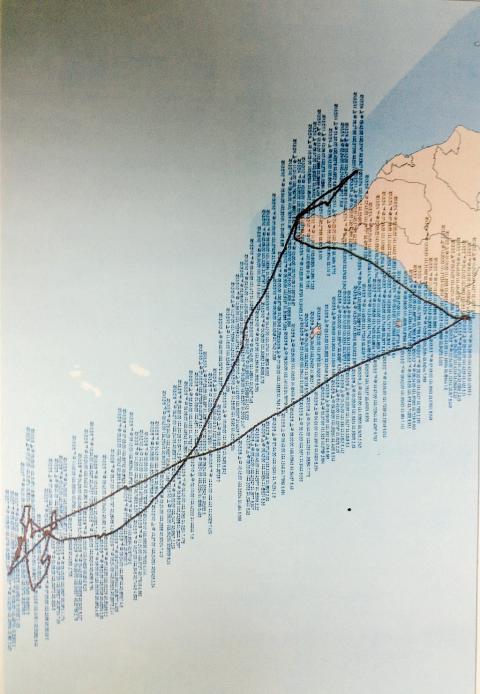
Photo: Huang Liang-chieh, Taipei Times
According to the information, the ship arrived at 20o north latitude and 123o east longitude at 2:30am on May 7 and was operating in the area between 19o 50 minutes and 20o 10 minutes north latitude, and between 122o 48 minutes and 123o 25 minutes east longitude until 8:24am on May 9, Tsay said.
From midnight on May 9 to 6:18am that day, the ship was sailing west by south at a speed of between 3 knots and 8 knots (5.6kph and 14.8kph) before it arrived at 19o 57 minutes north latitude, 122o 48 minutes east longitude, where it sailed at a lower speed of between 0 knots and 1 knot, he said.
The data showed that the ship sailed at a speed of between 4 knots and 5 knots in an east-south-east direction at 8:24am that day, while its speed increased to 10 knots at 10:12am, when its location was measured at 19o 59 minutes north latitude, 122o 55 minutes east longitude, “presumably being chased” by the Philippine vessel, Tsay said.
Tsay said the ship lost power at 11:24am at 20o 7 minutes, 123o east longitude, when its speed was measured at zero, data showed.
Analysis of the information has showed that it “contained no disruption to data recording during the voyage,” meaning that that the VDR system was operational, Tsay said.
The claims by the Philippines that its coast guard personnel were carrying out their duty to stop illegal fishing were “defamatory,” Tsay said.
“We have shown our evidence, but they haven’t,” he said.
Meanwhile, the Ministry of Justice said the Philippines had agreed to allow Taiwanese investigators to board the Philippine vessel that attacked the Kuang Ta Hsing No. 28.
Deputy Minister of Justice Chen Ming-tang (陳明堂) said the Philippines had agreed to allow Taiwanese investigators to inspect the firearms used and compare ballistics results with those obtained by Philippine investigators.
Chen said ministry official Yang Wan-li (楊婉莉) is now negotiating matters involving the investigation with the authorities in Manila.
The ministry is seeking to see the video of the incident shot by the Philippine patrol boat, but the negotiation is ongoing, Chen said.
He said the Philippines refused to allow Taiwanese to interview Philippine Coast Guard officers, but the ministry hoped that questions prepared for the suspects could be asked by Philippine investigators.
He reiterated that allowing Taiwanese investigators to join the probe in Manila would not intrude on the Philippine’s judicial sovereignty.
Chen said the ministry has agreed to Manila sending a team to Taiwan.
Earlier on Monday, Philippine Secretary of Justice Leila de Lima reiterated her opposition to the idea of a joint investigation, saying that Taiwan and the Philippines were instead conducting “parallel” or “respective” investigations.
“It’s not advisable to agree to a joint probe, because you know, aside from sovereignty issues involved, there is foreign policy implications involved because of the ‘one China’ policy,” De Lima said.
However, a Taiwanese team would be allowed to view written testimony given by the officers, De Lima said.
The Philippines has also expressed interest in sending its investigators to Taiwan to gain further information on the shooting.
De Lima said Manila hoped to meet the Taiwanese fishermen who were on the boat at the time of the incident and get their statements, as well as conduct another autopsy on the deceased fisherman, if his family agrees.
De Lima said that the Philippine National Bureau of Investigation had completed its investigation in the Philippines and was waiting to go to Taiwan to continue the investigation there, before issuing a final report.

The Tourism Administration yesterday announced that it would reward repeat international visitors with incentives of up to NT$8,000 to boost inbound tourism. The incentives are available to all international tourists, it said, adding that repeat visitors would be rewarded with NT$5,000 and would receive an additional NT$3,000 if they bring travel companions. The nation received 2,990,657 inbound visitors during the first quarter, marking a 3.8 percent increase from the same period last year, agency data showed. Japanese nationals are among groups visiting Taiwan the most. About 1.48 million Japanese tourists arrived last year, a year-on-year increase of more than 12
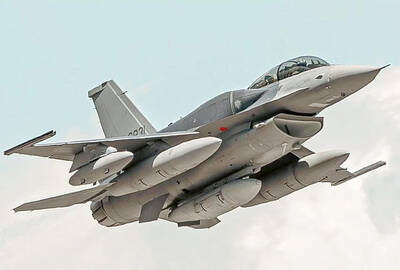
66 FIGHTER JETS: The aircraft is likely undergoing preparations for its transfer to Taiwan — a significant step forward in the nation’s modernization program, a lawmaker said The first of Taiwan’s order of F-16V Block 70 aircraft has been sighted in Texas ahead of delivery, Democratic Progressive Party (DPP) Legislator Wang Ting-yu (王定宇) said. Taiwan’s first F-16V Block 70 two-seat aircraft, tail number 6831, was seen flying from Lockheed Martin’s production facility in Greenville, South Carolina, to Naval Air Station Joint Reserve Base Fort Worth in Texas, Wang wrote on Facebook yesterday. The plane is likely undergoing preparations for its transfer to Taiwan, marking a significant step forward in the Republic of China Air Force’s modernization program, Wang said, citing military analysts. The F-16V Block 70 is a new-build version
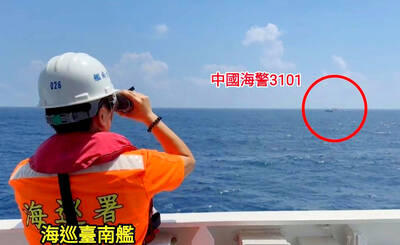
‘BRAZEN’: The holiday did not stop China from activities that infringe on Taiwan’s maritime jurisdiction, but the CGA is ready to defend the nation, Kuan Bi-ling said Beijing is intensifying maritime pressure on Taiwan, but the nation will never yield, Ocean Affairs Council Deputy Minister Sung Chen-en (宋承恩) said. The Coast Guard Administration (CGA) has adopted a “shadowing and monitoring” approach to avoid falling into a Chinese trap to escalate tensions and deepen the conflict, Sung said in an interview published yesterday in the Chinese-language Liberty Times (the Taipei Times’ sister newspaper). China Coast Guard formations patrolling waters east of Taiwan, as well as official Chinese vessels entering areas around Itu Aba Island (Taiping Island, 太平島) and Pratas Islands (Dongsha Islands, 東沙群島) show Beijing’s attempts to significantly step up
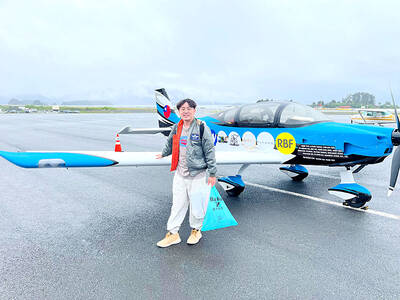
Taiwanese aviator Roger Lin (林睿哲) returned to Taiwan on Saturday after completing a nine-day round-the-world journey in a single-engine aircraft, becoming the first Taiwanese pilot to achieve the feat. Lin departed on June 5 from Los Angeles, California, and continued through Alaska, Japan, Taiwan, the Philippines, Indonesia, Malaysia, Thailand, Nepal, Jordan, Norway, Iceland and Canada before landing at the Taipei International Airport (Songshan) via Los Angeles and Japan. Lin shared numerous photos and videos of his journey on a Facebook page titled “Pilot Roger’s Around the World Flight,” including a video showing his aircraft flying over the Danjiang Bridge and


 RSS
RSS