


The government is mulling a plan to offer cash subsidies to people replacing their old cars or motorcycles, as policymakers aim to boost private consumption at a time when exports are dwindling.
Chinese-language newspapers yesterday reported that the Cabinet is considering offering subsidies to those who plan to replace vehicles they have used for more than 15 years.
Those who meet the requirements may receive NT$30,000 for a car, or NT$4,000 for a motorcycle, with dealers likely to sweeten the purchase by providing discounts of up to NT$10,000, reports said.
Council for Economic Planning and Development Minister Kuan Chung-ming (管中閔) said yesterday that the reported subsidies are not yet policy and the Cabinet is still considering different suggestions to boost the economy.
However, Minister of Finance Chang Sheng-ford (張盛和) said cash subsidies would be better than cutting the commodity tax to increase consumption and domestic demand, and thus help boost the nation’s economy.
“It would be more sensible to directly put the cash into a consumer’s pocket,” Chang said in a question-and-answer session at the legislature.
There are between 1.6 million and 1.7 million cars older than 15 years on the streets, accounting for approximately one-fourth of the total number of cars in the nation, while there are almost 3.5 million cars that are older than 10 years, accounting for 50 percent of the total, Hotai Motor Co (和泰汽車) deputy spokesman Yu Shiao-chung (喻曉忠) said by telephone yesterday, citing statistics compiled by the Ministry of Transportation and Communications.
Hotai, which sells Lexus and Toyota cars, is optimistic about the subsidy plan, but offered no forecast for how it would affect sales because is still pending government approval and the details are still unclear.
Fubon Securities Investment Services Co (富邦投顧) analyst Sean Ryan Hsiao (蕭文良) said a similar subsidy policy in 2004 and 2005 helped boost car sales to more than 400,000 units a year, their highest in the past 10 years.
“Customers are more careful about their spending, and they need incentives to buy new cars,” Hsiao said.
The government’s move could also raise fuel-efficiency, because old cars usually waste more gas and generate more air pollution, Chang said.
Chang said the government is not inclined to cut the commodity tax for now, because revising the law would take time and may fail to solve urgent economic issues in time.
However, providing cash subsidies can be executed much more quickly, he said
The government would pay the subsidies with part of the Air Pollution Control Fund and the Soil Pollution and Groundwater Pollution Remediation Fund, Chang said, adding that the government has not estimated how much it would pay in subsidies.

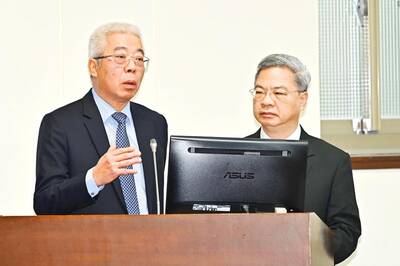
Taiwan has arranged for about 8 million barrels of crude oil, or about one-third of its monthly needs, to be shipped from the Red Sea this month to bypass the Strait of Hormuz and ease domestic supply pressures, CPC Corp, Taiwan (CPC, 台灣中油) said yesterday. The state-run oil company has worked with Middle Eastern suppliers to secure routes other than the Strait of Hormuz, through which about 20 percent of the world’s oil and liquefied natural gas typically passes, CPC chairman Fang Jeng-zen (方振仁) said at a meeting of the legislature’s Economics Committee in Taipei. Suppliers in Saudi Arabia have indicated they
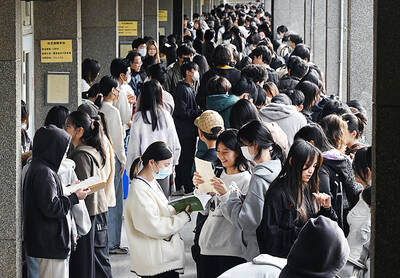
A global survey showed that 60 percent of Taiwanese had attained higher education, second only to Canada, the Ministry of the Interior said. Taiwan easily surpassed the global average of 43 percent and ranked ahead of major economies, including Japan, South Korea and the US, data from the Organisation for Economic Co-operation and Development (OECD) for 2024 showed. Taiwan has a high literacy rate, data released by the ministry showed. As of the end of last year, Taiwan had 20.617 million people aged 15 or older, accounting for 88.5 percent of the total population, with a literacy rate of 99.4 percent, the data
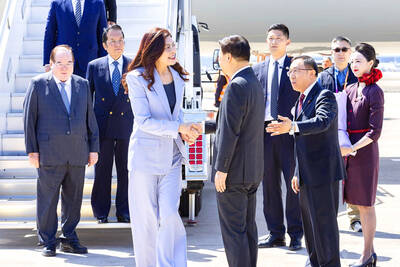
CCP ‘PAWN’? Beijing could use the KMT chairwoman’s visit to signal to the world that many people in Taiwan support the ‘one China’ principle, an academic said Chinese Nationalist Party (KMT) Chairwoman Cheng Li-wun (鄭麗文) yesterday arrived in China for a “peace” mission and potential meeting with Chinese President Xi Jinping (習近平), while a Taiwanese minister detailed the number of Chinese warships currently deployed around the nation. Cheng is visiting at a time of increased Chinese military pressure on Taiwan, as the opposition-dominated Legislative Yuan stalls a government plan for US$40 billion in extra defense spending. Speaking to reporters before going to the airport, Cheng said she was going on a “historic journey for peace,” but added that some people felt uneasy about her trip. “If you truly love Taiwan,

NEW LOW: The council in 2024 based predictions on a pessimistic estimate for the nation’s total fertility rate of 0.84, but last year that rate was 0.69, 17 percent lower An expected National Development Council (NDC) report expects the nation’s population to drop below 12 million by 2065, with the old-age dependency ratio to top 100 percent sooner than 2070, sources said yesterday. The council is slated to release its latest population projections in August, using an ultra-low fertility model, the sources said. The previous report projected that Taiwan’s population would fall to 14.37 million by 2070, but based on a new estimate of the total fertility rate (TFR) — the average number of children born to a woman over her lifetime — the population is expected to reach 12 million by


 RSS
RSS