


For more than a decade, wads of US dollars packed into suitcases, backpacks and, on occasion, plastic shopping bags have been dropped off every month or so at the offices of Afghanistan’s president — courtesy of the CIA.
All told, tens of millions of dollars have flowed from the CIA to the office of Afghan President Hamid Karzai, according to current and former advisers to the Afghan leader.
“We called it ‘ghost money,”’ said Khalil Roman, who served as Karzai’s chief of staff from 2002 until 2005. “It came in secret, and it left in secret.”
The CIA, which declined to comment for this article, has long been known to support some relatives and close aides of Karzai. However, the new accounts of off-the-books cash delivered directly to his office show payments on a vaster scale, and with a far greater impact on everyday governing.
Moreover, there is little evidence that the payments bought the influence the CIA sought. Instead, some US officials said, the cash has fueled corruption and empowered warlords, undermining Washington’s exit strategy from Afghanistan.
“The biggest source of corruption in Afghanistan,” one US official said, “was the United States.”
The US was not alone in delivering cash to the president. Karzai acknowledged a few years ago that Iran regularly gave bags of cash to one of his top aides.
At the time, in 2010, US officials jumped on the payments as evidence of an aggressive Iranian campaign to buy influence and poison Afghanistan’s relations with the US. What they did not say was that the CIA was also plying the presidential palace with cash — and unlike the Iranians, it still is.
US and Afghan officials familiar with the payments said the agency’s main goal in providing the cash has been to maintain access to Karzai and his inner circle and to guarantee the agency’s influence at the presidential palace, which wields tremendous power in Afghanistan’s highly centralized government. The officials spoke about the money only on the condition of anonymity.
It is not clear that the US is getting what it pays for. Karzai’s willingness to defy the US — and the Iranians, for that matter — on an array of issues seems to have only grown as the cash has piled up. Instead of securing his good graces, the payments may well illustrate the opposite: Karzai is seemingly unable to be bought.
Over Iran’s objections, he signed a strategic partnership deal with the US last year, directly leading the Iranians to halt their payments, two senior Afghan officials said. Now, Karzai is seeking control over the Afghan militias raised by the CIA to target operatives of al-Qaeda and insurgent commanders, potentially upending a critical part of US President Barack Obama’s administration’s plans for fighting militants as conventional military forces pull back this year.
However, the CIA has continued to pay, believing it needs Karzai’s ear to run its clandestine war against al-Qaeda and its allies, according to US and Afghan officials.

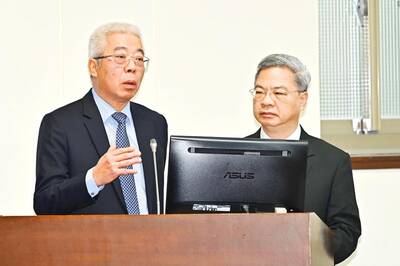
Taiwan has arranged for about 8 million barrels of crude oil, or about one-third of its monthly needs, to be shipped from the Red Sea this month to bypass the Strait of Hormuz and ease domestic supply pressures, CPC Corp, Taiwan (CPC, 台灣中油) said yesterday. The state-run oil company has worked with Middle Eastern suppliers to secure routes other than the Strait of Hormuz, through which about 20 percent of the world’s oil and liquefied natural gas typically passes, CPC chairman Fang Jeng-zen (方振仁) said at a meeting of the legislature’s Economics Committee in Taipei. Suppliers in Saudi Arabia have indicated they
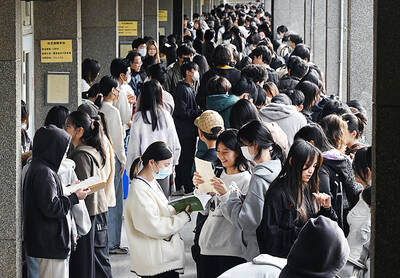
A global survey showed that 60 percent of Taiwanese had attained higher education, second only to Canada, the Ministry of the Interior said. Taiwan easily surpassed the global average of 43 percent and ranked ahead of major economies, including Japan, South Korea and the US, data from the Organisation for Economic Co-operation and Development (OECD) for 2024 showed. Taiwan has a high literacy rate, data released by the ministry showed. As of the end of last year, Taiwan had 20.617 million people aged 15 or older, accounting for 88.5 percent of the total population, with a literacy rate of 99.4 percent, the data
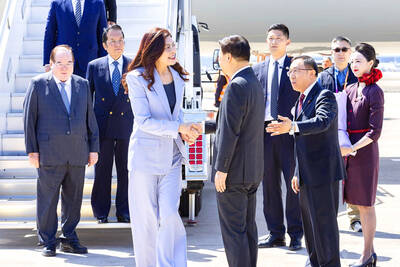
CCP ‘PAWN’? Beijing could use the KMT chairwoman’s visit to signal to the world that many people in Taiwan support the ‘one China’ principle, an academic said Chinese Nationalist Party (KMT) Chairwoman Cheng Li-wun (鄭麗文) yesterday arrived in China for a “peace” mission and potential meeting with Chinese President Xi Jinping (習近平), while a Taiwanese minister detailed the number of Chinese warships currently deployed around the nation. Cheng is visiting at a time of increased Chinese military pressure on Taiwan, as the opposition-dominated Legislative Yuan stalls a government plan for US$40 billion in extra defense spending. Speaking to reporters before going to the airport, Cheng said she was going on a “historic journey for peace,” but added that some people felt uneasy about her trip. “If you truly love Taiwan,

NEW LOW: The council in 2024 based predictions on a pessimistic estimate for the nation’s total fertility rate of 0.84, but last year that rate was 0.69, 17 percent lower An expected National Development Council (NDC) report expects the nation’s population to drop below 12 million by 2065, with the old-age dependency ratio to top 100 percent sooner than 2070, sources said yesterday. The council is slated to release its latest population projections in August, using an ultra-low fertility model, the sources said. The previous report projected that Taiwan’s population would fall to 14.37 million by 2070, but based on a new estimate of the total fertility rate (TFR) — the average number of children born to a woman over her lifetime — the population is expected to reach 12 million by


 RSS
RSS