


Undaunted by the Boston Marathon bombings, big crowds lined the route of London’s mass road race yesterday to cheer on about 36,000 runners, many of whom wore black ribbons to remember the dead and wounded.
Hundreds of extra police were deployed to secure the first race in the World Marathon Majors since two explosions near the finish line of the Boston Marathon on Monday last week that killed three people and wounded 176.
Some spectators held up banners that read “For Boston” and some runners had the name of the US city emblazoned on their vests, but despite these sombre reminders the mood was overwhelmingly one of celebration.
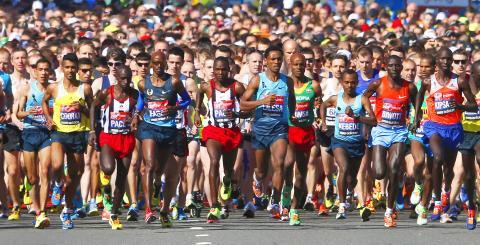
Photo: Reuters
“It was incredible, the amount of support, people coming out from everywhere, just cheering the whole way. Unbelievable,” said a breathless Mo Farah, Britain’s 5,000m and 10,000m Olympic champion, after running the first half of the course.
Prince Harry waited at the finish line on the Mall in front of Buckingham Palace to hand out medals to the winners.
“People have been saying they haven’t seen crowds like this for eight years around the route, which is remarkable to see,” he told the BBC. “The way that Boston has dealt with it has been absolutely remarkable. It’s never going to get anyone down here.”
London’s Metropolitan Police Service said it increased the number of officers on the streets to reassure the public and not in response to any specific threat.
Before the start of the men’s elite and mass races, official commentator Geoff Wightman led the crowd in a tribute to Boston.
“This week the world marathon family was shocked and saddened by the events at the Boston Marathon,” he said over loudspeakers. “In a few moments a whistle will sound and we will join together in silence to remember our friends and colleagues for whom a day of joy turned into a day of sadness.”
The packed ranks of competitors bowed their heads and stood silently for 30 seconds, then clapped and cheered when a second whistle marked the end of the tribute.
Moments later, the world’s elite runners led off the race. Behind them came thousands of competitors chasing personal goals or raising money for charity, many in fancy dress.
Kenya’s Priscah Jeptoo won the women’s race by a long distance, while Ethiopia’s Tsegaye Kebede snatched victory from Kenyan rival Emmanuel Mutai in the final kilometer, to huge cheers.
The organizers will donate £2 per finisher to The One Fund Boston, set up to raise money for the victims. They expect about 35,500 people to cross the line, meaning they would raise £71,000 (US$107,000).

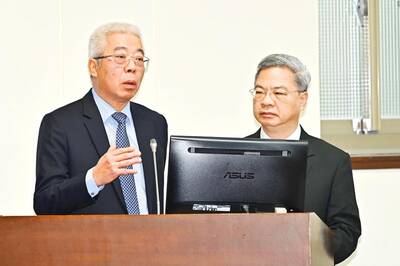
Taiwan has arranged for about 8 million barrels of crude oil, or about one-third of its monthly needs, to be shipped from the Red Sea this month to bypass the Strait of Hormuz and ease domestic supply pressures, CPC Corp, Taiwan (CPC, 台灣中油) said yesterday. The state-run oil company has worked with Middle Eastern suppliers to secure routes other than the Strait of Hormuz, through which about 20 percent of the world’s oil and liquefied natural gas typically passes, CPC chairman Fang Jeng-zen (方振仁) said at a meeting of the legislature’s Economics Committee in Taipei. Suppliers in Saudi Arabia have indicated they
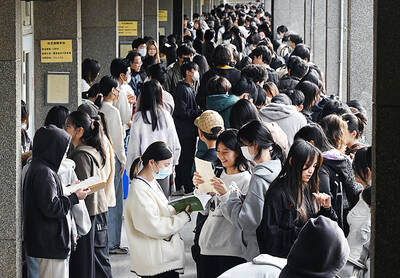
A global survey showed that 60 percent of Taiwanese had attained higher education, second only to Canada, the Ministry of the Interior said. Taiwan easily surpassed the global average of 43 percent and ranked ahead of major economies, including Japan, South Korea and the US, data from the Organisation for Economic Co-operation and Development (OECD) for 2024 showed. Taiwan has a high literacy rate, data released by the ministry showed. As of the end of last year, Taiwan had 20.617 million people aged 15 or older, accounting for 88.5 percent of the total population, with a literacy rate of 99.4 percent, the data

CCP ‘PAWN’? Beijing could use the KMT chairwoman’s visit to signal to the world that many people in Taiwan support the ‘one China’ principle, an academic said Chinese Nationalist Party (KMT) Chairwoman Cheng Li-wun (鄭麗文) yesterday arrived in China for a “peace” mission and potential meeting with Chinese President Xi Jinping (習近平), while a Taiwanese minister detailed the number of Chinese warships currently deployed around the nation. Cheng is visiting at a time of increased Chinese military pressure on Taiwan, as the opposition-dominated Legislative Yuan stalls a government plan for US$40 billion in extra defense spending. Speaking to reporters before going to the airport, Cheng said she was going on a “historic journey for peace,” but added that some people felt uneasy about her trip. “If you truly love Taiwan,

NEW LOW: The council in 2024 based predictions on a pessimistic estimate for the nation’s total fertility rate of 0.84, but last year that rate was 0.69, 17 percent lower An expected National Development Council (NDC) report expects the nation’s population to drop below 12 million by 2065, with the old-age dependency ratio to top 100 percent sooner than 2070, sources said yesterday. The council is slated to release its latest population projections in August, using an ultra-low fertility model, the sources said. The previous report projected that Taiwan’s population would fall to 14.37 million by 2070, but based on a new estimate of the total fertility rate (TFR) — the average number of children born to a woman over her lifetime — the population is expected to reach 12 million by


 RSS
RSS